
Across continents and centuries, 10 Archaeology Discoveries have forced scientists to reconsider how advanced ancient societies truly were. From a 2,000-year-old mechanical calculator recovered from a Mediterranean shipwreck to monumental stone temples older than agriculture, archaeologists say the findings challenge traditional assumptions about technological progress and the origins of civilization.
Table of Contents
Why These 10 Archaeology Discoveries Matter
Modern archaeological research no longer focuses only on recovering objects. It reconstructs behavior, trade, science, and belief systems. Increasingly, evidence suggests early societies were capable of sophisticated engineering, astronomy, and large-scale organization.
Dr. Sarah Parcak, an Egyptologist at the University of Alabama at Birmingham and pioneer in satellite archaeology, has said ancient cultures were “far more inventive and connected than early historians believed.”
For decades, historians assumed civilization followed a predictable path: farming first, then cities, then science. The 10 Archaeology Discoveries described here suggest the sequence was far more complex. Some technologies appeared early, vanished, and were rediscovered centuries later.
The Antikythera Mechanism: An Ancient Computer
Recovered from a shipwreck near the Greek island of Antikythera in 1901, this bronze gear device dates to around 100 BCE.
Researchers from University College London determined the device modeled the movements of the sun, moon, and planets and could predict eclipses. The machine contains over 30 precision gears.
Physicist Tony Freeth, a lead investigator, described it as “a mechanical representation of the cosmos.”
The mechanism reshaped understanding of ancient Greek engineering. Prior to this discovery, historians believed complex gear technology developed in medieval Europe. Instead, it existed more than a thousand years earlier.
Scholars now believe the device may have been used by teachers or astronomers to explain celestial motion — essentially functioning as an educational scientific instrument.
Göbekli Tepe and the Origins of Civilization
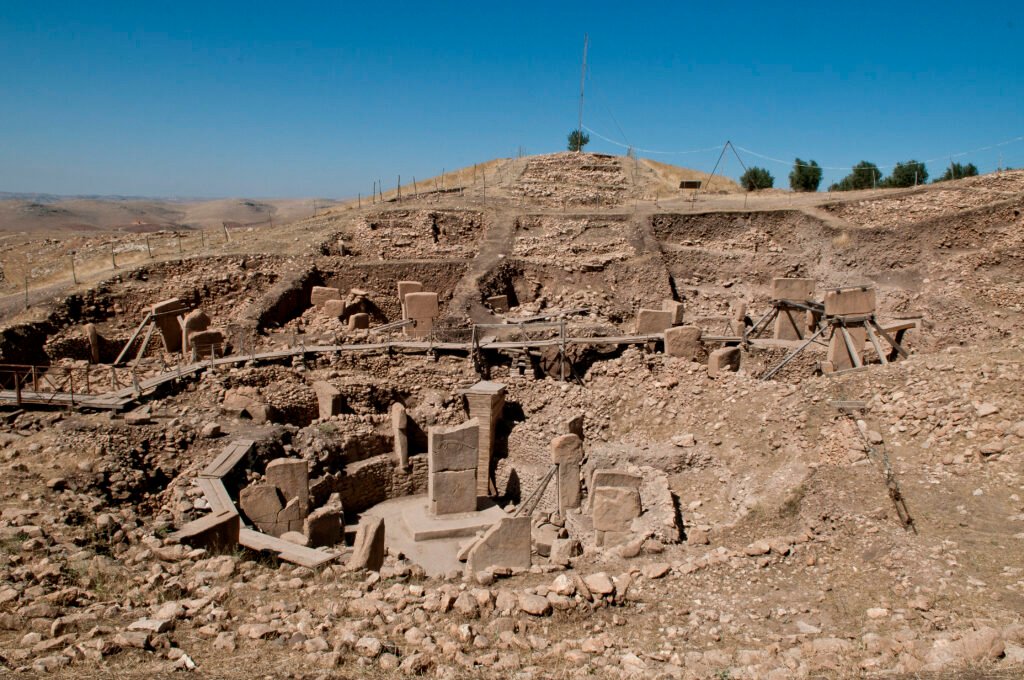
In southeastern Turkey stands one of the most significant sites among the 10 Archaeology Discoveries: Göbekli Tepe.
Excavations led by German archaeologist Klaus Schmidt revealed massive stone pillars carved around 9600 BCE. The builders were hunter-gatherers, not farmers.
According to the German Archaeological Institute, the site predates settled villages and agriculture by several thousand years.
This discovery reversed a major academic assumption. Previously, scholars believed agriculture created religion and temples. Göbekli Tepe suggests the opposite — religious gathering may have motivated humans to settle and develop farming.
Archaeologists also discovered carvings of animals such as foxes, snakes, and birds. Many researchers believe the imagery reflects early cosmology and symbolic storytelling.
The Nazca Lines: Giant Images Without Flight
Between 500 BCE and 500 CE, the Nazca culture created enormous drawings across Peru’s desert plateau.
Some figures stretch over 300 meters long. The shapes include hummingbirds, spiders, monkeys, and geometric spirals.
Researchers from Peru’s Ministry of Culture say the lines were likely ceremonial pathways. Archaeologists found pottery fragments and offerings near many of the geoglyphs.
Anthropologists believe the Nazca people walked along the lines during rituals connected to water and rainfall — a critical concern in one of the world’s driest regions.
The scale of the work required coordination and planning, suggesting a complex social structure.
The Terracotta Army: China’s Silent Military
Farmers digging a well in Shaanxi Province in 1974 uncovered one of the largest archaeological finds in history.
The burial complex of Emperor Qin Shi Huang includes approximately 8,000 life-size clay soldiers, along with horses, chariots, and weapons.
Each soldier has unique facial features. Some display different ranks, hairstyles, and armor styles matching the Qin Dynasty military hierarchy.
Chinese archaeologists believe the figures were designed to protect the emperor in the afterlife, reflecting ancient beliefs in spiritual continuity after death.
The site also revealed early mass-production techniques. Craftsmen used molds for bodies but hand-sculpted faces — a combination of standardization and personalization.
The Baghdad Battery Debate
Clay jars found near Baghdad include a copper cylinder and iron rod. Experiments show they can generate small electrical currents when filled with acidic liquid.
Some researchers proposed they powered electroplating of jewelry. Others disagree.
British Museum materials scientist Paul Craddock argued there is no direct evidence ancient people used them as batteries. They may have been storage containers or ritual objects.
The debate highlights a key challenge in studying ancient artifacts: objects survive, but written explanations often do not.
The Roman Dodecahedron Mystery
Small bronze 12-sided hollow objects have been discovered across northern Europe in former Roman territories.
No Roman texts mention them.
Proposed explanations include measuring instruments, religious items, or knitting devices. Because they appear mainly in frontier regions, some archaeologists believe they served a localized cultural function rather than an empire-wide one.
This remains one of archaeology’s most enduring historical mysteries.
Lost Maps and the Piri Reis Chart
In 1513, an Ottoman admiral compiled a world map using older sources. It accurately depicts coastlines of Africa and South America before many European surveys.
Historians from the Smithsonian Institution believe the map used earlier navigational charts, possibly from Islamic and Mediterranean sailors.
Although speculation exists about unknown civilizations, historians say maritime knowledge and trade networks sufficiently explain the map’s accuracy.
Stone Spheres of Costa Rica
Hundreds of precisely carved stone spheres dating from 600–1500 CE were discovered in Costa Rica’s Diquís Delta.
Some weigh several tons and are nearly perfectly round.
Archaeologists believe they symbolized social authority or marked territorial boundaries. Their precision without metal tools continues to fascinate researchers studying prehistoric engineering methods.
Viking Cat Burials: Changing the Viking Image
Archaeologists in Scandinavia uncovered carefully buried cats in Viking-age graves.
Norse mythology associated cats with the goddess Freyja, linked to fertility and protection. The burials suggest emotional and symbolic relationships with animals, contradicting the stereotype of Vikings solely as warriors.
This discovery humanized Viking society and revealed complex beliefs about companionship and the afterlife.
The London Hammer Curiosity
A hammer found embedded in rock in Texas became widely discussed in popular culture.
Geologists later explained mineral deposits formed around the tool, creating a natural stone concretion. The hammer itself dates to the 19th century.
While not evidence of prehistoric technology, it illustrates how natural processes can create misleading appearances in archaeological contexts.
Changing Our Understanding of the Past
Taken together, the 10 Archaeology Discoveries demonstrate that innovation was not exclusive to modern society.
Anthropologist Brian Fagan has written that early humans constantly experimented, adapted, and engineered solutions to environmental challenges.
Technologies such as astronomy, mapping, architecture, and symbolic art appeared independently across cultures.
How Archaeology Is Evolving
Modern archaeology increasingly relies on science and technology.
New methods include:
- ground-penetrating radar
- satellite imagery
- DNA analysis
- chemical residue testing
These tools allow archaeologists to study sites without excavation and reconstruct diet, migration patterns, and disease.
For example, genetic studies have revealed large-scale ancient human migrations across Eurasia thousands of years earlier than previously known.
Why Discoveries Continue Today
Many archaeologists say only a small portion of ancient sites have been explored. Dense forests, deserts, and urban areas still conceal buried settlements.
Satellite imaging has recently identified lost cities in the Amazon rainforest and previously unknown Roman roads in Britain.
Researchers believe the next decades may bring discoveries equal in importance to the 10 Archaeology Discoveries already known.
Final Paragraph
As technology improves and exploration expands, archaeologists expect further evidence to reshape world history. Each excavation adds detail to humanity’s long story, suggesting the past remains far less understood than once assumed.
FAQs About 10 Archaeology Discoveries
Q: Why do discoveries contradict textbooks?
Because historical knowledge evolves with new evidence and improved dating methods.
Q: Do mysterious artifacts prove lost advanced civilizations?
Most experts say no. Known societies possessed remarkable skills and knowledge using available tools.
Q: How are ancient objects dated?
Radiocarbon dating, stratigraphy, and material analysis determine age and origin.