

Early 2027 Social Security COLA projections indicate U.S. retirees may receive a smaller benefit increase than in recent years, reflecting easing inflation after pandemic-era price spikes. Analysts and advocacy groups say the projected adjustment, currently near 2.5%, would still protect purchasing power but may not keep pace with rising healthcare, housing, and insurance costs.
Table of Contents
2027 Social Security COLA
| Key Fact | Detail/Statistic |
|---|---|
| Preliminary COLA | About 2.5% increase projected |
| Official announcement | October 2026 |
| Formula basis | Consumer Price Index for Urban Wage Earners (CPI-W) |
| Beneficiaries affected | Over 70 million Americans |
| Average monthly benefit | About $1,900 |
Understanding the 2027 Social Security COLA
The Social Security cost-of-living adjustment, commonly called COLA, changes benefits each year to offset inflation. The increase affects more than 70 million Americans, including retirees, disabled workers, and survivors, according to the U.S. Social Security Administration (SSA).
The preliminary 2027 Social Security COLA estimate comes from The Senior Citizens League (TSCL), a non-partisan advocacy organization that tracks inflation trends and Social Security policy. The group calculates projections using data from the U.S. Bureau of Labor Statistics (BLS).
Mary Johnson, a policy analyst at TSCL, said the smaller expected adjustment is tied directly to cooling prices.
“Inflation has moderated significantly compared with 2022,” Johnson said in a statement. “That means the COLA will also moderate.”
The official COLA is determined using third-quarter inflation data — July through September 2026 — and announced in October.
Why COLA Exists
Congress created automatic COLA adjustments in 1972 after years of political disputes over benefit increases. Before then, retirees depended on Congress to approve raises, which often lagged inflation and caused a loss of purchasing power.
The automatic formula was designed to keep benefits stable in real terms, making Social Security one of the few federal programs with built-in inflation protection.
Why the Increase Is Smaller
Inflation Drives Social Security Raises
COLA adjustments follow a fixed formula. The SSA compares the average CPI-W inflation rate during the third quarter of one year with the same period from the previous year.
When inflation rises sharply, benefits increase sharply. When inflation slows, the increase declines.
The trend became evident after the pandemic:
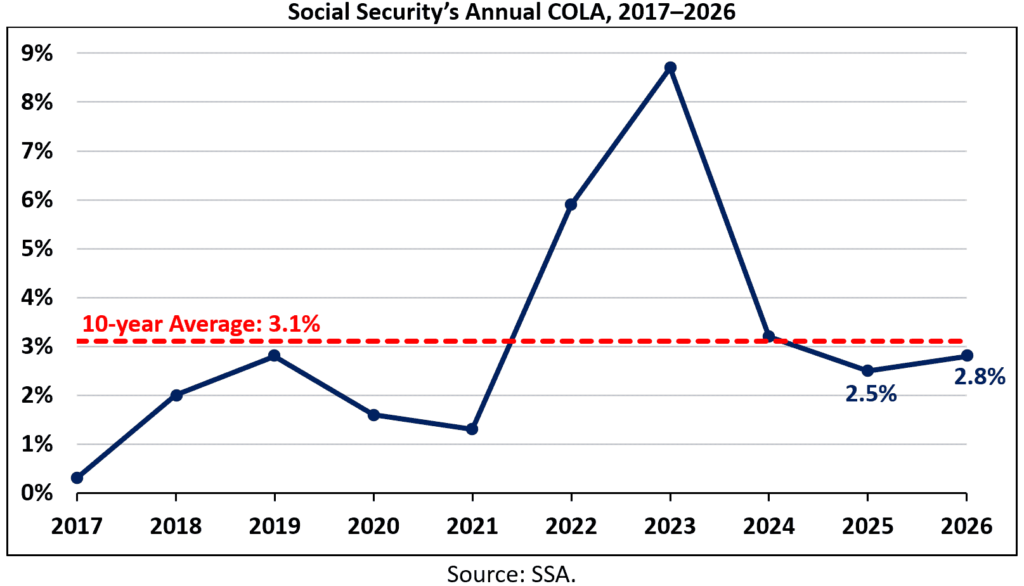
- 2023: 8.7% increase (largest since 1981)
- 2024: 3.2% increase
- 2025: 2.5% increase
- 2026: 2.8% increase
- 2027: projected near 2.5%
Economists say the projected figure reflects stabilizing prices rather than reduced government support.
Dr. Alicia Munnell, director of the Center for Retirement Research at Boston College, explained:
“A lower COLA is generally a sign inflation is under control, not that benefits are being cut.”
The Role of the Federal Reserve
Inflation slowed partly due to interest rate increases by the U.S. Federal Reserve, which raised borrowing costs beginning in 2022 to cool consumer demand. Lower inflation reduces the inflation and retirement income adjustment retirees receive.
Historical Perspective
The projected 2027 Social Security COLA is close to the long-term average. Since automatic adjustments began:
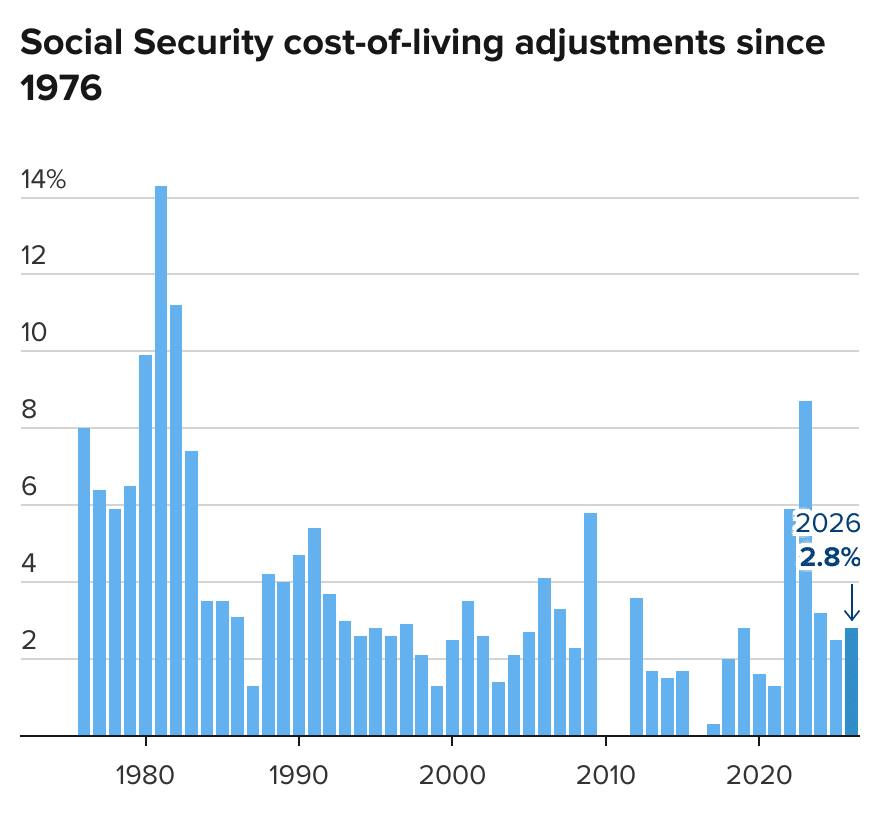
- Average COLA since 1975: roughly 3.7%
- Years with no COLA: 2010, 2011, and 2016
- Highest COLA ever: 14.3% in 1980
The unusually large 2023 adjustment followed pandemic supply shortages, energy price spikes, and global shipping disruptions.
Economists note that the large increases in recent years were historically abnormal rather than typical.
Concerns From Retiree Advocates
Cost pressures beyond inflation
Advocacy groups warn the inflation index used in the formula may not reflect older Americans’ real expenses. Retirees typically spend a larger share of income on healthcare and housing.
TSCL has argued the CPI-W inflation index tracks spending by working households and understates seniors’ living costs.
Healthcare spending illustrates the gap. According to Medicare projections, out-of-pocket medical expenses often rise faster than general inflation.
Johnson said:
“Many retirees experience inflation differently. A 2.5% COLA may not cover their actual increase in living costs.”
Housing costs, particularly property taxes and insurance premiums, have also increased faster than overall inflation in many U.S. regions.
Government Perspective and Fiscal Outlook
Impact on federal spending
The Social Security program distributes over $1.4 trillion annually in benefits, making COLA adjustments a major federal budget factor. A smaller increase reduces pressure on the Social Security trust fund.
According to the Social Security Trustees Report, the retirement trust fund may face depletion in the early 2030s if Congress does not act. At that point, payroll taxes would still cover roughly 75–80% of scheduled benefits.
Lawmakers from both political parties have proposed solutions, including:
- Increasing payroll tax caps
- Adjusting retirement age
- Modifying benefits for high earners
The SSA emphasizes the annual adjustment is automatic and not political.
An SSA spokesperson said:
“The COLA formula is set by law. It ensures benefits keep pace with inflation regardless of economic or political conditions.”
Household Impact: What Retirees May Actually Receive
The average retired worker currently receives about $1,900 monthly in benefits. A 2.5% COLA would increase payments by roughly $45–$50 per month.
However, Medicare Part B premiums — typically deducted directly from Social Security payments — may reduce the net gain.
Example Scenario
| Monthly Benefit | Estimated Increase | New Payment |
|---|---|---|
| $1,200 | +$30 | $1,230 |
| $1,900 | +$48 | $1,948 |
| $3,000 | +$75 | $3,075 |
If Medicare premiums rise $20 monthly, a beneficiary could effectively see only a $28 net increase.
Financial planners advise retirees not to rely solely on Social Security adjustments.
Certified financial planner Mark Luscombe said:
“COLA helps maintain stability, but it rarely improves a retiree’s lifestyle. It preserves purchasing power rather than expanding it.”
Broader Economic Effects
The 2027 Social Security COLA also affects the wider economy. Social Security payments represent a major source of consumer spending, especially in smaller communities and rural regions.
Economists say retirees typically spend benefits quickly on necessities such as groceries, rent, and healthcare. As a result, benefit changes influence local economies.
Lower COLA increases may slightly slow consumer spending growth, but they also reflect improved inflation conditions, which supports economic stability overall.
FAQ
When will the 2027 COLA be finalized?
The SSA will announce the official increase in October 2026 after third-quarter inflation data becomes available.
Are benefits being cut?
No. Benefits are still rising. The increase is simply smaller because inflation has slowed.
Who receives the adjustment?
Retirees, disabled workers, and survivor beneficiaries automatically receive COLA increases.
Why does the COLA change each year?
It is tied directly to inflation measured by the CPI-W.
Could the estimate change?
Yes. Energy prices, housing costs, and economic growth in mid-2026 could raise or lower the final figure.
Forward Outlook
Economists expect modest adjustments if inflation remains near the Federal Reserve’s 2% target. Policymakers continue debating long-term Social Security financing, but the annual adjustment remains automatic under current law.
Munnell summarized:
“The COLA is working as designed. The real policy debate is how the United States finances Social Security in the next decade, not the size of next year’s increase.”