
Along the far southern edge of South America, Patagonia has always felt like a place untouched by time. Endless winds, wide skies, and empty coastlines give the impression of a world operating on ancient rules. For decades, those rules seemed simple: penguins ruled the beaches, while pumas stayed inland, stalking prey across mountains and open steppe. That clear division is now fading. What’s happening today has surprised scientists, conservationists, and locals alike. The story of penguins and pumas sharing the same ground is not a strange coincidence or a viral wildlife moment. It is a real ecological shift, unfolding quietly along Patagonia’s remote shores. As environmental pressures mount and food sources change, animals are adapting in ways that challenge what we thought we knew about their behavior. This clash is not dramatic in the way movies portray it, but it is powerful, meaningful, and deeply revealing about the state of the natural world.
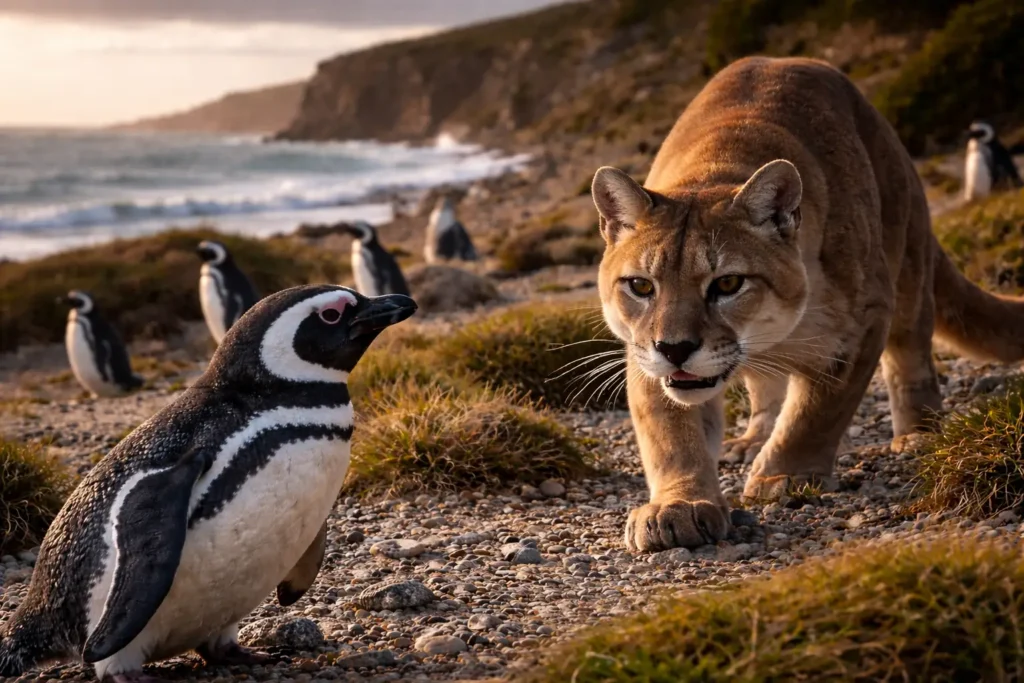
The idea of penguins and pumas crossing paths feels almost surreal, yet it is becoming increasingly common along parts of Patagonia’s coastline. Penguins have long depended on isolated beaches to breed and raise their chicks, returning to the same sites year after year. Pumas, known for their adaptability, are now venturing into these coastal zones in search of food. The overlap is not accidental. It reflects changing conditions inland and the growing need for predators to expand their hunting strategies. This unexpected interaction has drawn attention because it breaks long-standing assumptions about habitat boundaries. Penguins were never meant to face large land predators at their nesting sites. Pumas were never thought to rely on marine birds for survival. Together, they tell a story of ecosystems in motion, responding to pressure rather than tradition.
Table of Contents
Penguins vs. Pumas
| Aspect | Details |
|---|---|
| Region | Coastal Patagonia, Argentina |
| Primary Penguin Species | Magellanic penguins |
| Predator Involved | Puma |
| Main Cause | Changes in inland prey availability |
| Timing | Most common during penguin breeding season |
| Key Concern | Long-term stability of penguin colonies |
Patagonia’s Penguin Strongholds
- Patagonia hosts some of the largest penguin colonies on the planet. Every breeding season, vast numbers of Magellanic penguins return to the same stretches of coast, driven by instinct and memory. These beaches offer proximity to food-rich waters and, historically, safety from major land predators. Penguins nest in burrows or shallow scrapes, relying on numbers and isolation rather than defense.
- For generations, this strategy worked. The land posed little threat, allowing penguins to focus their energy on raising chicks and surviving harsh weather. The arrival of pumas into these strongholds disrupts that balance. What was once a reliable refuge has become a place of risk, altering breeding success and behavior in subtle but significant ways.
The Puma: A Master Of Adaptation
- Few predators are as flexible as the puma. Across the Americas, it survives in deserts, forests, mountains, and grasslands. Its success lies in its ability to adjust rather than specialize. When prey becomes scarce in one area, pumas move, observe, and learn.
- In Patagonia, this adaptability has led some pumas toward the coast. Inland prey such as guanacos and smaller mammals are affected by land use changes, fencing, and shifting vegetation. For a hungry predator, exploring new territory becomes a necessity. Once a puma discovers a penguin colony, it finds a dense, predictable source of food that requires less energy than chasing fast-moving prey inland.
Why Pumas Are Moving Toward the Coast
The movement of pumas toward coastal areas is not driven by curiosity. It is shaped by environmental pressure. Human activity has altered large portions of Patagonia’s interior, influencing where prey animals can move and graze. Climate change adds another layer, affecting vegetation patterns and water availability. Penguin colonies, by contrast, are stable in location and seasonal in timing. During breeding season, thousands of birds are concentrated in small areas, slow and vulnerable on land. For pumas, this represents an opportunity. Over time, individual pumas learn these patterns and return, turning occasional visits into regular hunting behavior.
How Penguins Respond To A New Threat
Penguins evolved without large land predators in their nesting areas. When pumas enter a colony, the results can be immediate and severe. Adult penguins may be killed, chicks abandoned, and nests destroyed. The stress alone can cause breeding failure even without direct predation. However, penguins are not passive victims. In some areas, colonies show early signs of adaptation. Penguins may shift nesting sites slightly, choose areas with better visibility, or cluster more tightly together. These changes suggest an attempt to cope, but it is unclear whether they will be enough if predation pressure continues or increases.
Ecological Consequences Beyond the Kill
- The presence of pumas in penguin colonies affects more than just the two species involved. Scavengers such as birds and smaller mammals benefit from leftover carcasses. Other predators may alter their behavior in response to the presence of a dominant hunter. This creates a ripple effect that reshapes the local ecosystem.
- Predation can sometimes play a balancing role, preventing overpopulation and reducing disease spread within dense colonies. The challenge lies in determining whether current predation levels are part of a natural adjustment or the result of human-driven imbalance. This distinction is critical for making informed conservation decisions.
Conservation Dilemmas On Remote Shores
- Protecting both penguins and pumas presents a difficult dilemma. Penguins are iconic, closely monitored, and economically important through tourism. Pumas are keystone predators whose removal can destabilize entire ecosystems. Choosing one over the other is not a viable solution.
- Most conservationists now favor observation over intervention. By studying patterns over time, researchers hope to understand whether this interaction will stabilize on its own. Heavy-handed responses, such as relocating or removing predators, risk creating more problems than they solve.
The Role of Climate and Human Influence
Climate change looms over every aspect of this story. Warming oceans affect fish populations, forcing penguins to travel farther for food. Longer foraging trips leave chicks unattended for extended periods, increasing vulnerability. On land, changing weather patterns influence prey distribution for pumas. Human infrastructure also plays a quiet but powerful role. Roads, fences, and settlements guide animal movement, sometimes funneling predators toward coastal areas without intention. The clash between penguins and pumas is not purely natural. It reflects a landscape shaped by human choices over time.
Looking Ahead: Coexistence Or Conflict?
- The future of Patagonia’s coastal ecosystems remains uncertain. It is possible that penguins and pumas will settle into a new balance, with predation remaining limited and localized. It is also possible that continued environmental pressure will intensify the conflict.
- What is clear is that this story challenges the idea of fixed roles in nature. Patagonia’s remote shores remind us that ecosystems are dynamic, responsive, and deeply interconnected. Penguins and pumas are not villains or victims. They are survivors, adapting to a world that is changing faster than ever. Whether humans choose to understand that change or ignore it will shape what Patagonia looks like in the years to come.
FAQs on Penguins vs. Pumas
Why Are Penguins and Pumas Encountering Each Other In Patagonia
Penguins and pumas are crossing paths because environmental conditions are changing. Inland prey for pumas is becoming less predictable due to climate shifts and human land use, pushing them toward coastal areas where penguin colonies provide a seasonal and concentrated food source.
Which Penguin Species Is Most Affected By Pumas
Magellanic penguins are the most affected because they form large breeding colonies along Patagonia’s coastline.
Is This a Natural Behavior for Pumas
Yes, pumas are highly adaptable predators. While coastal hunting is unusual, it is a natural response to changing food availability.
Are Penguin Populations in Danger
Some local colonies have experienced declines, especially smaller or more exposed ones. However, there is no evidence of a widespread population collapse so far.