
Under-Ice Submarine Discovery Ends: It began as a daring scientific expedition into the icy shadows beneath Antarctica’s frozen frontier. A high-tech submarine named Ran ventured where no human could go, navigating miles beneath the Dotson Ice Shelf in West Antarctica. But after capturing groundbreaking data about one of the most vulnerable glacial regions on Earth, it disappeared — without a trace. This is the true story of an under-ice submarine discovery that ends in a sudden disappearance — a tale of science, climate urgency, and the silent mysteries of Earth’s last untouched places.
Table of Contents
Under-Ice Submarine Discovery Ends
Though Ran disappeared into the depths, its mission was far from a loss. In fact, the data it brought back — images of melting ice staircases, evidence of channelized erosion, and insights into deep ocean heat — may redefine how we predict sea-level rise. We often think of exploration as a heroic return. But sometimes, the greatest discoveries are made in silence. Ran did its job. And the world is better informed because of it.
| Topic | Details |
|---|---|
| Mission Name | International Thwaites Glacier Collaboration (ITGC) |
| Submarine Name | Ran – Autonomous Underwater Vehicle (AUV) |
| Location | Dotson Ice Shelf, West Antarctica |
| Discovery | Terraced melting patterns, under-ice channels, and teardrop-shaped pits |
| Vanishing Point | Lost contact after final scheduled mission |
| Significance | Advances climate modeling, informs sea-level rise projections |
| Relevant Careers | Oceanographer, Marine Engineer, Polar Data Analyst |
| Source | ITGC Official Website |
The Context: Why Antarctica Matters to All of Us
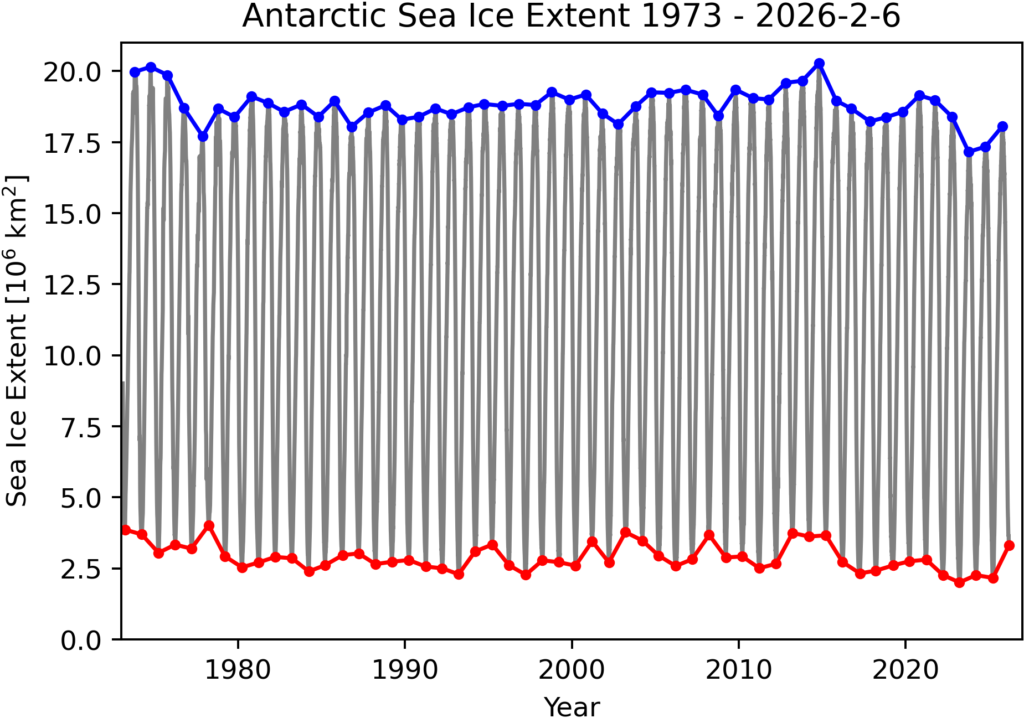
Antarctica might seem far away — a silent, frozen land few will ever visit. But what happens there directly affects people across the United States and around the world. The Thwaites and Dotson Ice Shelves, part of the vast West Antarctic Ice Sheet, are melting at an accelerating rate.
According to the National Snow and Ice Data Center (NSIDC), Antarctica loses over 150 billion tons of ice annually. If the Thwaites Glacier collapses entirely — a real possibility in this century — sea levels could rise by over 10 feet, inundating coastal cities like Miami, New York, and New Orleans.
That’s why Ran was deployed. Its mission was part of the International Thwaites Glacier Collaboration (ITGC), a joint U.S.-U.K. initiative involving 100+ scientists and technicians. The goal: understand how warm ocean water melts Antarctica’s ice from below, hidden from satellites.
The Mission: Inside Ran’s Final Voyage
Built by researchers at Sweden’s University of Gothenburg, Ran was no ordinary robot. This autonomous underwater vehicle (AUV) was designed to explore under ice sheets — areas that are physically inaccessible to humans and impossible to observe via satellite.
The sub measured about 23 feet long, operated with no live communication once beneath the ice (since radio and GPS can’t pass through ice), and was programmed to carry out detailed underwater surveys using multi-beam sonar, temperature, salinity, and velocity sensors.
Mission Objectives Included:
- Mapping the topography beneath the ice shelf
- Measuring ocean temperature and salinity near the base of the ice
- Identifying signs of melting and structural change
- Feeding real-time insights into sea-level rise prediction models
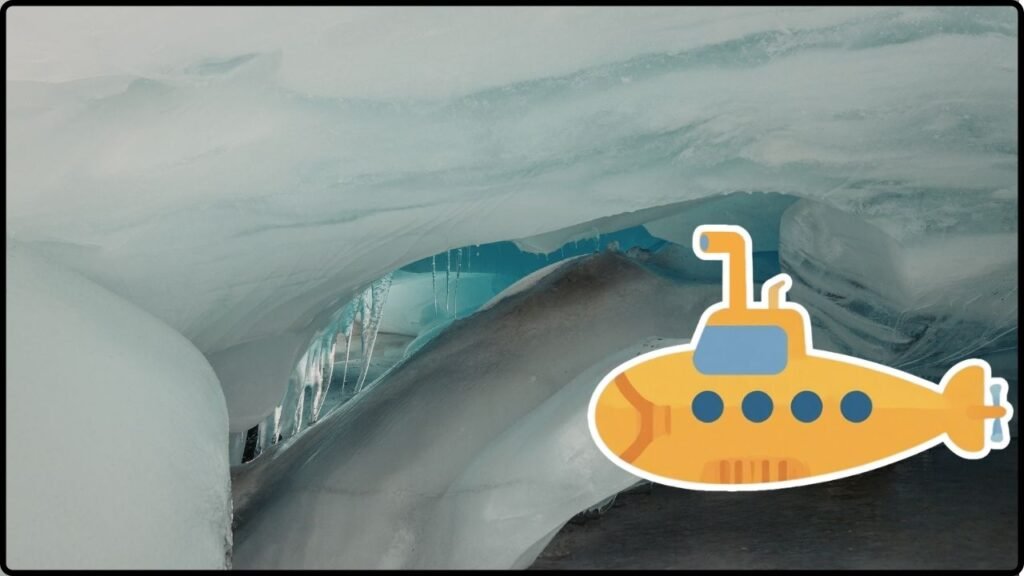
Over the course of multiple missions in 2022, Ran successfully navigated the sub-ice terrain of the Dotson Ice Shelf, an area roughly the size of West Virginia. Its sonar scans revealed bizarre and unexpected features.
Under-Ice Submarine Discovery Ends: Revealing the Hidden Landscape Below the Ice
Among Ran’s major scientific discoveries:
1. Terraced Ice Layers
Rather than a smooth underside, Ran revealed stepped terraces — flat ledges stacked like giant frozen stairs. These are likely shaped by repeated cycles of melting and refreezing.
2. Teardrop-Shaped Pits
The sub found deep, narrow pits carved into the base of the ice. Scientists believe these result from focused warm-water currents melting from underneath.
3. Channelized Melting
Instead of uniform melting, warm water carves out hidden channels, sometimes hundreds of meters deep, making the shelf structurally unstable.
These findings disrupted existing models, which previously assumed more gradual, uniform melting. Instead, this mission confirmed a far more chaotic, fast-moving erosion process.
“We thought we had a solid understanding of under-ice melting. What Ran showed us turned that on its head.”
— Dr. Ted Scambos, ITGC U.S. Lead Scientist
Disappearance Without Warning
After completing a series of missions, Ran was programmed to surface at a predetermined location and time. But on that final dive, something went wrong.
When the crew attempted to re-establish contact, no signal returned. They initiated emergency search protocols, using underwater sonar beacons and acoustic pings to track it — all to no avail.
Possible Theories:
- Mechanical failure in the propulsion or navigation system
- Entrapment in a newly collapsed ice cavity
- Software glitch causing a directional error or missed rendezvous
- Collision with sharp ice ridges or debris
Despite weeks of scanning, Ran was never recovered. It remains somewhere beneath miles of glacial ice, frozen in time.
The Scientific Legacy of a Lost Sub
Though its disappearance was a blow, Ran had already collected enough data to make history. The mission greatly improved our understanding of how melting occurs beneath Antarctica’s floating ice shelves — and what that means for the future.
Why This Matters for Sea-Level Rise:
Ice shelves act like corks, holding back larger inland glaciers. As they weaken or collapse, massive amounts of land ice can slide into the ocean, raising sea levels globally.
Ran’s data revealed how deep ocean water, only slightly above freezing, can tunnel beneath the shelf, causing erosion 20–40% faster than previously estimated.
This is critical for coastal resilience planning, especially for vulnerable U.S. cities where millions live within just a few feet of current sea level.
NOAA projects that U.S. sea levels could rise 10–12 inches by 2050, even without major ice sheet collapse — a number likely to rise if melting accelerates.
Career Opportunities in Climate Exploration
Missions like Ran’s don’t just need scientists. They rely on a multi-disciplinary team of professionals:
| Role | Responsibility |
|---|---|
| Oceanographer | Studies currents, water chemistry, and temperature |
| Marine Engineer | Designs AUVs to survive extreme conditions |
| Roboticist | Programs navigational and sensor systems |
| Glaciologist | Analyzes ice structure and behavior |
| Data Analyst | Processes sonar and melt data for climate models |
| Environmental Policy Analyst | Uses findings to guide national policy |
If you’re a student considering STEM, or a professional considering a career shift, polar research offers meaningful work with global impact.
Historical Context: The Evolution of Under-Ice Exploration
The first under-ice missions began in the 1970s, but technology limited how far subs could go or what they could map. With the invention of modern AUVs like Ran, we can now conduct high-resolution 3D scans of glacial cavities that were previously invisible.
Compared to earlier missions, Ran featured:
- Longer battery life
- Advanced terrain avoidance systems
- Highly sensitive thermal sensors
- Autonomous course correction abilities
It represents a new era in ocean exploration — one where machines push farther than ever before.
What’s Next? Replacing Ran and Continuing the Work
Although Ran was lost, its success paved the way for future missions. Researchers are currently developing next-generation AUVs equipped with:
- Real-time ice tracking AI
- Improved ice-penetrating sonar
- Hybrid communication systems for sub-glacial relays
The goal is to deploy fleets of autonomous subs to monitor multiple glaciers simultaneously — offering real-time data to scientists and policymakers.
Funding for these efforts comes from agencies like NSF, NASA, and the British Antarctic Survey, as well as international climate alliances.
A Startup Wants to Light Up Earth’s Nights With Space Mirrors — Astronomers Are Alarmed
Hospitals Move Away from a Common Anesthesia Gas Linked to Climate Impact
Scientists Challenge the Idea That Trees Can Sense Solar Eclipses