
Earth’s Oceans Just Logged Another Record Heat Year: In 2025, Earth’s oceans hit a milestone that has scientists worldwide sounding the alarm: they stored more heat than ever recorded in human history. This isn’t a fluke or a freak weather event — it’s a hard climate truth. The oceans are warming steadily, absorbing the majority of the excess heat caused by greenhouse gas emissions from human activity. According to a recent study published in Advances in Atmospheric Sciences, 2025 saw the ocean absorb around 23 zettajoules of heat — the most ever in a single year.
To put that into perspective, that’s enough energy to power the entire United States for hundreds of thousands of years. It’s the equivalent of exploding hundreds of millions of atomic bombs in the ocean — not that you’d notice with your bare eyes, but you would certainly feel it in the form of more extreme weather, rising seas, and changing marine ecosystems.
Table of Contents
Earth’s Oceans Just Logged Another Record Heat Year
Earth’s oceans just logged their hottest year ever — and scientists are more concerned than ever. This isn’t just about water getting warmer. It’s about a planet out of balance, with rising seas, stronger storms, vanishing ecosystems, and lives disrupted across the globe. The oceans are telling us something — loud and clear. The question is: Will we listen?
| Topic | 2025 Data & Insights |
|---|---|
| Ocean Heat Content (OHC) | Gained ~23 zettajoules, the highest ever |
| Oceans’ Role in Global Warming | Absorb over 90% of Earth’s excess heat |
| Surface Ocean Temperatures | 3rd warmest globally |
| Sea-Level Rise Impact | Accelerated due to thermal expansion and melting ice |
| Ecosystem Harm | 84% of coral reefs affected by bleaching |
Why Earth’s Oceans Just Logged Another Record Heat Year Matters More Than Air Temperature?
It’s tempting to think climate change is all about what we feel in the air — hotter summers, strange winters, etc. But the real climate story is happening beneath the waves.
Ocean = Earth’s Climate Battery
Oceans cover over 70% of the Earth’s surface and hold more than a thousand times more heat than the atmosphere. So, while we may feel the heat waves above ground, the oceans are silently soaking up that energy — like a giant planetary heat sink.
“The oceans are the true memory of climate change,” says Dr. Kevin Trenberth, a climate scientist at the National Center for Atmospheric Research. “They tell us what the Earth is doing over the long term.”
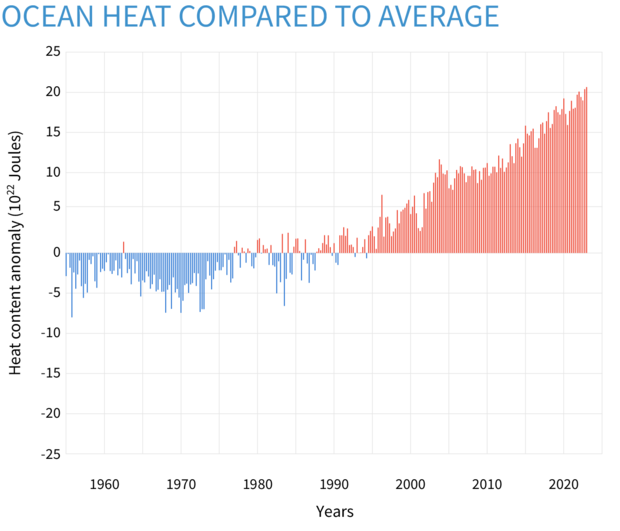
That’s why Ocean Heat Content (OHC) is considered a gold standard in climate monitoring. It’s a far more stable and reliable indicator of global warming than surface air temperature, which can vary from year to year due to natural cycles.
A Closer Look at the 2025 Earth’s Oceans Just Logged Another Record Heat Year
In 2025:
- The top 2,000 meters of Earth’s oceans warmed more than any previous year on record.
- The North Atlantic, Southern Ocean, and western Pacific saw particularly sharp increases.
- The Mediterranean Sea reached temperatures that disrupted both wildlife and fisheries.
Even with a mild La Niña transitioning to El Niño in the Pacific, which typically affects global temperatures, the underlying warming trend continued upward — confirming that this is a man-made, long-term issue.
How This Earth’s Oceans Just Logged Another Record Heat Year Affects Everyone?
The average person may think, “Why should I care if the ocean is a little warmer?” But warming oceans affect life on land just as much as at sea. Here’s how:
1. Sea-Level Rise and Flooding
When water heats up, it expands — a phenomenon called thermal expansion. Combine that with melting glaciers and ice sheets, and we get:
- Coastal flooding in places like Miami, New Orleans, and Jakarta
- Saltwater intrusion into freshwater supplies
- Erosion of coastlines, loss of wetlands and property
According to NASA, global sea level has risen about 8 inches since 1880, but the rate is accelerating fast. And the number one cause? Warming oceans.
2. Stronger, More Destructive Storms
Tropical storms, hurricanes, and cyclones draw their power from warm ocean waters. As sea surface temperatures increase, storms intensify more rapidly, dump more rain, and travel farther inland.
Example: In 2025, Hurricane Jenna went from a tropical storm to a Category 5 hurricane in just 24 hours due to unusually warm waters in the Gulf of Mexico — a phenomenon known as rapid intensification.
3. Coral Bleaching and Ecosystem Collapse
Warmer oceans cause coral reefs to bleach and die, impacting entire ecosystems. Reefs are home to 25% of marine species and serve as vital fisheries and tourism resources.
Between 2023–2025, the world experienced its fourth global coral bleaching event, affecting 84% of reef ecosystems, including iconic areas like the Great Barrier Reef.
4. Disrupted Fisheries and Global Food Supply
As fish migrate to cooler waters, fishermen are left behind, impacting economies that rely on seafood. This includes:
- Alaskan salmon runs
- New England lobster fisheries
- West African coastal fishing communities
Warmer waters also increase dead zones — low-oxygen areas that suffocate marine life and cause mass fish die-offs.
Long-Term Climate Risks from Ocean Warming
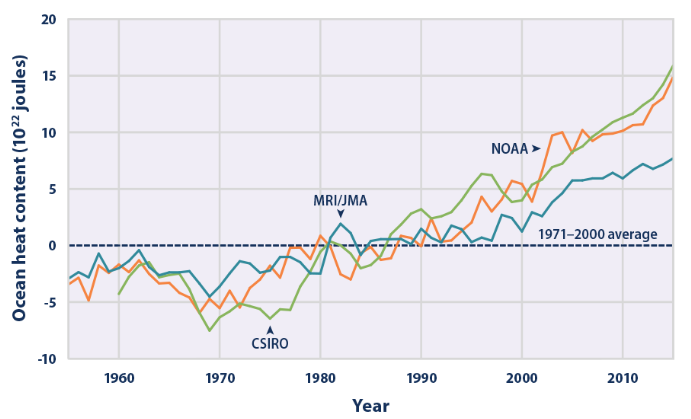
The heat building up in the ocean won’t just disappear.
Ocean water moves slowly — which means heat absorbed today can continue influencing global climate for decades or centuries. That’s bad news for:
- Polar ice stability — warming oceans melt ice from below.
- Jet stream changes — which can lead to weather extremes like deep freezes or deadly heat domes.
- Carbon cycling — warmer oceans absorb less CO₂, weakening nature’s ability to regulate greenhouse gases.
These are feedback loops — processes that accelerate global warming even further.
What Can Be Done? A Guide to Action
This isn’t just a science headline. It’s a call to action.
Whether you’re a policymaker, student, city planner, or just someone trying to make a difference — you have a role in slowing ocean warming.
National and Global Solutions
- Transition to renewable energy: Solar, wind, and hydro power reduce the burning of fossil fuels.
- Strengthen climate treaties: Recommit to the Paris Agreement and enforce global emissions cuts.
- Invest in carbon capture and storage (CCS): Technologies that pull carbon out of the air are vital to balancing emissions.
Local Community Solutions
- Protect wetlands, mangroves, and coral reefs: These natural barriers help absorb wave energy and storm surges.
- Update building codes: Especially in flood-prone areas, we must plan for higher seas.
- Educate citizens: Climate literacy is the first step to action. Start with schools, libraries, and community events.
Personal Actions That Add Up
- Drive less. Walk, bike, or take public transit.
- Eat more plant-based foods. Livestock emissions contribute to warming.
- Support businesses committed to sustainability.
- Vote with climate in mind.
What the Experts Say About Earth’s Oceans Just Logged Another Record Heat Year?
“The oceans are warming fast — faster than we expected — and the consequences are already upon us. What we’re seeing today is the result of emissions from decades ago.”
— Dr. Lijing Cheng, oceanographer and lead study author
“We have a narrow window to act. Ocean heat won’t just impact future generations — it’s shaping our weather, food, and economies today.”
— Dr. Gavin Schmidt, NASA GISS Director
A Startup Wants to Light Up Earth’s Nights With Space Mirrors — Astronomers Are Alarmed
What Travelers May Notice First as TSA Rolls Out New Security Changes in 2026
A New Sulfur-Based Battery Concept Could Deliver Much Higher Power