
Astronomers Spot a Lemon-Shaped World: In a discovery that’s lighting up both scientific journals and stargazing forums, astronomers using NASA’s James Webb Space Telescope (JWST) have spotted a truly bizarre alien world. Its name? PSR J2322-2650b. Its shape? Believe it or not—a lemon. This oddball of a planet orbits a pulsar, a type of dead star, about 2,000 light-years from Earth. And it’s doing things that no planet, according to our current models, should be able to do. It’s challenging the rules of planet formation, defying atmospheric expectations, and giving scientists a lot to think about. Let’s break it all down—whether you’re a ten-year-old future astronaut or a PhD physicist.
Table of Contents
Astronomers Spot a Lemon-Shaped World
PSR J2322-2650b isn’t just another exoplanet—it’s a reality check for everything we thought we understood about the universe. Its bizarre shape, deadly environment, and alien chemistry paint a picture of just how diverse and unpredictable planetary systems can be. As scientists continue to explore with telescopes like JWST, it’s clear that the universe still has plenty of surprises. And every now and then, those surprises come in the shape of a lemon.
| Feature | Details |
|---|---|
| Planet Name | PSR J2322-2650b |
| Shape | Lemon-shaped, heavily distorted by pulsar gravity |
| Host Object | Neutron star (pulsar), incredibly dense and fast-spinning |
| Distance from Host | ~1 million miles |
| Orbital Period | 7.75 hours (extremely fast year) |
| Atmosphere | Mostly helium, carbon molecules (C₂, C₃), no water or oxygen |
| Likely Surface | Possibly diamond-forming due to pressure |
| Tools Used | James Webb Space Telescope (JWST) |
| Published In | Astrophysical Journal Letters, peer-reviewed |
| Discovery Team | University of Chicago, Stanford, Carnegie Institution |
| Source | NASA News – UChicago |
Why Is Astronomers Spotting a Lemon-Shaped World So Unusual?
Planets usually form in a disk of gas and dust around a young star. Over millions of years, particles clump together to form rocks, then boulders, then planets. We expect them to end up mostly round and to orbit regular stars like our Sun.
But PSR J2322-2650b throws a wrench into that idea.
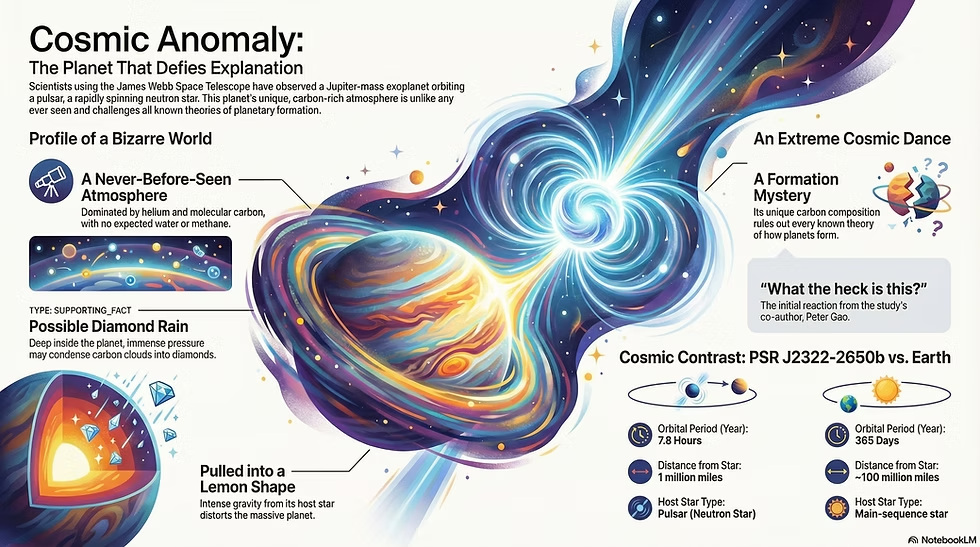
Instead of orbiting a normal star, it’s whipping around a pulsar, which is the collapsed core of a massive star that exploded in a supernova. Pulsars are extremely dense—imagine stuffing the mass of our entire Sun into a sphere the size of New York City—and they spin rapidly, sometimes hundreds of times per second.
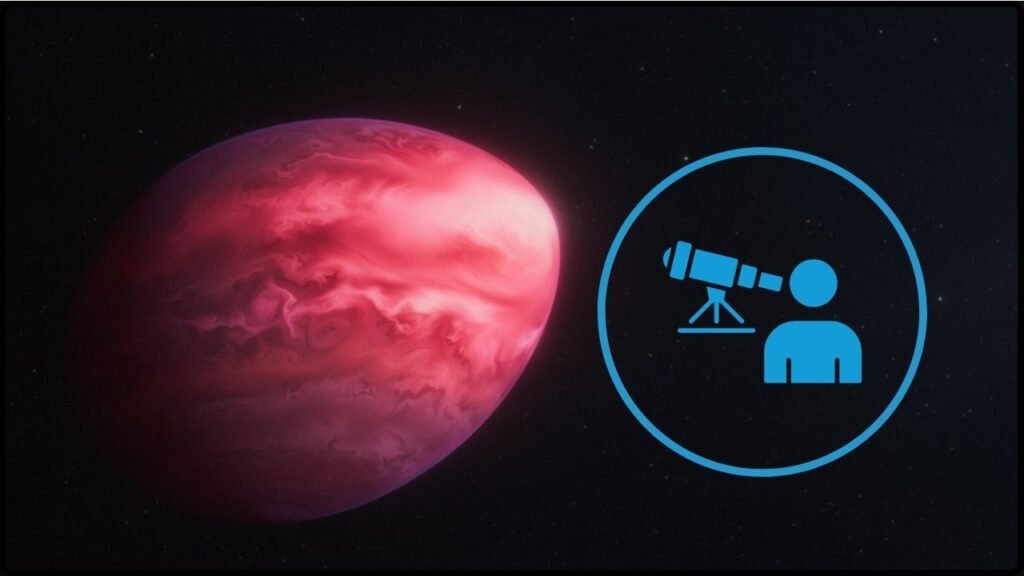
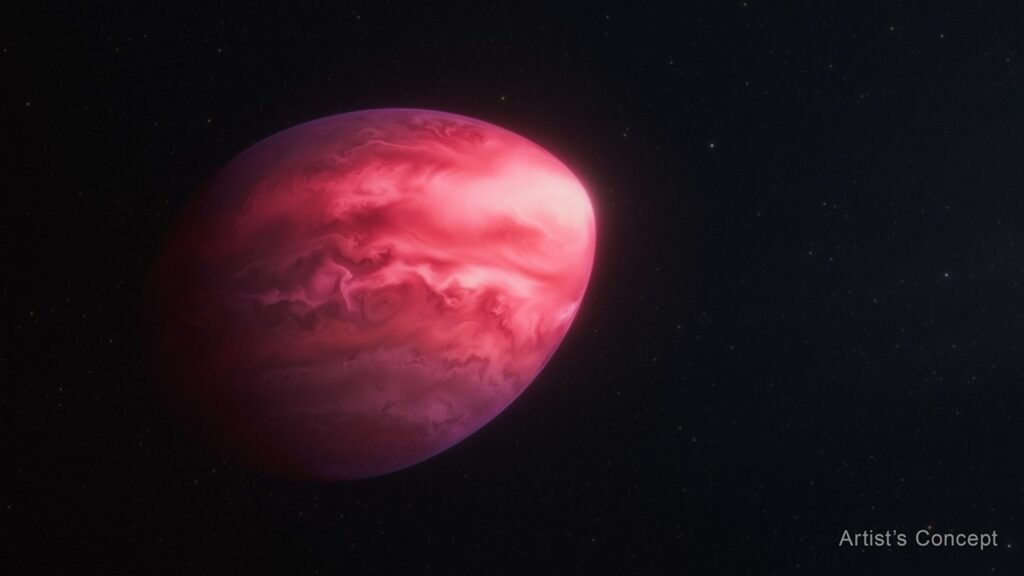
This intense gravitational pull has physically distorted the planet into a lemon-like shape, making it one of the most deformed planetary bodies ever found.
And this deformation isn’t just a fun shape fact—it has real scientific consequences for how we understand gravity, planetary structure, and orbital mechanics.
A Closer Look at the Pulsar System
The planet orbits its pulsar host at just 1 million miles—compare that to Earth’s distance from the Sun: 93 million miles. That’s a 90%+ reduction in distance. In this hyper-close orbit, gravity is so strong it’s actually stretching the planet.
Its orbital period is a mere 7.75 hours, meaning a full year there lasts less than a typical school day. The planet’s movement is so fast that it’s traveling at speeds over 400,000 miles per hour, making Mercury’s 107,000 mph seem sluggish in comparison.
Pulsars also emit powerful beams of radiation, especially X-rays and gamma rays, which would fry any known form of life. For context, these beams are so intense they’re used as natural space-time clocks by astronomers.
Yet somehow, this planet is there, intact, weird, and doing just fine.
Astronomers Spot a Lemon-Shaped World: What’s in the Atmosphere
What JWST found in the planet’s atmosphere surprised even veteran scientists.
Instead of the usual suspects—like hydrogen, methane, or water vapor—they found:
- Helium: A light gas typically associated with stars.
- C₂ and C₃ molecules: Forms of carbon rarely seen in planetary atmospheres.
- Almost zero oxygen or nitrogen: Making Earth-like life impossible.
- Signs of soot-like clouds: Suggesting carbon is condensing in high layers.
Under the extreme pressure deeper in the atmosphere, carbon atoms may crystallize into diamonds, just like theorized on other carbon-rich exoplanets such as 55 Cancri e.
This isn’t science fiction. Similar processes are thought to occur on Uranus and Neptune, where diamond rain may fall in their icy interiors.
How Was a Lemon-Shaped World Discovered?
Thanks to JWST’s infrared instruments, scientists were able to gather high-quality spectroscopic data from the planet’s atmosphere, despite its extreme environment.
Normally, a star would outshine the planet, making it difficult to isolate atmospheric features. But since pulsars emit mostly in X-ray and gamma-ray wavelengths, Webb had an unusually “clean” view of the planet’s thermal emission in the infrared spectrum.
That unique combination of circumstances created the perfect scientific opportunity.
“It’s one of the only cases where we get to observe a planet like this without being blinded by the light of its host.”
— Dr. Michael Zhang, University of Chicago
Why Does This Matter?
This is not just a quirky headline or an odd celestial body. It has major implications for astronomy, planetary science, and astrophysics.
1. It Challenges Existing Models
Our planet formation theories depend on stable, circular orbits and balanced mass distribution. A lemon-shaped planet with extreme chemical makeup flying around a pulsar? That doesn’t fit the model.
We may need new equations and simulations to account for how such systems evolve.
2. It Shows What’s Possible
Previously, it was assumed no planets could survive close to a pulsar. This find proves that even in the harshest places in space, planets can form or survive.
It opens the door to finding other exotic systems—possibly with habitable moons or binary partners.
3. It Teaches Us About Exotic Chemistry
Understanding atmospheres like this one could help scientists explore non-Earth-like environments. That’s vital for designing future telescopes, probes, and even SETI (Search for Extraterrestrial Intelligence) efforts.
Educational and Career Relevance
For students, this discovery can be a gateway into careers in:
- Astronomy: Observational techniques, data analysis, and instrument design
- Planetary Science: Modeling extreme planetary interiors
- Astrophysics: Studying gravitational interactions and radiation
- Data Science: Using machine learning for exoplanet detection
For teachers, this is a great story to introduce advanced concepts in simple terms—gravity, orbital mechanics, radiation, and chemistry—all using a real, current example.
Practical Examples: How Weird Can Planets Get?
PSR J2322-2650b isn’t alone in the hall of cosmic weirdos. Here are a few other mind-bending exoplanets:
- HD 189733b: Rains molten glass sideways at 5,000 mph.
- 55 Cancri e: Possibly covered in diamonds.
- TrES-2b: So dark it reflects less than 1% of light—darker than coal.
But none of them orbit a pulsar at 1 million miles while being stretched into a lemon and possibly raining diamonds. That’s what makes PSR J2322-2650b unique.
Astronomers Discover a Saturn-Sized Planet Hidden in the “Einstein Desert”
Astronomers Identify a Lemon-Shaped Planet That Challenges Existing Models
Scientists Say Earth’s Day Could Gradually Stretch Toward 25 Hours