
Human evolution has always been presented as a clear and confident story. We evolved in Africa. We migrated outward. We replaced earlier human species. That framework has shaped textbooks, research papers, and public understanding for decades. But science rarely stands still. Every so often, a discovery forces researchers to pause and reconsider what they thought they knew. This mysterious human skull could rewrite the Out of Africa theory, and that possibility has sparked serious debate among experts. In fact, this mysterious human skull could rewrite the Out of Africa theory by revealing that human evolution was far more interconnected and regionally complex than we once believed. The fossil in question was not discovered recently. It was hidden away for decades. Only in the past few years has it been carefully studied and analyzed using modern technology. As researchers continue to examine it, many now believe this mysterious human skull could rewrite the Out of Africa theory not by overturning it entirely, but by adding critical nuance to the story of our origins.
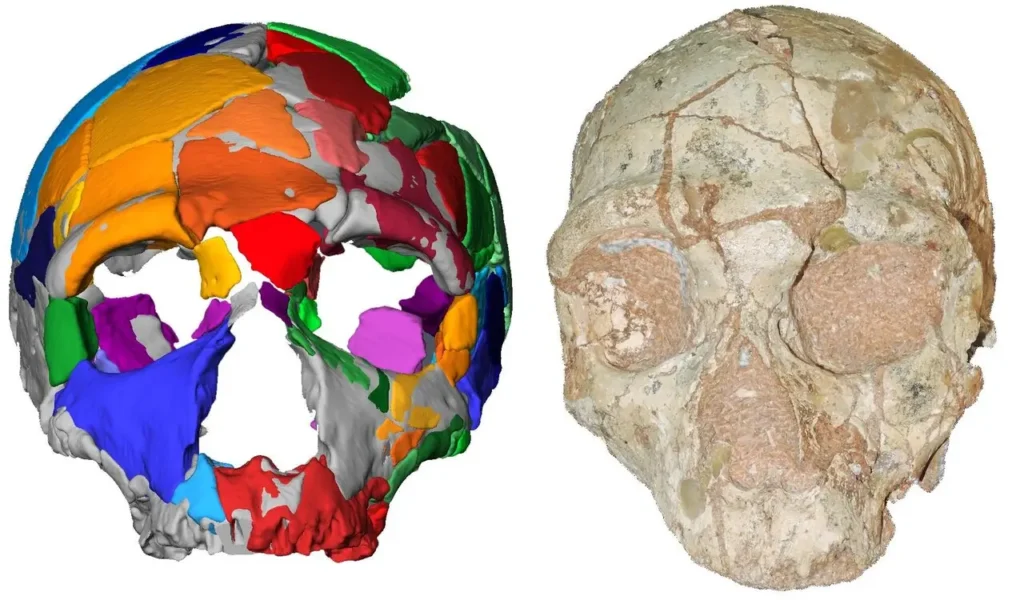
The fossil at the center of this discussion is widely known as the Dragon Man skull. It was first uncovered in 1933 in Harbin, located in northeastern China. At the time, the region was under political tension, and the man who discovered the skull chose to hide it in a well rather than turn it over to authorities. For decades, it remained concealed. Only in 2018 was it recovered by the discoverer’s family and handed to scientists for proper study. When researchers finally examined it, they were stunned by its condition. Unlike many ancient human fossils that consist of fragments or partial remains, this skull is almost completely intact. That level of preservation is rare and extremely valuable. It allows scientists to measure facial proportions, brain size, bone thickness, and structural features with unusual accuracy. The research team proposed that the skull represents a new species named Homo longi. The name translates to Dragon River human, referencing the region where it was found. The classification immediately generated global attention because of what it might imply about human evolution in Asia.
Table of Contents
Mysterious Human Skull
| Category | Details |
|---|---|
| Common Name | Dragon Man Skull |
| Proposed Species | Homo longi |
| Location Found | Harbin, Heilongjiang Province, China |
| Estimated Age | At least 146,000 years |
| Geological Period | Middle Pleistocene |
| Brain Size | Comparable to modern humans |
| Key Physical Traits | Thick brow ridge, large molars, broad nose |
| Possible Connection | Denisovans |
| Scientific Significance | May complicate traditional Out of Africa model |
A Skull Hidden for Decades
- The backstory alone makes this fossil remarkable. According to family accounts, the original finder feared the skull would be taken or destroyed during a turbulent political era. By hiding it, he unknowingly preserved one of the most important anthropological finds of the century.
- When scientists gained access to the skull nearly 90 years later, technology had advanced dramatically. High resolution CT scanning, 3D digital modeling, and comparative morphometric analysis allowed researchers to study it in ways that were impossible in the mid twentieth century. This timing may have been fortunate. The fossil could now be analyzed with precision tools that provide deeper insight into ancient human anatomy.
A Face Unlike Any Other
- At first glance, the skull presents a fascinating combination of traits. Its cranial capacity falls within the range of modern Homo sapiens. That means its brain size was comparable to ours. However, other features appear more archaic.
- The brow ridge is thick and prominent. The face is broad. The nose is wide, possibly an adaptation to cold climates. The molars are large, suggesting a diet that required heavy chewing. These physical characteristics do not fit neatly into the categories scientists use to classify early humans.
- This blend of modern and ancient traits is exactly why some researchers argue that this mysterious human skull could rewrite the Out of Africa theory. It suggests that human evolution was not confined to one region or one linear path.
How Old Is The Fossil
- Dating techniques place the skull at a minimum of 146,000 years old. Some estimates suggest it could be even older. That age places it in the Middle Pleistocene, a period when multiple human groups coexisted across different continents.
- During this time, Homo neanderthalensis inhabited Europe and parts of western Asia. In Africa, early populations of Homo sapiens were developing traits that would later define modern humans. Meanwhile, genetic research has confirmed the existence of another archaic group known as the Denisovans in Asia.
- The Harbin skull appears to belong within this complex network of overlapping populations.
A Challenge To The Out Of Africa Theory
- The Out of Africa theory remains strongly supported by genetic evidence. Studies of mitochondrial DNA and whole genome sequencing consistently point to Africa as the primary origin of modern humans. However, fossil discoveries outside Africa continue to add complexity to that model.
- If this mysterious human skull could rewrite the Out of Africa theory, it would do so by highlighting regional diversity. Instead of a simple replacement model where modern humans spread outward and displaced all other groups, the evidence increasingly supports interaction and interbreeding.
- Genetic data shows that many modern humans carry small percentages of Neanderthal DNA. Some populations also carry Denisovan DNA. That means ancient groups did not exist in isolation. They encountered each other. They mixed. They shared genes.
- The Dragon Man skull strengthens the argument that Asia may have hosted advanced human populations that were closely related to modern humans long before large scale migrations occurred.
Is Dragon Man A Denisovan
- One of the most intriguing questions is whether the skull represents a new species or a physical example of Denisovans. Denisovans are known primarily from fragmentary fossils discovered in Siberia and Tibet. Scientists have identified them mainly through genetic evidence rather than complete skeletal remains.
- Some researchers believe the Harbin skull matches what we would expect a Denisovan to look like based on genetic clues. Its size, location, and age fit the timeline. However, without extractable DNA from the skull itself, this remains speculative.
- If future advances allow scientists to recover genetic material from the fossil, the results could significantly clarify whether this mysterious human skull could rewrite the Out of Africa theory in a dramatic way.
Rethinking Human Evolution
- Over the past two decades, the idea of a simple evolutionary ladder has faded. Instead, scientists now describe human evolution as a branching tree with overlapping limbs. Different groups emerged, adapted to local environments, and sometimes reconnected through migration and interbreeding.
- Climate shifts during the Ice Ages created changing migration routes. Populations expanded and contracted depending on environmental conditions. Asia, Europe, and Africa were not isolated evolutionary laboratories. They were interconnected landscapes shaped by movement and adaptation.
- The Harbin fossil reinforces this broader view. It suggests that East Asia may have been more than a passive destination for migrating humans. It may have been an active center of human development.
What Scientists Still Do Not Know
Despite years of analysis, many questions remain unanswered. Was Homo longi truly a distinct species. Did it interbreed with early Homo sapiens. Was it actually Denisovan. How widespread was this population across Asia. Science advances by asking better questions, not by rushing to conclusions. Researchers continue to compare the skull with other fossils using advanced computational models. Each comparison brings us closer to understanding its place in the human story.
Why This Discovery Matters
- It is tempting to frame every new fossil as revolutionary. In reality, scientific progress usually happens gradually. This mysterious human skull could rewrite the Out of Africa theory not by discarding it, but by refining it. Africa remains central to the story of modern human origins. That foundation is supported by strong genetic data. However, fossils like the Dragon Man skull remind us that evolution is rarely simple. Human history appears to be shaped by waves of migration, regional adaptation, and shared ancestry.
- The discovery also highlights how much remains unknown. Entire chapters of our evolutionary past are still buried underground. Each new find has the potential to challenge assumptions and reshape timelines. In the end, what makes this fossil so powerful is not just its age or its size. It is the reminder that our origins are complex. We are the result of countless generations of movement, survival, and interaction across continents.
- As researchers continue to study the Harbin skull using the latest imaging and analytical tools, one thing is clear. Human evolution is a dynamic, evolving field of study. And sometimes, a single skull hidden in a well for nearly a century can reopen one of the biggest debates in science. This mysterious human skull could rewrite the Out of Africa theory by deepening it, complicating it, and ultimately bringing us closer to understanding where we truly come from.
FAQs on Mysterious Human Skull
1. What Is the Dragon Man Skull
The Dragon Man skull is a nearly complete ancient human fossil discovered in Harbin, China. Researchers have proposed that it belongs to a species called Homo longi.
2. Could This Skull Really Rewrite the Out of Africa Theory
The discovery does not completely overturn the Out of Africa model, which is strongly supported by genetic evidence. However, it adds complexity to the narrative.
3. Is Homo Longi the Same as Denisovans
Scientists are still debating this question. Denisovans are known mostly from DNA and fragmentary fossils found in Asia. Some researchers believe the Harbin skull could represent a Denisovan individual, while others argue it may be a distinct lineage.
4. How Does the Skull Compare to Modern Humans
The skull has a brain size comparable to modern Homo sapiens, but it also displays thick brow ridges, large molars, and a broad facial structure.