
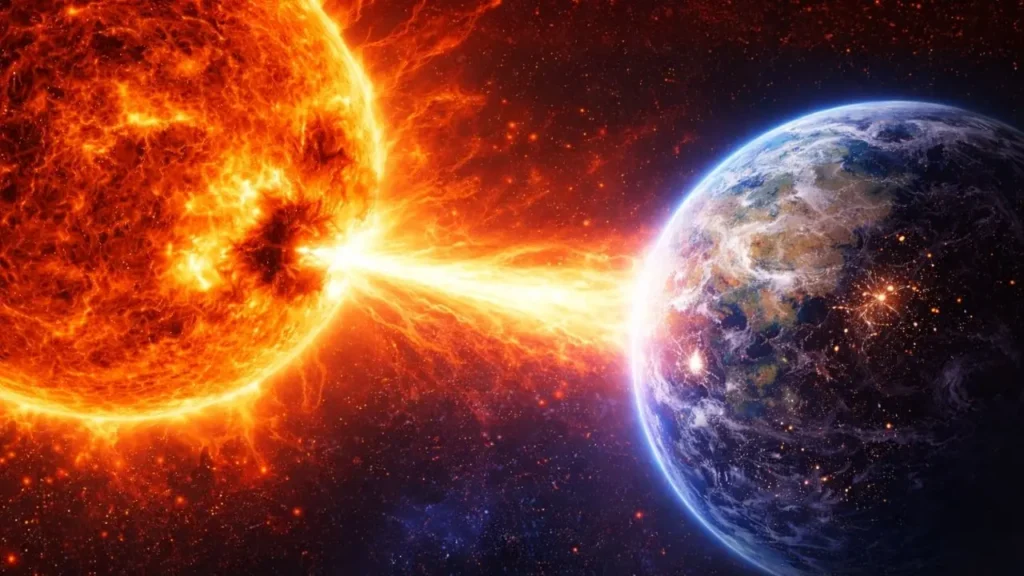
Space agencies and astronomers worldwide are closely monitoring Intensifying Solar Flare activity emerging from a newly Earth-facing sunspot on the Sun’s surface. The region rotated into view in early February 2026 and has already produced multiple powerful eruptions, raising concerns about possible disruptions to satellites, navigation systems, aviation communications, and other technologies that rely on stable space weather conditions.
Table of Contents
Intensifying Solar Flare Activity From A Newly Aligned Sunspot
| Key Fact | Detail/Statistic |
|---|---|
| Active region | Earth-facing sunspot producing repeated flares |
| Strongest flares | Several M-class and at least one X-class eruption |
| Possible effects | GPS interference, radio blackouts, satellite risk |
Scientists will continue watching the sunspot as it crosses the visible face of the Sun over the coming days. Forecasters say the level of disruption depends on whether future eruptions launch particle clouds toward Earth, a development that can only be confirmed after each flare occurs. Researchers emphasize that such activity is a natural part of the Sun’s cycle, and monitoring systems are designed to provide early warning if risks increase.
What Is Happening on the Sun
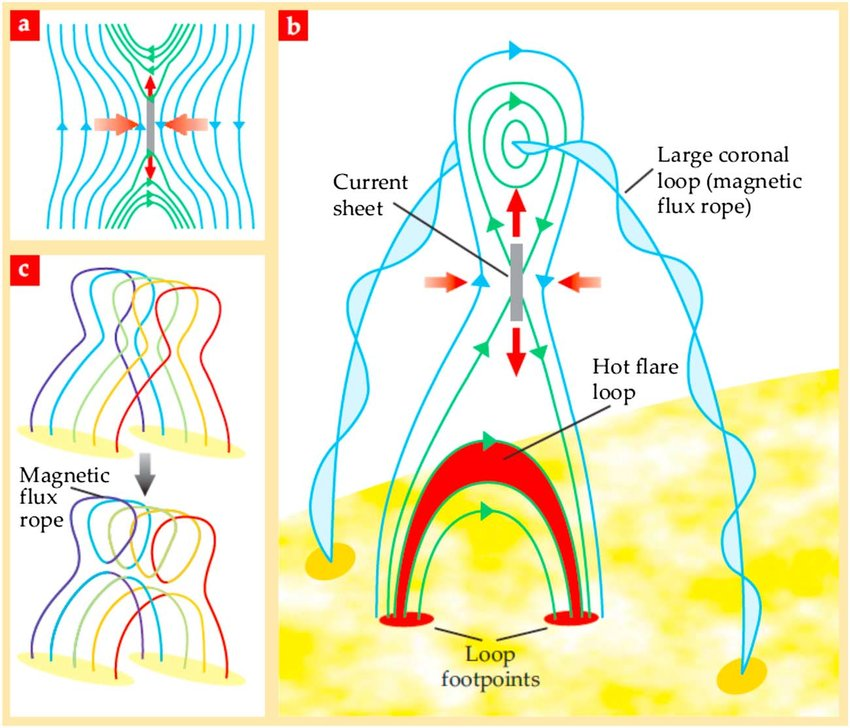
Astronomers say the newly aligned sunspot is a magnetically complex region where intense energy accumulates beneath the Sun’s visible surface. When magnetic fields suddenly snap and reconnect, that stored energy releases as radiation and charged particles known as solar flares.
According to the National Oceanic and Atmospheric Administration (NOAA) Space Weather Prediction Center, the region has produced repeated mid-to-strong eruptions within a short period, an unusual concentration even during active solar conditions.
“Active regions like this are essentially giant magnetic knots,” NOAA forecasters explained in a public advisory. “When the magnetic structure destabilizes, it releases large amounts of energy almost instantly.”
These eruptions fall into three categories — C, M, and X class — with X-class flares considered the most powerful. Scientists reported several M-class flares and at least one strong X-class event as the sunspot turned toward Earth.
Why Alignment With Earth Matters
The Sun rotates roughly every 27 days. A flare from the far side rarely affects Earth. However, once the sunspot faces our planet, the emitted radiation and possible coronal mass ejections (CMEs) can travel directly toward Earth’s magnetic field.
NASA officials note that solar radiation from a flare arrives within minutes, while CMEs — massive clouds of charged particles — take one to three days to reach Earth.
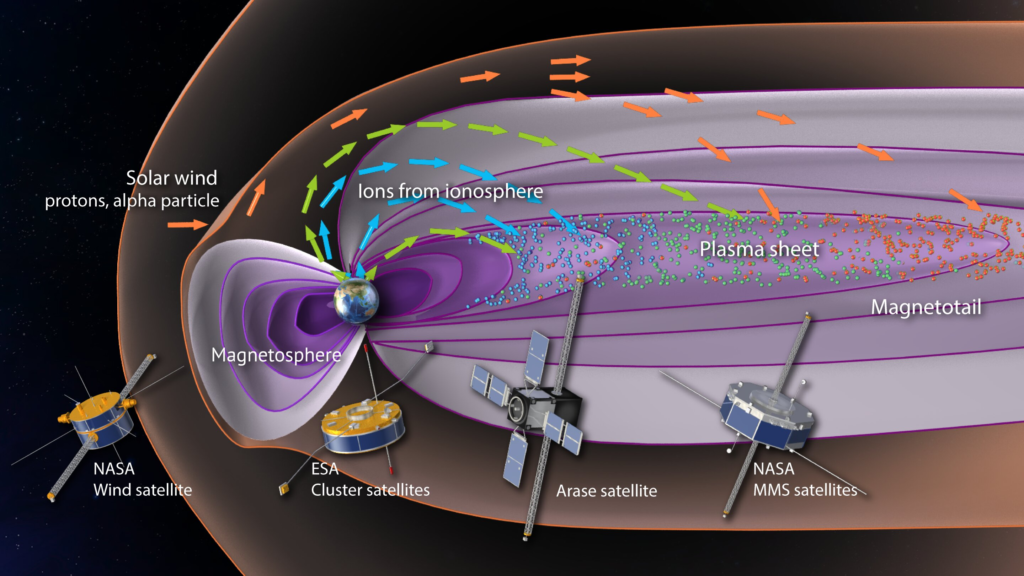
“If a CME follows the flare, that is when we can see geomagnetic storms,” NASA solar physicists stated in a space weather update. Such storms occur when charged particles interact with Earth’s magnetosphere.
The Intensifying Solar Flare therefore depends less on the flare alone and more on whether a CME accompanies it. A strong CME can compress Earth’s magnetic field, causing disturbances collectively known as a solar storm.
Potential Effects on Technology
Solar flares do not threaten human life on the ground because Earth’s atmosphere blocks harmful radiation. The primary risk is technological.
According to NASA and NOAA guidance, strong solar activity may cause:
- High-frequency radio blackouts affecting aircraft and ships
- GPS accuracy errors and navigation disruptions
- Satellite electronics disturbances
- Temporary power grid fluctuations in extreme cases
Commercial airlines flying polar routes are especially sensitive because communication there relies heavily on high-frequency radio signals.
Satellites orbiting Earth face additional risk. Charged particles can damage onboard electronics or temporarily disable instruments. Satellite operators often place spacecraft into safe mode during severe space weather events.
Effects on Astronauts and Space Missions
Astronauts are more vulnerable than people on Earth because they operate above much of the planet’s protective atmosphere. The International Space Station (ISS) includes shielded areas where astronauts can shelter during high radiation events.
Space agencies monitor radiation exposure carefully. During a strong geomagnetic storm, astronauts may be instructed to delay spacewalks.
Future missions to the Moon under NASA’s Artemis program will face even greater challenges because lunar explorers will lack Earth’s magnetosphere protection.
Part of a Larger Solar Cycle
Scientists emphasize the activity is not unexpected. The Sun is currently near the peak of Solar Cycle 25, an approximately 11-year period marked by rising sunspot numbers and increased eruptions.
The National Aeronautics and Space Administration (NASA) predicted heightened solar activity through 2025-2026 as the cycle reaches its maximum phase.
“We expect more frequent flares and geomagnetic storms during solar maximum,” researchers at NASA’s Heliophysics Division explained in prior briefings. “Events like this are consistent with the cycle’s behavior.”
Historically, the most extreme example remains the 1859 Carrington Event, which disrupted telegraph systems worldwide. Modern satellites and electrical grids make current infrastructure more vulnerable, though engineers now use forecasting models and protective measures.
Could a Major Solar Storm Happen?
Scientists say a catastrophic event is unlikely but not impossible. A Carrington-level solar storm today could temporarily disable satellites and disrupt electrical systems.
Power companies now coordinate with space weather forecasters. Electrical grids can reduce load and isolate equipment to prevent damage.
Insurance analysts and governments increasingly treat severe space weather as a natural disaster risk similar to hurricanes or earthquakes.
Visible Effects: Auroras Possible
One noticeable consequence could be expanded aurora displays. Charged solar particles colliding with Earth’s upper atmosphere produce the northern and southern lights.
If a CME reaches Earth, auroras may appear farther from the poles than usual. In rare cases, they can be visible in mid-latitude regions.
Observers are advised to look toward dark northern skies after sunset, away from city lights.
How Scientists Predict Space Weather
The field of space weather forecasting has advanced rapidly. Satellites positioned between Earth and the Sun monitor solar activity continuously.
Key monitoring spacecraft include:
- NASA Solar Dynamics Observatory
- NOAA GOES weather satellites
- DSCOVR solar wind monitoring satellite
These spacecraft measure radiation, magnetic fields, and solar wind speed. Scientists analyze the data to predict whether a solar storm will reach Earth.
Forecast alerts are issued in stages — watch, warning, and severe storm — similar to hurricane tracking.
Why Modern Society Is Vulnerable
Human civilization depends heavily on satellite technology. GPS navigation, financial transactions, aviation routes, internet timing systems, and weather forecasting all rely on stable orbital infrastructure.
Banking networks also depend on precise timing signals transmitted from satellites. A prolonged geomagnetic storm could temporarily affect financial synchronization systems.
Despite these risks, experts emphasize preparations are improving each year.
Historical Perspective
Space weather has affected Earth before modern technology existed. During the 1859 Carrington Event, telegraph wires reportedly sparked and shocked operators.
In 1989, a geomagnetic storm caused a nine-hour power outage in Quebec, Canada. That event demonstrated the vulnerability of modern electrical grids.
Researchers use such past events to model how an intensifying solar flare today might impact interconnected infrastructure.
Monitoring and Forecasting
The NOAA Space Weather Prediction Center and international observatories continuously monitor the Sun using satellites such as NASA’s Solar Dynamics Observatory.
Forecasting has improved significantly over the last decade. Operators of satellites, aviation networks, and power systems receive warnings hours or days in advance.
“Space weather is now treated much like terrestrial weather forecasting,” NOAA officials noted. “Advance notice allows operators to reduce system stress during storms.”
FAQs About Intensifying Solar Flare Activity From A Newly Aligned Sunspot
Are solar flares dangerous to people?
No. Earth’s atmosphere and magnetic field block harmful radiation at the surface.
Can solar flares cause blackouts?
Only extreme geomagnetic storms may affect power grids. Modern systems include protective measures.
How long will this activity last?
Typically about one to two weeks while the sunspot remains Earth-facing during the Sun’s rotation.
Will this affect mobile phones or the internet?
Directly, rarely. However, GPS accuracy and some radio communications may temporarily degrade.
Can planes still fly safely?
Yes. Airlines may reroute polar flights temporarily if radio communication becomes unreliable.