
A Past Climate Event May Be Linked to the Ragnarök Story — and scientists, historians, and climate experts are taking that idea seriously. What if one of the most dramatic myths in Norse history was shaped by a real environmental catastrophe? Modern research suggests that a severe climate disaster in 536 CE may have influenced the legend of Ragnarök, the apocalyptic event in Norse mythology preceded by a devastating winter called Fimbulwinter. As someone who has covered climate science and cultural history for years, I can tell you this straight up — when hard geological data lines up with ancient storytelling, that’s not random. That’s a signal. And here in the USA, where we’re seeing billion-dollar climate disasters almost every year, understanding how past societies handled environmental chaos is more than interesting — it’s essential.
Table of Contents
A Past Climate Event May Be Linked to the Ragnarök Story
A Past Climate Event May Be Linked to the Ragnarök Story highlights the powerful intersection of climate science and cultural memory. Evidence from ice cores, tree rings, archaeology, and historical records confirms that a severe volcanic winter occurred around 536 CE. While Ragnarök remains mythology, the parallels between real climate catastrophe and the legend of Fimbulwinter suggest that ancient Norse societies may have preserved environmental trauma through storytelling. The lesson for modern America is clear: climate events reshape societies — and the stories we tell about them.

| Topic | Details |
|---|---|
| Climate Event | Volcanic Winter of 536 CE |
| Cause | Massive volcanic eruptions injecting sulfur aerosols into the atmosphere |
| Temperature Drop | Estimated 1.5°C–2.5°C (2.7–4.5°F) cooling |
| Societal Impact | Crop failures, famine, village abandonment |
| Myth Connection | Fimbulwinter before Ragnarök |
| Archaeological Evidence | Gold hoards, farm abandonment, burial shifts |
| Scientific Sources | Tree rings, ice cores, historical texts |
| Official Climate Resources | NASA Climate • USGS |
What Happened in 536 CE? The Past Climate Event Explained
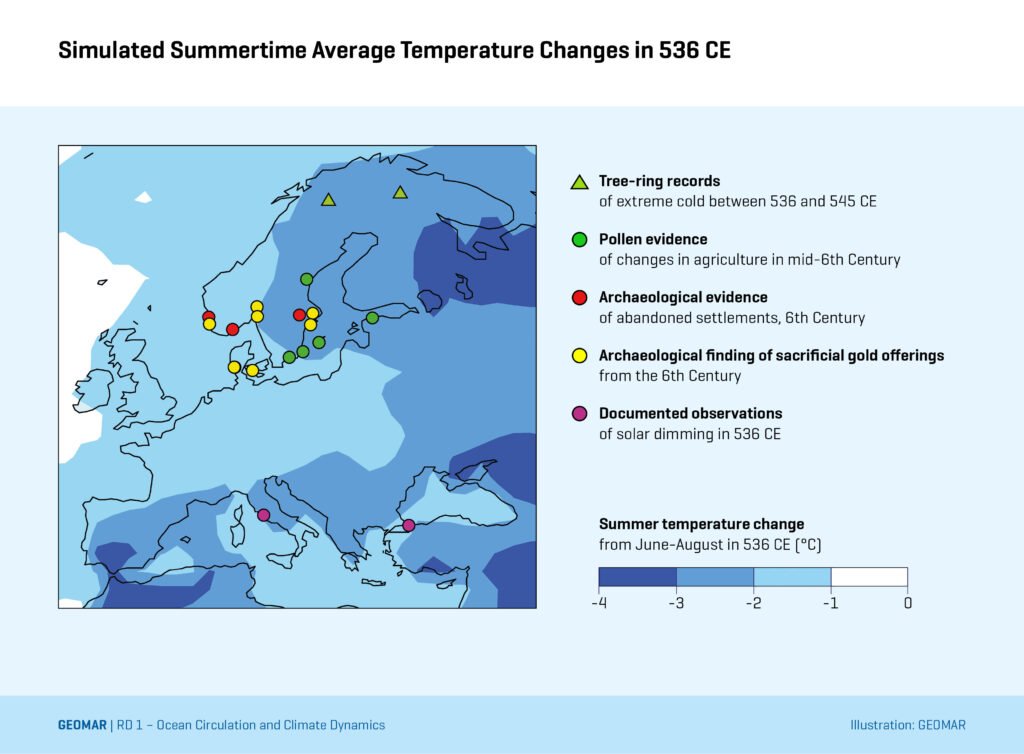
Around 536 CE, the Northern Hemisphere experienced one of the coldest decades in the last 2,000 years. Scientists believe massive volcanic eruptions released sulfur dioxide into the stratosphere. That sulfur formed aerosols that reflected sunlight back into space, reducing surface temperatures.
According to research published in Nature and climate reconstructions supported by the National Oceanic and Atmospheric Administration (NOAA), temperatures may have dropped as much as 2°C. That might sound small, but globally? That’s huge.
To put it in perspective: modern global warming since the late 1800s is around 1.2°C. So this cooling event was even stronger — just in the opposite direction.
Historical Descriptions
Byzantine historian Procopius wrote that the sun gave forth its light “without brightness.” Chinese chronicles reported summer frosts and crop failures.
When multiple cultures across continents describe strange skies and cold summers at the same time — that’s not folklore. That’s climate data hiding in plain sight.
Understanding Ragnarök and Fimbulwinter
In Norse mythology, Ragnarök is the final battle that destroys gods, giants, and the world itself — only for it to be reborn.
Before that destruction comes Fimbulwinter, described in the Poetic Edda as:
- Three winters back-to-back
- No summers in between
- Widespread famine
- Social breakdown
Now here’s where it gets real interesting.
The climate data from 536 CE shows multi-year cooling and agricultural collapse in Northern Europe — the same region where Norse oral traditions developed.
Coincidence? Maybe. But the parallels are hard to ignore.
A Past Climate Event May Be Linked to the Ragnarök Story: Archaeological Evidence from Scandinavia
Archaeologists have uncovered signs of serious disruption around this period:
- Abandoned farms in Sweden and Norway
- Increased burial activity
- Large gold hoards buried between 536–550 CE
A study in Antiquity Journal estimated that up to 50–75% of villages in parts of Sweden were abandoned after the cooling event.
That’s not just bad weather. That’s social stress on a big scale.
Some researchers suggest the buried gold may have been ritual offerings — attempts to restore balance in a world that suddenly felt broken.
The Science Behind the Evidence (Step-by-Step)
Let’s break down how researchers connect volcanoes to mythology:
Step 1: Ice Core Analysis
Greenland ice cores contain sulfur spikes dating to 536 CE — evidence of volcanic eruptions.
Step 2: Tree-Ring Data
Tree rings from Europe and North America show extremely narrow growth patterns during the same years. NOAA explains how tree rings serve as natural climate records.
Step 3: Radiocarbon Dating
Settlements and artifacts align chronologically with the cooling event.
Step 4: Cross-Cultural Historical Records
Written accounts from Europe and Asia confirm atmospheric dimming.
Step 5: Mythological Timeline Comparison
The Norse myths, recorded centuries later, preserve memory of catastrophic winters.
This interdisciplinary approach strengthens the hypothesis.
Additional Perspective: The Late Antique Little Ice Age
Climate scientists now refer to the period following 536 CE as part of the Late Antique Little Ice Age, lasting roughly from 536 to 660 CE.
This prolonged cooling likely contributed to:
- Famine across Europe
- Population decline
- Political instability
- Migration waves
Sound familiar? History shows climate stress can reshape entire civilizations.
Lessons for Modern America
Here in the USA, we’ve experienced:
- $165 billion in weather-related damages in 2022 (NOAA Billion-Dollar Disasters Report)
- Record-breaking wildfire seasons
- Agricultural disruptions in California and the Midwest
Climate shifts don’t just affect thermometers. They affect:
- Food prices
- Migration patterns
- Political stability
- Public health
The 536 event reminds us that climate disruption can alter cultural identity itself.
Indigenous Knowledge and Oral Tradition
Native American communities understand something modern society is rediscovering — stories carry ecological memory.
From the Lakota winter counts to Navajo seasonal narratives, Indigenous storytelling preserves climate cycles and environmental warnings.
The Norse were doing something similar.
When winters lasted too long and crops failed, the experience became legend. Over generations, hardship turned into mythic narrative.
That’s how humans process trauma and survival.
Practical Takeaways for Climate Professionals
If you work in environmental science, policy, or education, here’s what this case teaches:
1. Communicate Through Story
Data matters. But narrative connects.
2. Respect Cultural Memory
Oral traditions often encode real environmental knowledge.
3. Plan for Societal Ripple Effects
Climate resilience planning must include:
- Food security
- Infrastructure protection
- Community mental health
A Rare Dinosaur Egg Agate Shows Natural Patterns Scientists Can’t Replicate
Strange Blue Aurora On Jupiter Forces Scientists To Rethink The Giant Planet
Scientists Challenge the Idea That Trees Can Sense Solar Eclipses
The Bigger Cultural and Scientific Picture
We can’t say Ragnarök literally happened.
But we can say this: climate trauma leaves a mark.
It shapes economies. It shapes migration. It shapes belief systems.
And sometimes, it shapes stories powerful enough to survive a thousand years.
When science and storytelling line up, we pay attention.
Because maybe — just maybe — ancient myths are echoing real environmental warnings.