
Stand on the ground anywhere in the world and it feels unmoving and dependable. But beneath your feet the Earth is far from simple. It is a dynamic planet with intense heat, pressure, and motion occurring thousands of kilometers below the surface. Recently, scientists analyzing global earthquake patterns uncovered evidence of something unexpected a possible Hidden Layer at Earth’s Center.
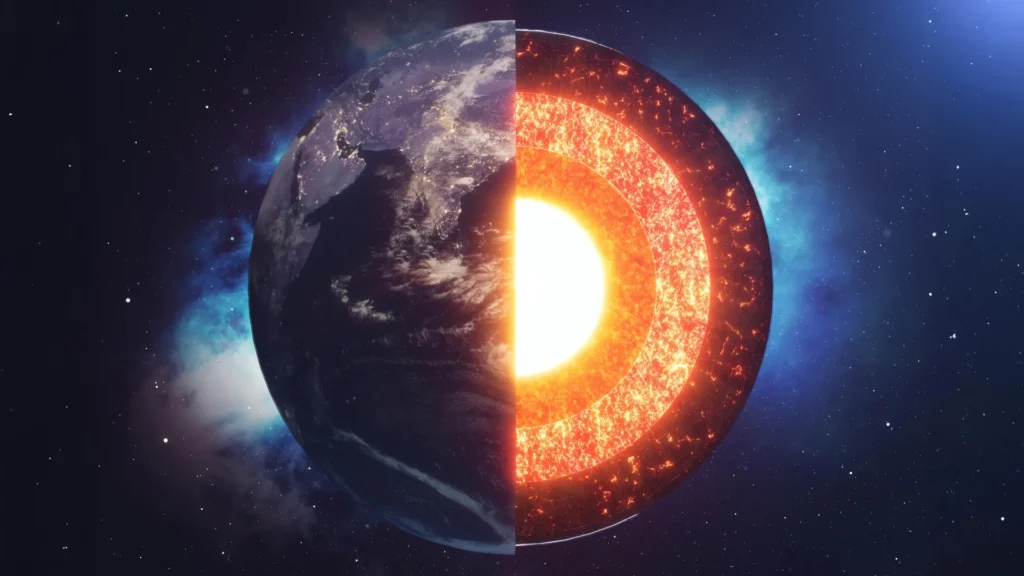
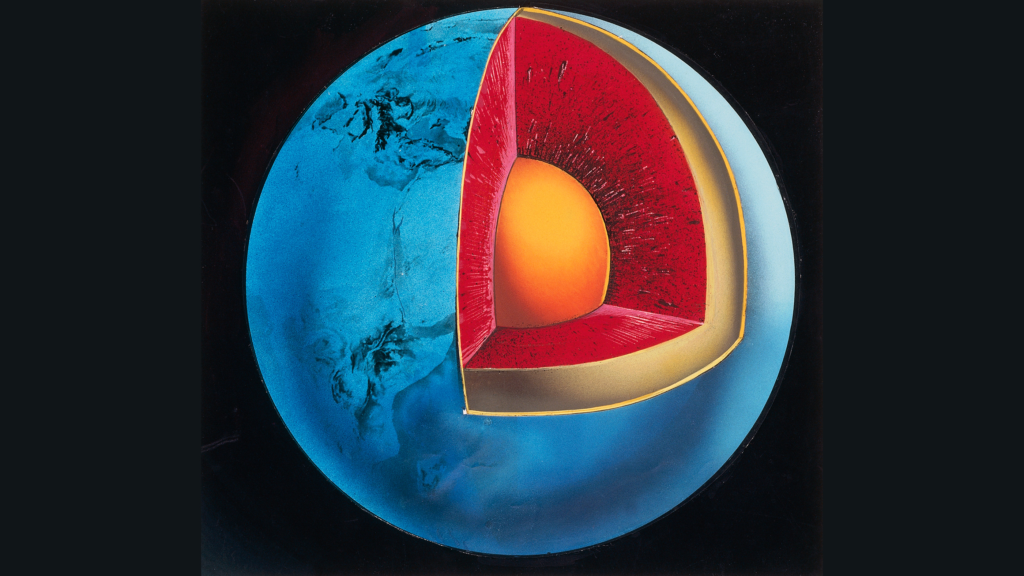
This discovery is changing how geophysicists understand the planet’s deepest structure and how Earth evolved over billions of years. For a long time, students learned the same basic structure of Earth in school: crust, mantle, outer core, and inner core. However, modern seismic research now suggests the story is more complicated. Careful measurements of earthquake waves indicate the inner core itself may contain an internal boundary. In simple terms, the Hidden Layer at Earth’s Center could be a separate structural region formed during a different stage of Earth’s history. This matters because the core controls the magnetic field, influences planetary cooling, and plays a major role in making Earth habitable.
The Hidden Layer at Earth’s Center is not a hollow chamber or a pocket of magma. Instead, it appears to be a structural difference inside the solid inner core nearly six thousand kilometers beneath the surface. Scientists discovered it by studying repeating earthquake signals recorded across multiple continents over several decades. Some seismic waves traveled faster in certain directions and slower in others, something a uniform inner core cannot explain. The most reasonable interpretation is that a second internal boundary exists, likely made of iron crystals arranged differently from the surrounding material. This suggests Earth’s core formed gradually over time rather than all at once, giving scientists valuable clues about planetary cooling and magnetic field development.
Table of Contents
Additional Hidden Layer at Earth’s Center
| Feature | Details |
|---|---|
| Depth | Approximately 5,100 to 6,370 km below surface |
| Discovery Method | Seismic wave analysis |
| Composition | Solid iron and nickel |
| Main Finding | Internal structural boundary inside inner core |
| Importance | Influences heat flow and magnetic field |
| Formation | Gradual cooling over billions of years |
| Research Status | Supported but still under study |
Even today, our own planet remains mysterious. The discovery of a Hidden Layer at Earth’s Center reminds us that science is always evolving. What seemed settled decades ago can change with better technology and patient observation. By studying earthquake vibrations, scientists are essentially listening to Earth itself. Each tremor carries information from regions humans will never reach physically. The new findings suggest the core is not a simple solid sphere, but a complex structure formed over immense spans of time. As research continues, we will learn not only about the planet’s interior but also about how Earth became capable of sustaining life. The deepest part of our world still has stories to tell, and scientists are only beginning to understand them.
What Scientists Found
- Interestingly, researchers were not initially searching for a new structure. Their goal was to compare seismic waves from earthquakes occurring in similar locations but years apart. Normally, waves traveling through the same path inside Earth should produce almost identical readings.
- Instead, scientists noticed slight differences in arrival times of the waves. Some waves reached detectors earlier while others arrived later than expected. These differences were tiny, often fractions of a second, but they appeared consistently across thousands of measurements. Over time, a clear pattern emerged.
- The only logical explanation was that the inner core is not uniform. The Hidden Layer at Earth’s Center appears to act like a boundary separating two regions with slightly different physical properties. This finding surprised many scientists because the inner core was already considered one of the least accessible and least understood regions of the planet.
How Seismic Waves Revealed The Structure
- Since humans cannot directly travel to the Earth’s core, earthquakes act as natural probes. Every strong earthquake sends energy waves throughout the planet. These waves travel differently depending on the material they pass through. Think of it like sound traveling through air, water, and metal. Each material changes the speed and direction of the sound. Seismic waves behave in a similar way.
- Researchers focused on waves that pass straight through the center of Earth. By comparing recordings from seismic stations across the globe, they tracked how these waves moved through the deepest region. If the inner core were perfectly uniform, the waves would behave predictably every time. Instead, scientists saw the waves bend slightly and change speed at a specific depth. The Hidden Layer at Earth’s Center caused refraction similar to how light bends when entering water. This tiny effect provided strong evidence of a separate internal structure.
What The Hidden Layer Might Be
- The inner core is mostly iron compressed under enormous pressure, far greater than anything experienced on the surface. At such extreme conditions, iron atoms form crystal structures. Scientists believe the Hidden Layer at Earth’s Center contains crystals oriented differently from the outer portion of the inner core. This alignment affects how seismic waves travel depending on direction.
- The most likely explanation involves age. The deepest central part of Earth may be the oldest solid material in the entire planet. When Earth was young, the core was completely molten. As it cooled, the very center solidified first. Over time, additional layers of iron froze around it, creating a newer shell surrounding an older interior. This layered growth would naturally produce a boundary detectable by seismic waves.
Why This Matters For Earth’s Magnetic Field
Earth’s magnetic field is essential for life. It protects the atmosphere from solar wind and shields living organisms from harmful radiation. Without this invisible barrier, Earth might resemble Mars, which lost most of its atmosphere long ago. The magnetic field forms in the liquid outer core, where moving molten iron generates electrical currents. The inner core influences how heat flows outward, which drives these currents. The Hidden Layer at Earth’s Center may change heat transfer patterns from the core. That affects convection in the outer core and ultimately impacts the strength and stability of the magnetic field. Some scientists even think this could be related to magnetic pole reversals that occur periodically throughout geological history. Understanding the deep core helps explain why Earth maintains a stable magnetic shield capable of supporting life.
Evidence From Decades Of Earthquake Records
- This discovery did not rely on a single earthquake. Researchers analyzed seismic data collected from the 1960s to the present day. They studied events from different regions of the world and compared how waves traveled through the planet.
- Stations in North America, Europe, Asia, and Australia all recorded similar patterns. The consistency across continents and decades makes measurement error extremely unlikely.
- Because the same signal differences appeared repeatedly, scientists concluded the Hidden Layer at Earth’s Center is a stable and permanent feature rather than a temporary phenomenon.
Scientific Debate And Caution
- Even strong evidence does not immediately become accepted fact in science. Some researchers suggest temperature variations inside the core could create similar wave behavior. Others think small changes in chemical composition might be responsible.
- Scientists remain cautious. More earthquakes and improved monitoring equipment will help confirm the discovery. Ocean floor seismic sensors and advanced computing models are expected to provide clearer data in the future.
- For now, the Hidden Layer at Earth’s Center remains one of the most exciting developing ideas in geophysics.
What This Means For Understanding Earth’s History
- Earth formed about 4.5 billion years ago from dust and debris orbiting the young Sun. Early in its history, the planet was extremely hot and largely molten. Over time, it cooled and the core began to solidify. The layered inner core suggests this process did not happen at a constant rate. Instead, solidification may have occurred in stages. Each stage may have affected the strength of the magnetic field.
- Some scientists connect the strengthening magnetic field to the emergence of complex life hundreds of millions of years ago. Improved radiation protection may have allowed organisms to evolve on land. In this way, the Hidden Layer at Earth’s Center may represent a key chapter in the story of life on Earth.
The Next Steps in Research
Scientists are now using powerful computers to simulate core conditions. Laboratory experiments compress iron using high pressure equipment to mimic the deep interior. Future research may include global seismic monitoring networks, ocean floor detectors, machine learning analysis of wave patterns, and high-pressure metal experiments. Each earthquake will provide more data. Over time, researchers hope to build a detailed map of the inner core.
FAQs About Additional Hidden Layer at Earth’s Center
1. What is the Hidden Layer at Earth’s Center
It is a possible internal boundary inside the solid inner core detected through seismic wave patterns.
2. How deep is the Earth’s inner core
The inner core begins roughly 5,100 kilometers below the surface and extends to the center of the planet.
3. Can humans drill to the core
No. The deepest borehole ever drilled reached about 12 kilometers, far short of the thousands of kilometers required.
4. Does the discovery affect people directly
Indirectly yes. It helps scientists understand the magnetic field that protects Earth from solar radiation and supports modern technology.