
For decades, physicists have searched the cosmos for a natural laboratory powerful enough to push Einstein’s theory of gravity to its limits. Telescopes have tested relativity around planets, stars, and even merging black holes, yet most of those environments still represent relatively mild gravitational conditions.
The center of our galaxy, however, is anything but mild. Buried within a dense cloud of gas and stars lies a supermassive black hole whose gravity warps space and time on an enormous scale. Recently, astronomers detected a promising signal that may finally allow scientists to examine gravity in its most extreme accessible form.
Instead of relying on complicated experiments built on Earth, researchers may be able to use a cosmic clock already placed near this extreme object. Observations suggest the presence of a rapidly spinning neutron star close to the Milky Way’s central black hole. If confirmed, this pairing could allow scientists to measure the behavior of spacetime itself and evaluate whether Einstein’s predictions remain perfectly accurate under the strongest gravitational conditions ever studied.
Table of Contents
Pulsar Orbiting a Black Hole
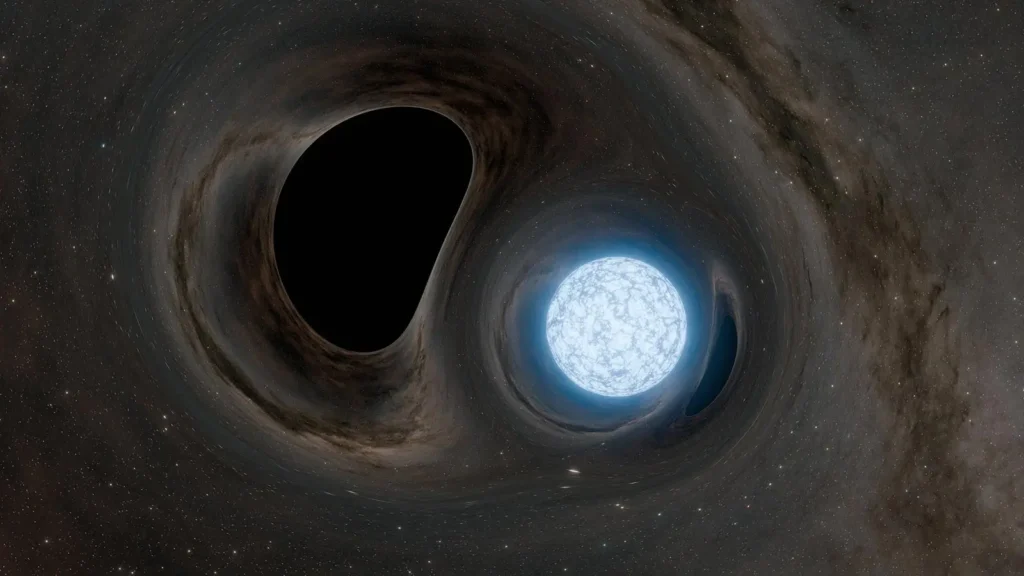
A pulsar orbiting a black hole represents one of the rarest and most valuable astronomical systems scientists can imagine. A pulsar emits extremely regular radio pulses, functioning like a natural timekeeper. When such a clock moves through intense gravity, the timing of its pulses changes in measurable ways. By tracking those tiny variations, astronomers can study how gravity bends time, alters motion, and distorts space near a supermassive black hole. In simple terms, researchers would not just observe gravity — they would measure it directly with precision.
A Pulsar Orbiting a Black Hole
| Feature | Description | Key Facts | Scientific Importance |
|---|---|---|---|
| Pulsar | Rapidly spinning neutron star emitting radio pulses | Spins in milliseconds; ultra-dense stellar remnant | Acts as a precise cosmic clock |
| Sagittarius A* | Supermassive black hole at Milky Way’s center | ~4.3 million times the Sun’s mass | Produces extreme spacetime curvature |
| Proposed System | Pulsar located close to the black hole | Detected via radio signal | Allows precision gravity testing |
| Measurement Method | Timing radio pulses | Small delays or shifts measured from Earth | Tests Einstein’s general relativity |
| Expected Outcome | Compare theory vs observation | Could confirm or challenge relativity | May reveal new physics |
What Exactly Are the Objects Involved?
The Pulsar
A pulsar forms after a massive star explodes in a supernova. The leftover core collapses into a neutron star — an object so dense that a spoonful of its material would weigh more than a mountain. As it spins, beams of radio waves shoot from its magnetic poles. When the beam crosses Earth’s line of sight, astronomers detect a pulse.
These pulses arrive with astonishing regularity. Some pulsars rotate hundreds of times per second, and the interval between pulses can be predicted with near-perfect accuracy. Because of this consistency, scientists treat pulsars as precise clocks in space.
The Supermassive Black Hole
At the center of the Milky Way sits Sagittarius A*, a black hole millions of times heavier than the Sun. Its gravitational pull bends light, stretches time, and reshapes the orbits of nearby stars. Even light struggles to escape its influence once it crosses a boundary called the event horizon.
Black holes do not merely pull objects inward. According to relativity, they curve spacetime itself. Around a supermassive black hole, the curvature becomes extreme — making it the perfect place to test gravitational physics.
Why a Pulsar Near a Black Hole Is a Scientific Jackpot
A pulsar alone is useful. A black hole alone is fascinating. But together they form an extraordinary scientific instrument.
Because a pulsar keeps time so precisely, even a tiny disturbance in spacetime will change when its pulses arrive at Earth. If the pulsar passes near the black hole, its signals will speed up, slow down, or shift slightly depending on the strength of gravity along its path.
Scientists can measure these tiny changes. Each shift reveals how gravity behaves in that region. Essentially, the pulsar becomes a probe mapping the geometry of spacetime around the black hole.
No laboratory experiment on Earth could reproduce such conditions.
What Researchers Think They Found
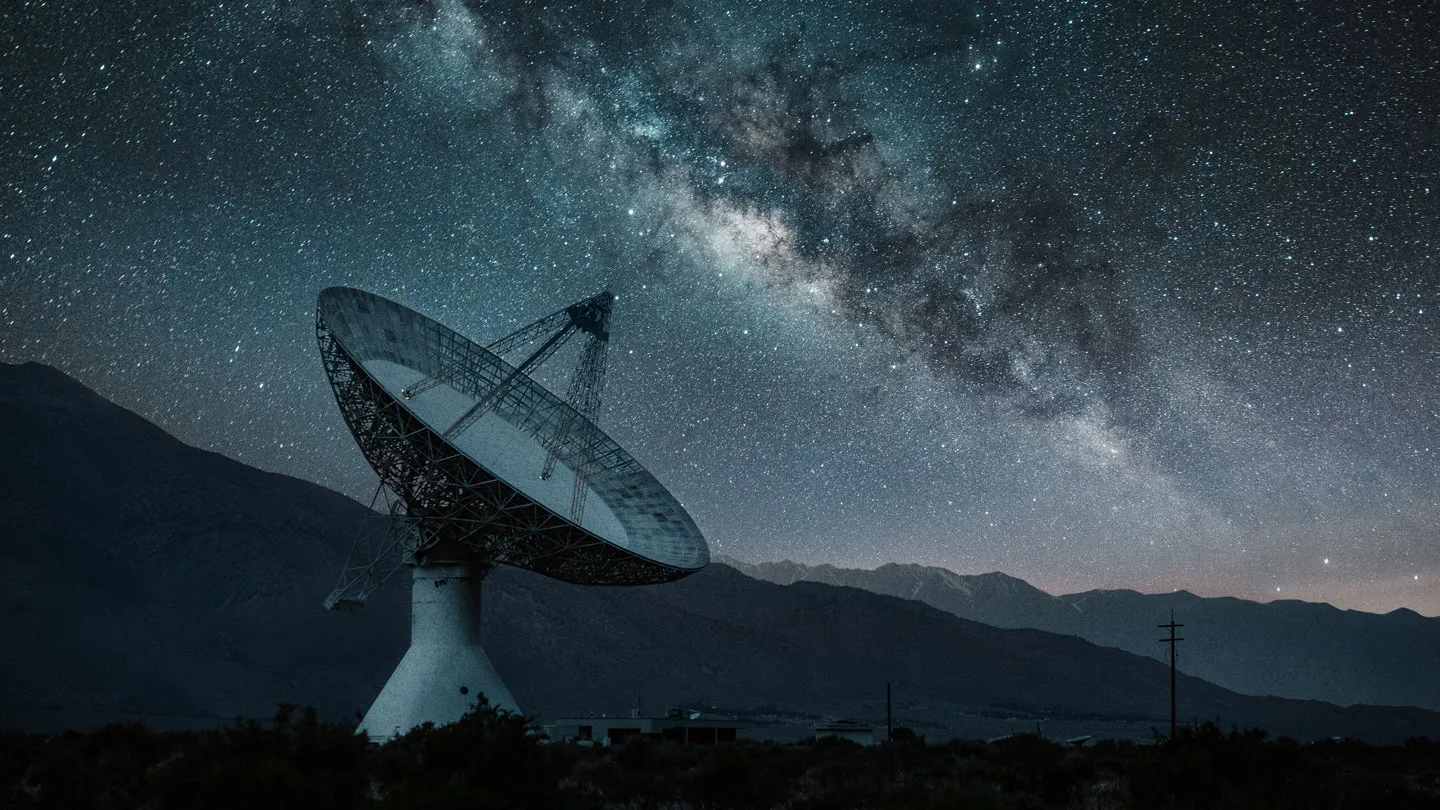
Astronomers conducting radio observations detected a repeating signal consistent with a millisecond pulsar near the galactic center. The object appears to spin in only a few milliseconds per rotation, placing it among the fastest known neutron stars.
Finding pulsars near the galactic center has been difficult. Dust and gas clouds scatter radio waves and hide signals from telescopes. For years, scientists suspected pulsars should exist there but could not detect them. This new signal offers strong evidence that at least one resides close to the central black hole.
If future observations confirm the orbit around Sagittarius A*, the system would become one of the most valuable gravitational experiments ever discovered.
What Exactly Could Be Tested?
The pulsar-black-hole system would allow researchers to evaluate several major predictions of general relativity.
Spacetime Curvature
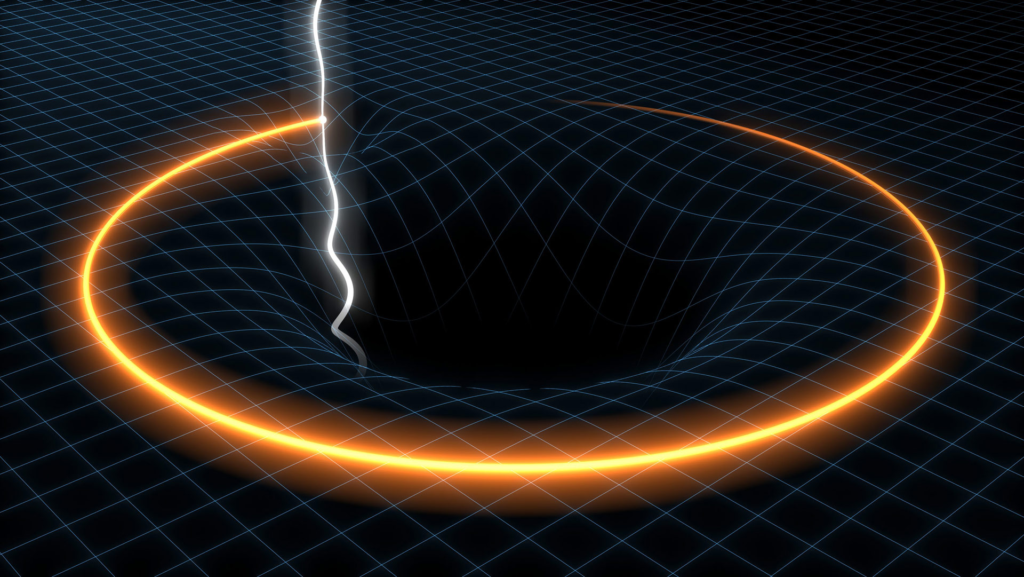
Einstein proposed that gravity is not a force pulling objects together but the bending of spacetime caused by mass. Precise timing of the pulsar’s signals could map how spacetime curves near the black hole.
Frame-Dragging
A rotating black hole should twist spacetime around it. This effect, called frame-dragging, would alter the pulsar’s orbit and timing signals. Detecting it clearly would strongly support relativity.
The No-Hair Theorem
Relativity predicts that a black hole can be described by only a few properties: mass, spin, and charge. If measurements show additional complexities, it could mean the theory is incomplete.
Extreme Gravity Testing
Most tests of relativity involve weak gravity — such as planetary motion or satellite clocks. This system would test the theory under the strongest gravitational conditions accessible in our galaxy.
Why This Is a Big Deal in Physics
Einstein’s general relativity has survived every experimental challenge for over a century. GPS satellites rely on it. Astronomical observations support it. Gravitational waves confirmed it again.
Yet physicists know the theory is incomplete. It does not fit perfectly with quantum mechanics, the framework describing particles and forces at microscopic scales. Scientists suspect that under extreme gravity, relativity might begin to show small discrepancies.
A pulsar near a supermassive black hole provides the best opportunity to look for those discrepancies. Even a tiny deviation from prediction could signal the need for a deeper theory of gravity — possibly a step toward unifying physics.
The Bottom Line
A pulsar orbiting the Milky Way’s central black hole would be more than a rare astronomical curiosity. It would function as a precision instrument placed by nature in the most powerful gravitational environment available for observation.
By tracking its radio pulses, astronomers could measure how time flows, how space bends, and how motion changes in extreme gravity. The results could strengthen Einstein’s theory once again — or reveal the first cracks in it.
Either outcome would be historic. In one case, relativity would be confirmed in its toughest test yet. In the other, physics would gain clues pointing toward a new understanding of the universe.