
Chimú Sacred Road and Temple Complex in Peru: and this discovery is reshaping how historians, archaeologists, and cultural preservation experts understand Indigenous engineering and sacred landscapes in South America. As someone who has spent years studying Native civilizations across the Americas, I can say with confidence: this isn’t just another dig in the desert. This is a window into how a powerful society organized faith, food production, governance, and community life into one unified system. Deep in Peru’s northern coastal desert, in the Chicama Valley of the La Libertad region, researchers identified a ceremonial road stretching nearly two kilometers, connected to a large temple platform, a massive plaza, and more than 100 hectares of agricultural land. The scale, alignment, and planning reflect a highly organized society operating centuries before European contact. And when we slow down and really look at it, we see something bigger than architecture—we see intention.
Table of Contents
Chimú Sacred Road and Temple Complex in Peru
The discovery of a Chimú sacred road and temple complex in Peru’s Chicama Valley is more than a remarkable archaeological finding—it’s a reminder of Indigenous innovation, leadership, and environmental intelligence. Through ceremonial planning, irrigation engineering, and centralized governance, the Chimú shaped a thriving society in one of the world’s driest coastal regions. For professionals, the implications touch urban planning, sustainability, preservation, and cultural studies. For everyday readers, the lesson is simple: ancient wisdom still carries weight. History isn’t buried—it’s waiting to be understood.
| Category | Details |
|---|---|
| Civilization | Chimú (c. AD 900–1470) |
| Location | Chicama Valley, La Libertad, Peru |
| Sacred Road Length | Approx. 2 kilometers |
| Temple Platform | 40 x 50 meters |
| Ceremonial Plaza | 100 x 80 meters |
| Agricultural Complex | 100+ hectares of irrigated fields |
| Largest Urban Center | Chan Chan (20 sq km) |
| Estimated Population | 30,000–60,000 residents at peak |
| World Heritage Status | Chan Chan designated UNESCO site |
| Official Reference | UNESCO – https://whc.unesco.org/en/list/366 |
Understanding the Chimú Civilization
To fully appreciate this discovery, we need to understand the Chimú civilization itself. The Chimú flourished along Peru’s northern coast from roughly AD 900 until their conquest by the Inca around 1470. Their capital, Chan Chan, remains the largest adobe-built city in the Americas.
According to UNESCO, Chan Chan spans nearly 20 square kilometers and reflects advanced political organization, social hierarchy, and architectural precision. Population estimates range between 30,000 and 60,000 residents during its height. That’s comparable to many major medieval cities in Europe at the same time.
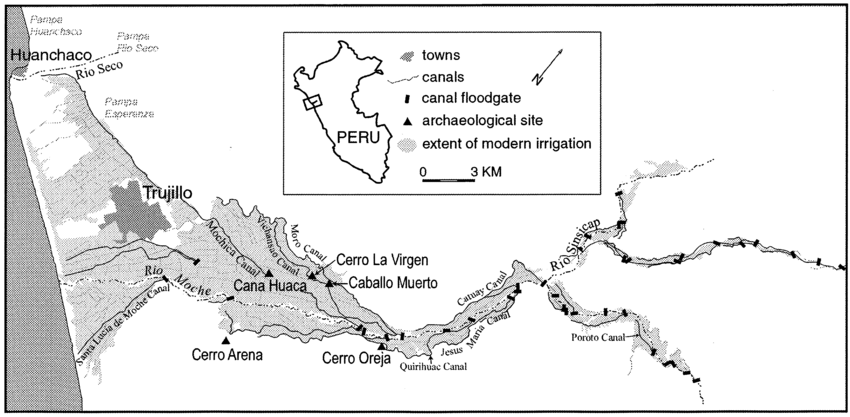
What made the Chimú stand out was their mastery of water management in one of the driest regions of South America. The Peruvian coast receives minimal rainfall, yet the Chimú constructed extensive canal systems diverting water from Andean rivers to irrigate vast desert fields. The Ministry of Culture of Peru documents how these irrigation systems supported maize, beans, squash, and cotton production.
And here’s the key point: their political power was tied directly to their control of water and agriculture.
The Sacred Road: Engineering with Spiritual Purpose
The newly identified sacred road in the Chicama Valley runs in a remarkably straight alignment across desert terrain. It is defined by carefully placed stones forming a linear geoglyph-like corridor. Archaeologists believe this was not an ordinary transport path but a ceremonial route used for ritual processions.
In many Indigenous traditions across the Americas, landscape is sacred. Mountains, rivers, and valleys are living entities connected to spiritual cosmology. The Chimú likely aligned this road with sacred hills in the surrounding valley, integrating natural geography into ceremonial practice.
From a professional archaeological standpoint, this demonstrates planned spatial organization. The road connects a fortified settlement to agricultural lands and culminates near the temple platform. That alignment suggests coordinated design rather than random expansion.
For readers in the United States, think about how Washington, D.C., was deliberately laid out with symbolic alignments and sightlines. Now imagine that level of planning happening nearly a thousand years ago in coastal Peru.
That’s sophisticated statecraft.
The Temple Platform and Plaza: A Center of Authority
Adjacent to the sacred road stands a stone platform measuring approximately 40 by 50 meters. In front of it lies a massive ceremonial plaza roughly 100 by 80 meters. The scale alone indicates this was a major gathering space.
Ceremonial plazas in Andean societies were not casual meeting spots. They were stages for political announcements, ritual offerings, seasonal festivals, and elite display. The platform likely served as an elevated space for priests or leaders during ceremonies.
Excavations in similar Chimú sites reveal evidence of offerings such as ceramics, textiles, and possibly food sacrifices tied to agricultural cycles. Archaeologists working in the region have noted that public plazas often reinforced social hierarchy—elite classes occupying elevated platforms while commoners gathered below.
From an anthropological perspective, this layout reinforces centralized authority. Control over ritual space reinforced political legitimacy.
In simpler terms? Leadership was visible. Power was public.
Agricultural Infrastructure: Feeding an Empire
More than 100 hectares of surrounding farmland were identified near the sacred complex. This confirms the integration of ceremonial life with agricultural productivity.
According to the Food and Agriculture Organization (FAO) of the United Nations, ancient Andean irrigation systems represent some of the most advanced pre-industrial agricultural engineering models in the world. Gravity-fed canals transported water across long distances, maximizing limited river flow.
The Chimú expanded these systems extensively. Their agricultural model included:
- Canal irrigation
- Furrow planting systems
- Raised field techniques
- Soil moisture management
Modern sustainability researchers studying drought resilience often reference Andean water systems as case studies. In the American Southwest, where states like Arizona and Nevada face water scarcity, engineers are examining Indigenous irrigation techniques for low-energy, sustainable alternatives.
This isn’t nostalgia. It’s applied environmental science.
Broader Historical Context of Chimú Sacred Road and Temple Complex in Peru
The Chimú were successors to the earlier Moche civilization and predecessors to Inca expansion in the region. When the Inca conquered Chimú territory around AD 1470, they absorbed much of the administrative and agricultural infrastructure into their own imperial system.
Comparatively, Inca roads are better known due to their massive scale. However, the sacred road in Chicama shows that ceremonial infrastructure predated Inca imperial highways.
For scholars, this discovery fills a gap in understanding regional political organization before Inca consolidation.
It also challenges outdated narratives that Indigenous societies were small-scale or loosely organized. The archaeological evidence says otherwise.
How Archaeologists Conducted the Chimú Sacred Road and Temple Complex in Peru Research?
The discovery involved a combination of modern technology and traditional fieldwork:
Remote sensing and drone surveys first revealed geometric alignments across the valley floor. High-resolution imagery allowed researchers to identify straight-line features invisible from ground level.
Ground teams then conducted pedestrian surveys to confirm stone placements and structural remains.
Measurements of the platform and plaza were recorded using GPS mapping tools.
Soil sampling and surface artifact collection helped identify agricultural activity and occupation patterns.
Comparative analysis linked architectural features with known Chimú construction styles at Chan Chan.
Organizations such as the Archaeological Institute of America emphasize the importance of combining aerial survey methods with ground verification. This project reflects those best practices.
Preservation Challenges
Like many archaeological sites worldwide, the Chicama Valley complex faces threats from modern development, agricultural expansion, and infrastructure projects.
Peru’s Ministry of Culture actively works to document and protect heritage sites, but enforcement challenges remain. Urban sprawl and unauthorized land use have damaged other coastal sites in the past.
In the United States, similar preservation battles occur at places like Chaco Canyon and Bears Ears National Monument. The lesson here is universal: once destroyed, archaeological heritage cannot be replaced.
Responsible stewardship requires collaboration between governments, local communities, researchers, and international organizations.
Professional Takeaways for Cultural Resource Managers
If you work in archaeology, urban planning, or heritage management, here are practical insights:
First, treat landscapes—not just buildings—as cultural assets.
Second, integrate drone mapping early in site assessment projects.
Third, understand that agricultural zones may contain ceremonial or political significance.
Fourth, advocate for buffer zones around identified archaeological features.
Finally, prioritize community consultation. Indigenous voices matter in preservation planning.
As someone who has participated in tribal consultation efforts in the U.S., I can tell you plainly: preservation works best when descendant communities are included in decision-making.
Why This Discovery Matters Globally?
The Chicama Valley sacred road reinforces three key truths:
Indigenous civilizations engineered complex societies long before European contact.
Spirituality and governance were deeply intertwined.
Environmental management was central to political power.
This discovery strengthens academic understanding while also offering lessons for modern sustainability and land management.
It reminds us that technological sophistication does not require steel skyscrapers or modern highways. It requires knowledge, organization, and vision.
And the Chimú clearly had all three.
Study Reexamines the Ritual Drink Used in the Ancient Eleusinian Mysteries
Sumerian Builders Used Bitumen Like Asphalt Over 4,000 Years Ago, Study Shows
Unexpected Inland Whale Fossils Discovered During Mammoth Research