
A Planet With Vast Water Reserves located 124 light-years from Earth is drawing global scientific attention after new measurements from the James Webb Space Telescope revealed atmospheric chemistry consistent with a massive ocean world. Researchers studying the exoplanet K2-18 b say the findings represent a major advance in evaluating whether life could exist beyond the Solar System.
Table of Contents
Planet With Vast Water Reserves
| Key Fact | Detail/Statistic |
|---|---|
| Distance from Earth | ~124 light-years |
| Planet type | Possible “Hycean” ocean world |
| Atmospheric gases detected | Methane and carbon dioxide |
| Habitable zone | Yes |
James Webb Observations and the Discovery of K2-18 b
The discovery comes from scientists analyzing James Webb Space Telescope observations. The telescope, launched in 2021, is the most powerful infrared observatory ever deployed in space and is designed to study the early universe and the atmospheres of distant planets.
K2-18 b was originally identified in 2015 by NASA’s Kepler mission. At that time, astronomers could only confirm its existence and approximate size. The new data now allow scientists to examine the planet’s exoplanet atmosphere in detail.
Astronomer Nikku Madhusudhan of the University of Cambridge led the international research team.
“This is the first strong evidence of carbon-bearing molecules in the atmosphere of a habitable-zone planet,” he said in the research publication.
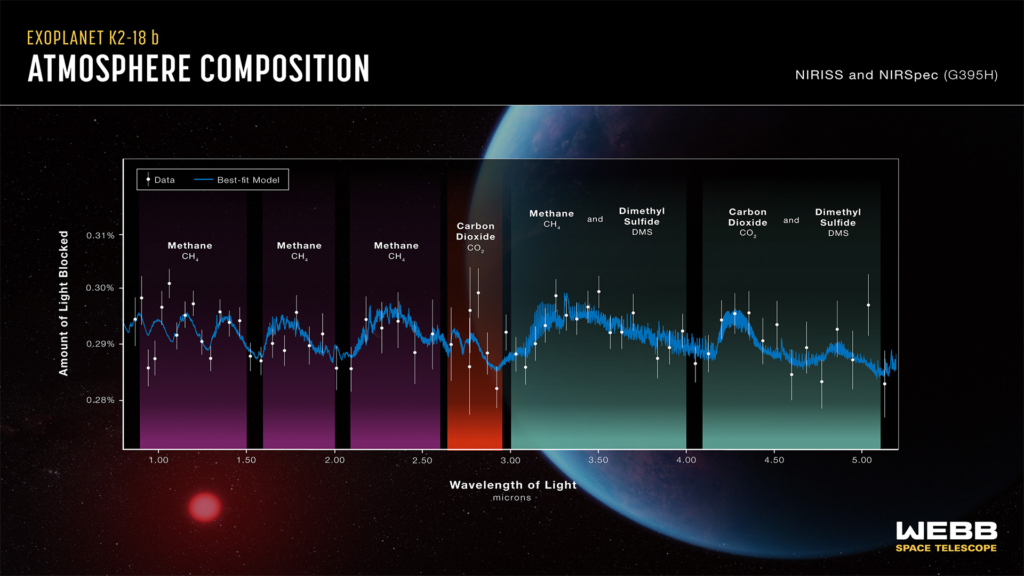
Using a technique known as transit spectroscopy, scientists observed light from the planet’s host star filtering through the atmosphere as the planet passed in front of it. Different gases absorb specific wavelengths, leaving identifiable chemical fingerprints.
The team detected methane and carbon dioxide. The absence of ammonia was equally important. According to atmospheric models, that combination strongly suggests the presence of a large body of liquid water.
What Scientists Mean by a Planet With Vast Water Reserves
The phrase Planet With Vast Water Reserves does not mean rivers, lakes, or continents like Earth.
Instead, scientists believe K2-18 b could be a “Hycean” world — a theoretical class of planets covered by a deep global ocean beneath a thick hydrogen atmosphere.
K2-18 b is:
- 8.6 times Earth’s mass
- 2.6 times Earth’s diameter
- Orbiting a cool red dwarf star
Because the star emits less energy than the Sun, the planet orbits much closer while still remaining in the habitable zone, where temperatures could allow liquid water.
Researchers believe its surface might resemble a permanent ocean stretching across the entire planet.
“The models are most consistent with a water ocean under a hydrogen-rich atmosphere,” Madhusudhan explained.
However, conditions would likely differ dramatically from Earth. Surface pressure could be extremely high, and clouds may permanently cover the sky.
Possible Biological Signals
The most debated aspect of the study involves a tentative detection of dimethyl sulfide (DMS).
On Earth, DMS is produced mainly by microscopic marine organisms such as phytoplankton. Because of that association, scientists consider it a potential biosignature gas.
Researchers emphasize caution.
“We are not claiming life,” Madhusudhan said. “We are reporting something interesting that needs confirmation.”
Planetary scientist Christopher Glein noted that non-biological chemical reactions could also generate similar molecules.
Future observations by the James Webb Space Telescope are scheduled to verify the signal. If confirmed, it would become one of the strongest indirect indicators of biological activity beyond Earth.
Why the Discovery Matters for the Search for Extraterrestrial Life
For decades, astronomers searched mainly for planets identical to Earth. The new findings shift the strategy.
Scientists now believe ocean worlds may be far more common than rocky planets.
The search for extraterrestrial life therefore may focus on water-rich planets orbiting small stars. Red dwarf stars make up about 70% of the Milky Way galaxy.
If many of those systems host ocean planets, habitable environments could be widespread.
NASA scientists say the telescope now enables atmospheric analysis rather than simple detection.
“We are entering an era of planetary climate science beyond our Solar System,” a NASA mission statement explained.
How the James Webb Space Telescope Made the Discovery
The James Webb Space Telescope orbits about 1.5 million kilometers from Earth at a location called the Sun-Earth Lagrange Point 2. Its massive sunshield protects its instruments from heat, allowing extremely sensitive infrared measurements.
Infrared light is essential because molecules absorb energy in that wavelength range. This allows scientists to identify gases such as methane, carbon dioxide, and water vapor.
Before Webb, earlier telescopes like Hubble could detect water vapor hints but lacked the precision to confirm atmospheric composition.
Webb’s instruments — particularly NIRSpec and NIRISS — allowed detailed measurements that made the Planet With Vast Water Reserves hypothesis plausible.
Historical Context: The Search for Other Worlds
The idea of planets beyond the Solar System remained unproven until 1995, when astronomers discovered the first confirmed exoplanet orbiting a Sun-like star.
Since then, discoveries accelerated rapidly:
- 2009: Kepler mission launched
- 2015: K2-18 b discovered
- 2021: James Webb Space Telescope launched
- 2023–2025: Detailed atmospheric studies begin
More than 5,500 exoplanets have now been confirmed.
However, most detections provided only size and orbit. Webb allows researchers to investigate planetary environments directly.
Could Humans Ever Visit?
Even if habitable, K2-18 b is far beyond practical travel distance.
At current spacecraft speeds, reaching it would take tens of thousands of years.
Additionally, scientists believe the environment would be unsuitable for humans:
- Possibly crushing atmospheric pressure
- No breathable oxygen
- Potentially high temperatures
The research is therefore about understanding life in the universe, not colonization.
Scientific Debate and Caution
Some researchers warn against overinterpretation.
Atmospheric measurements are extremely delicate. Signals can be influenced by stellar activity, instrument noise, or data modeling assumptions.
Astronomers stress that multiple observations are required before any strong biological conclusion.
“The extraordinary claims require extraordinary evidence,” Glein said.
This cautious approach reflects the history of astronomy, where previous potential biosignatures — including Mars methane — later proved uncertain.
What Happens Next
Scientists plan additional JWST observations over the coming years. They will attempt to:
- Confirm DMS detection
- Measure water vapor more precisely
- Estimate temperature and pressure
Future telescopes, including the European Extremely Large Telescope and NASA’s proposed Habitable Worlds Observatory, may provide even more detailed data.
If similar planets show comparable chemistry, the case for ocean worlds supporting life would strengthen.
Outlook
The discovery of a Planet With Vast Water Reserves marks a turning point in astronomy. Researchers now study planetary habitability directly instead of speculating from distance alone.
Madhusudhan summarized the significance:
“The universe may be rich with environments suitable for life. We are finally gaining the tools to find out.”
FAQs About Planet With Vast Water Reserves
Is life discovered on K2-18 b?
No. Scientists detected possible chemical hints but no confirmed biological activity.
Why is water important?
Liquid water is essential for known biological chemistry and is considered a primary requirement for life.
Why can’t we see the ocean directly?
The planet is too distant and covered by clouds. Scientists infer oceans from atmospheric chemistry.
Could Earth-like animals live there?
Highly unlikely. Conditions would probably support only microscopic organisms, if any life exists.