
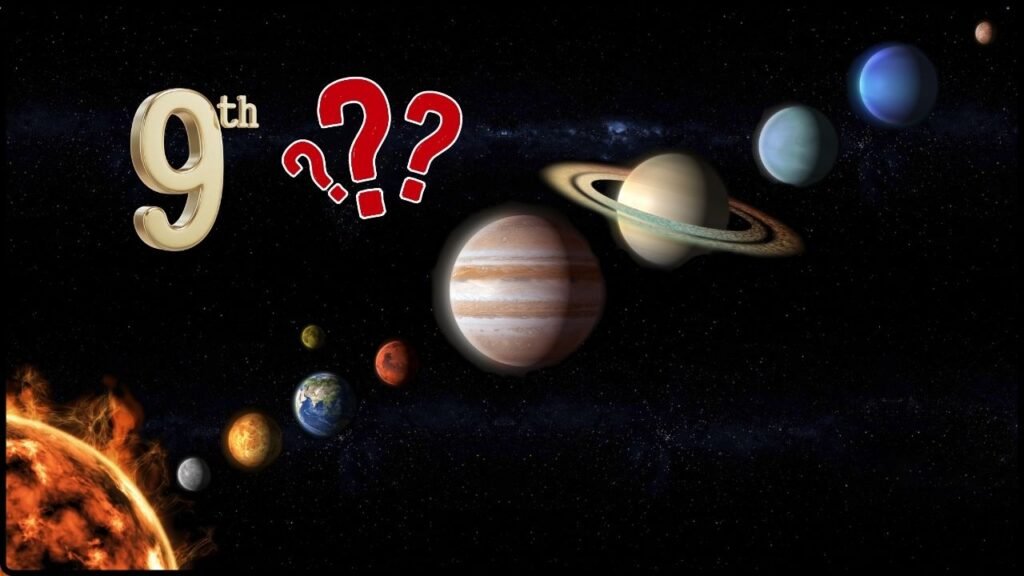
Possible Ninth Planet Beyond Neptune: The phrase “Planet Nine” has been buzzing in science circles and across the internet like a New York City subway train at rush hour. Astronomers, physicists, and space enthusiasts have been chasing clues about a mysterious world beyond Neptune—a hidden planet that could reshape what we know about our own cosmic backyard. In this article, we’re going to break it all down plain and simple, like sharing cool space facts with your cousin at a Fourth of July barbecue — but with expert, data‑backed reporting that even pros can rely on. We’ll explore what Planet Nine is, why it matters, the science behind the search, the latest evidence (both promising and puzzling), and what’s coming next. Along the way, we’ll dive into practical examples, historical context, and professional insights that make the topic approachable for beginners and valuable for experts.
Table of Contents
Possible Ninth Planet Beyond Neptune
The hunt for Planet Nine is a cosmic detective story—a tale of mystery, cutting-edge science, and patient observation. While no one has seen it directly, gravitational hints and sophisticated simulations suggest it may indeed be out there, lurking in the dark reaches of the Solar System. The search teaches valuable lessons about teamwork, patience, and scientific rigor. Whether Planet Nine is confirmed or disproven, the journey itself expands our understanding of the vast, strange, and fascinating universe we call home.
| Topic | Details |
|---|---|
| Hypothetical Planet | Planet Nine (aka Planet X) |
| Proposed Mass | ~5–10× Earth’s mass |
| Estimated Distance from Sun | ~400–1,500 AU* |
| Orbit Cycle | ~5,000–12,000+ years |
| Where Evidence Comes From | Orbits of distant icy bodies |
| Current Status | Not yet directly detected |
| Official Info | NASA Planet Nine Overview |
| Latest Survey Projects | Vera C. Rubin Observatory, Subaru Telescope |
| Dwarf Planet Challenge | New discovery Ammonite complicates orbit patterns |
What Is a Possible Ninth Planet Beyond Neptune?
Right up front: Planet Nine is a hypothetical planet—meaning astronomers haven’t seen it yet with a telescope, but we think it might be out there. This idea popped up because of strange behavior in the outer reaches of the Solar System, in the icy realm of objects called trans‑Neptunian objects (TNOs). These distant bodies orbit the Sun in ways that don’t totally add up — unless something big, like a planet, is tugging on them with gravity.
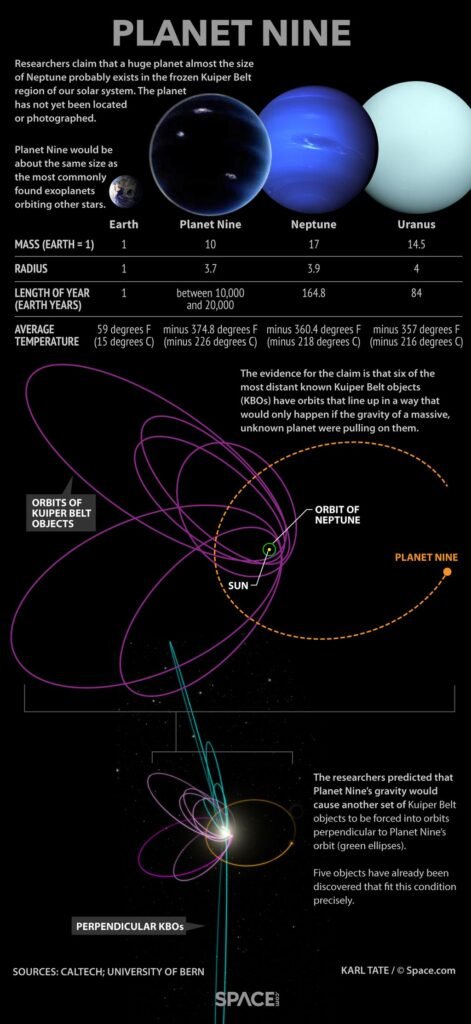
According to scientific analyses, this speculated world could be about 5–10 times the mass of Earth and orbit the Sun hundreds of times farther away than we are. That’s far beyond Pluto, in a part of space that we’ve only just started to explore. Its orbit could take 5,000–12,000 years to complete a single loop around the Sun. The planet would be in a region with very little sunlight, making it incredibly dim and extremely difficult to spot with conventional telescopes.
But here’s the kicker: No one’s actually seen Planet Nine with a telescope yet. Every clue so far is circumstantial—like finding giant footprints in the snow but not spotting the creature that made them. Still, the search is serious science, not science fiction.
The Story So Far: How This All Started
The story of Planet Nine is a fascinating mix of astronomy, detective work, and a little luck. Back in the early 2010s, astronomers noticed something odd in the far reaches of the Solar System. Groups of icy objects beyond Neptune were lining up in space in a way that shouldn’t happen by chance. Imagine throwing a handful of rocks into a field and watching them all land in a perfect circle—pretty weird, right?
In 2016, scientists Konstantin Batygin and Mike Brown at the California Institute of Technology published a paper suggesting these orbital oddities could be explained by a massive planet lurking far beyond known planets. They called it Planet Nine, a nod to its potential role as the ninth major planet of the Solar System.
This wasn’t just armchair speculation — it was grounded in mathematical models, gravitational simulations, and years of meticulous observation. Since then, Planet Nine has sparked debates, inspired searches, and captured the imagination of astronomers and the public alike.
Why Scientists Think of a Possible Ninth Planet Beyond Neptune?
Even though no one has seen Planet Nine, there are several reasons scientists believe it might exist. These come from both observational evidence and computer simulations.
1. Clustered Orbits of Distant Objects
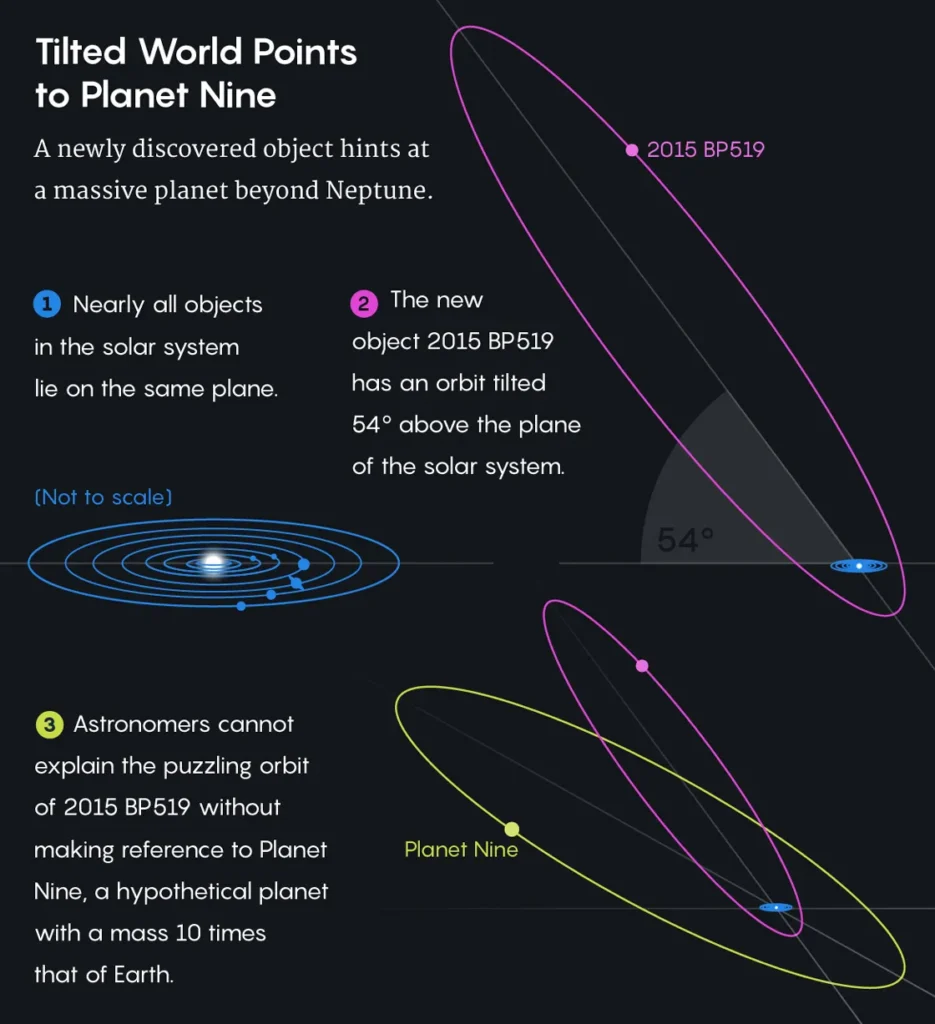
Many icy bodies beyond Neptune have orbits that are strangely aligned, almost like they’re being shepherded by something massive. This gravitational nudging could explain why their orbits tilt and curve in ways that would otherwise seem random. Without a massive influence, these alignments would be statistically unlikely.
2. Simulations Match Observations
Computer models show that a planet with roughly 5–10 Earth masses, orbiting far from the Sun, could produce exactly the patterns observed in the outer Solar System. Astronomers have even narrowed down the most likely regions of the sky where Planet Nine could be hiding, which helps guide telescope searches.
3. Infrared and Archival Sky Surveys
Infrared surveys, such as IRAS and AKARI, scan the entire sky and can detect faint heat from distant objects. Comparing data taken decades apart, researchers have spotted slow-moving faint objects that could match the predicted signature of Planet Nine. While these findings are preliminary, they offer a tantalizing hint that the planet might be out there, just waiting to be found.
How Astronomers Are Searching for a Possible Ninth Planet Beyond Neptune?
The hunt for Planet Nine is a mix of high-tech instruments, smart simulations, and even citizen science. Here’s how researchers are tackling this cosmic challenge:
Subaru Telescope (Hawaii)
The Subaru Telescope has one of the largest mirrors in the world and a wide field of view, making it ideal for scanning large areas of the sky. Astronomers can capture faint objects and track their movement across the sky over time, which is crucial for detecting something as dim and distant as Planet Nine.
Vera C. Rubin Observatory (Chile)
This next-generation observatory is designed to survey billions of objects in the sky. Its massive camera can take 1,000 images per night, effectively creating a time-lapse of the sky. The observatory will be a game-changer in the search for distant planets, providing the depth and coverage necessary to spot slow-moving, faint objects far from the Sun.
Citizen Science and Crowd-sourced Projects
Some astronomers are enlisting everyday people to help. Platforms like Zooniverse allow volunteers to analyze sky images, helping scientists sift through huge amounts of data. This collaboration has led to discoveries in the past and may play a role in finally spotting Planet Nine.
Challenges and Controversies
While the evidence is compelling, Planet Nine is still hypothetical. Scientists face several challenges:
Direct Detection Is Missing
No telescope has captured Planet Nine directly yet. Detecting a planet so distant is extremely hard because sunlight is weak that far out, and the planet may be dark and reflective only in infrared wavelengths.
New Discoveries Complicate the Picture
In 2025, a distant dwarf planet nicknamed Ammonite was discovered, with an orbit that didn’t quite fit the patterns Planet Nine was supposed to explain. These new findings suggest the outer Solar System may be more chaotic and complex than previously thought.
Alternative Explanations
Some researchers argue that the observed orbital alignments could be due to observation bias—we’re only seeing the objects we happen to have looked at. Others propose modifications to gravitational models or other physics-based explanations that don’t require a new planet at all.
Practical Lessons From the Planet Nine Hunt
Even if Planet Nine remains elusive, the search teaches valuable lessons for both professional and amateur astronomers:
- Use of Advanced Modeling – Gravitational simulations help predict where unknown objects may be, highlighting the importance of computational astrophysics.
- Persistence Pays Off – Searching for something thousands of AU away requires patience, decades of observation, and international collaboration.
- Collaboration Is Key – Both large observatories and citizen scientists contribute to progress, showing how teamwork accelerates discoveries.
- Question Everything – Just because an orbit looks odd doesn’t guarantee a new planet. Skepticism is part of scientific rigor.
China Faces a Space Crisis as Top Astronauts Remain Stuck in Orbit
Astronomers Spot a Lemon-Shaped World That Defies Traditional Planet Models
SpaceX’s Next-Gen Super Heavy Booster Survives Four Days of Extreme Cryogenic Testing