
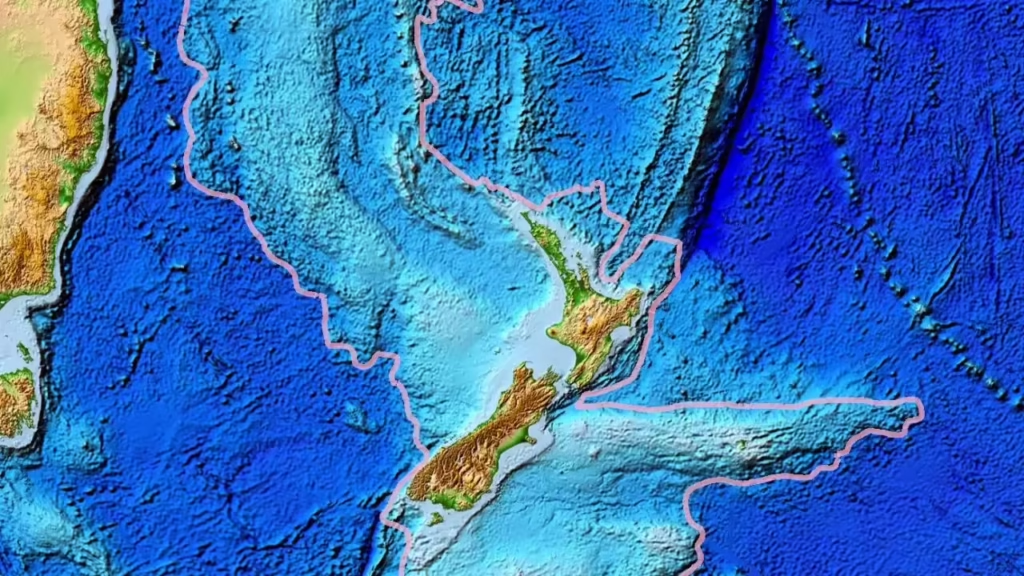
For generations, classrooms taught that Earth contains seven continents. Now Zealandia’s Hidden Landmass is prompting scientists to reconsider that assumption. Geological mapping and ocean drilling confirm that a vast, mostly underwater region in the southwest Pacific possesses the structure of a continent. The discovery is reshaping understanding of continental formation, tectonic movement, and the geological history of the planet.
Table of Contents
Zealandia’s Hidden Landmass
| Key Fact | Detail / Statistic |
|---|---|
| Size | About 4.9 million square kilometers |
| Above water | Roughly 5–6% visible land |
| Origin | Broke from Gondwana ~80 million years ago |
Researchers continue mapping the Pacific seabed with improved instruments. Future expeditions aim to drill deeper and reconstruct the continent’s complete geological timeline. As exploration expands, scientists say Zealandia’s Hidden Landmass may help answer one of Earth science’s biggest questions: how continents are born, change, and eventually vanish beneath the oceans.
Zealandia’s Hidden Landmass Is Changing How Scientists View Earth’s Continents
Scientists increasingly agree Zealandia qualifies as a continent because it meets the same geological criteria as Africa, Antarctica, and Australia.
“Continents are defined by their crust, not by sea level,” said Dr. Nick Mortimer, a geologist with New Zealand’s Crown Research Institute GNS Science and lead author of a major classification study published by the Geological Society of America.
Unlike oceanic crust, which is thin and basalt-based, continental crust is thicker and composed largely of granite and metamorphic rock. Researchers have now identified those characteristics beneath the Pacific seafloor.
The discovery clarifies why New Zealand experiences frequent earthquakes and volcanic activity. The islands are not isolated oceanic formations, scientists say. They are elevated fragments of a larger geological plate.
In simple terms, New Zealand is not a remote island chain — it is the exposed high ground of a submerged continent.
How Scientists Proved It Exists
For decades, geologists suspected a missing continent in the southwest Pacific, but technological limits prevented confirmation. The turning point came in the 1990s and 2000s when satellites began mapping Earth’s gravity field in detail.
Variations in gravitational pull revealed thicker crust hidden beneath the ocean.
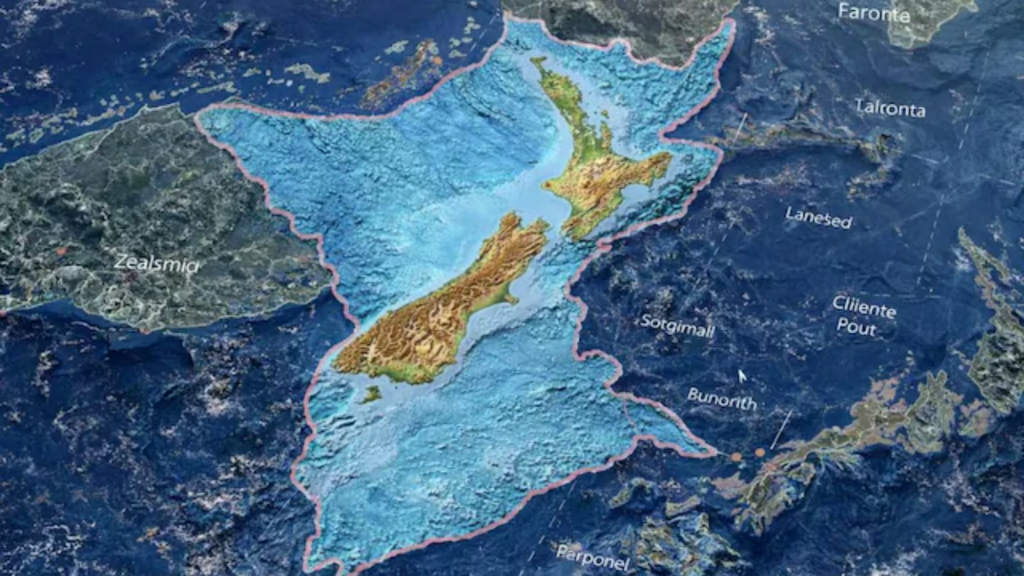
Researchers later conducted deep-sea drilling through the International Ocean Discovery Program (IODP). Rock cores retrieved from beneath the seabed contained limestone, sandstone, and granite — rock types typically formed on continents, not on ocean floor.
Marine geologist Dr. Gerald Dickens of Rice University said the samples were decisive.
“The rocks tell the story,” Dickens explained in a research briefing. “They formed in shallow seas and on land. That cannot happen on normal oceanic crust.”
Fossilized pollen and microscopic marine organisms found in sediment layers indicate forests and coastal ecosystems once existed across parts of Zealandia tens of millions of years ago.
Why It Sank
Zealandia separated from the supercontinent Gondwana around 80–83 million years ago, during the late Cretaceous period. At the time, dinosaurs still dominated Earth.
When tectonic plates began pulling apart, the crust stretched dramatically. The thinning reduced buoyancy, causing the landmass to slowly sink.
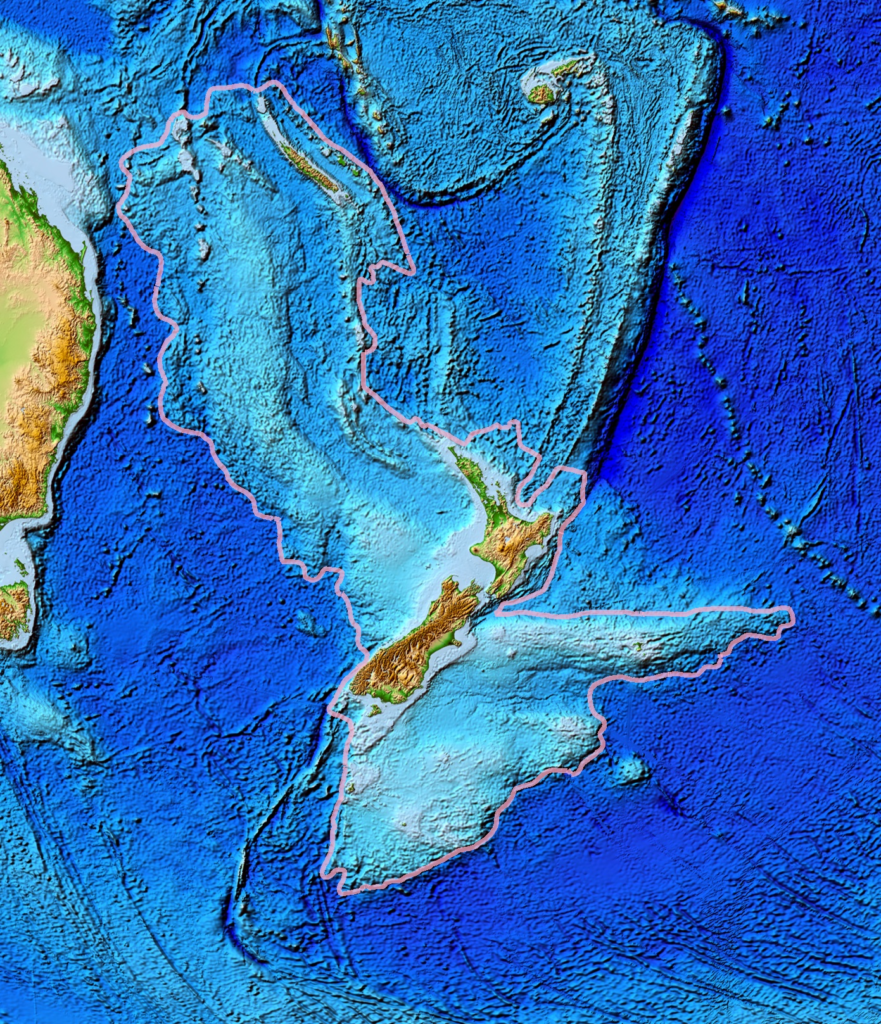
Scientists compare the process to floating wood. Thick wood floats high, thin wood sinks lower. Zealandia’s crust became unusually thin — about half the thickness of typical continents.
Today, approximately 95% of the submerged continent lies beneath 1 to 2 kilometers of ocean water.
A Shift in Geological Thinking
Recognition of Zealandia challenges long-standing geographic assumptions.
Historically, continents were identified visually — large landmasses above water separated by oceans. Zealandia demonstrates this definition is incomplete.
“This forces a change in perspective,” said Dr. Julie Rowland, an Earth science professor at the University of Auckland. “Continents are geological entities. Water coverage is secondary.”
The discovery has also influenced plate tectonics research. Zealandia sits along the boundary between the Pacific Plate and the Australian Plate, one of the most active tectonic regions on Earth.
Scientists now believe its unusual structure contributes to New Zealand’s earthquakes and volcanic systems.
A Window Into Earth’s Ancient Climate
Zealandia is also helping scientists reconstruct Earth’s past climate.
Sediment samples show that parts of the continent were once subtropical and warm. Fossil plant remains suggest forests similar to modern southern Chile or southeastern Australia.
Researchers discovered that around 50 million years ago, much of Zealandia briefly rose closer to the ocean surface, forming island chains. Those islands may have served as migration pathways for animals and plants between Antarctica and Australia.
Climate scientists use this evidence to refine models of prehistoric greenhouse climates, when global temperatures were higher than today.
Unique Wildlife and Biological Clues
The continent’s isolation produced unusual biodiversity. Species in New Zealand evolved separately for tens of millions of years after Zealandia sank.
Flightless birds such as the kiwi and extinct moa, as well as ancient reptiles like the tuatara, may owe their survival to Zealandia’s isolation.
Biologists believe the submerged continent functioned as a “biological time capsule.” With limited predators and no land mammals, ecosystems evolved differently from the rest of the world.
Scientists studying evolutionary biology now use Zealandia as a natural laboratory to understand species survival after continental breakup.
Indigenous Knowledge and Cultural Context
For Māori communities in New Zealand, stories of ancient lands beneath the ocean predate modern geology.
Traditional oral histories describe lost territories and changing shorelines after great floods. While not scientific evidence, researchers say these accounts reflect long-term observations of rising seas and shifting coastlines.
Some archaeologists now collaborate with Indigenous historians to understand coastal changes over thousands of years.
Modern Exploration Technology
The confirmation of Zealandia became possible only with modern tools:
- Satellite gravimetry
- Deep-sea robotic submersibles
- Seismic imaging
- High-pressure ocean drilling
These technologies allow scientists to map the seabed in greater detail than the surface of Mars in some regions.
Researchers are still charting sections of the Pacific Ocean, suggesting additional continental fragments may remain undiscovered.
Broader Implications for Earth Science
The discovery affects several scientific fields:
- Plate tectonics modeling
- Earthquake hazard assessment
- Paleoclimate reconstruction
- Evolutionary biology
- Ocean circulation studies
Oceanographers also study whether Zealandia influenced global ocean currents, which regulate climate patterns.
Some models suggest its gradual sinking altered Pacific circulation and may have affected ancient climate cooling events.
Economic and Political Implications
Zealandia also has geopolitical importance. Under the United Nations Convention on the Law of the Sea (UNCLOS), countries may claim extended seabed territory if they prove geological continuity of continental crust.
New Zealand has submitted geological evidence to support expanded maritime boundaries.
Such recognition could affect access to seabed minerals, rare earth elements, and deep-sea energy resources.
Is It Officially the Eighth Continent?
There is no international organization that formally designates continents. Instead, scientists rely on consensus.
Most geologists now accept Zealandia as a continent geologically, though educational materials vary worldwide.
“Science is evidence-based,” Mortimer said. “Zealandia fits every continental definition we use.”
FAQ
Is Zealandia visible above water?
Only about 5–6% is visible, mainly New Zealand and New Caledonia.
Why wasn’t it discovered earlier?
Because most of it lies nearly a mile beneath the ocean surface and required satellite mapping and drilling technology.
Does this mean Earth has eight continents?
Geologically, many scientists say yes. Educational definitions still vary.