
Archaeologists say Prehistoric Artists Carved Geometric Patterns on ostrich eggshell containers about 60,000 years ago, providing new evidence that early Homo sapiens in southern Africa practiced symbolic communication and shared cultural traditions. The discovery suggests organized social identity existed far earlier than once believed during the Middle Stone Age.
Table of Contents
Prehistoric Artists Carved Geometric Patterns on Eggshells
| Key Fact | Detail |
|---|---|
| Artifact Age | About 60,000 years old |
| Object Type | Ostrich eggshell water containers |
| Main Significance | Early symbolic communication and social identity |
What Scientists Found
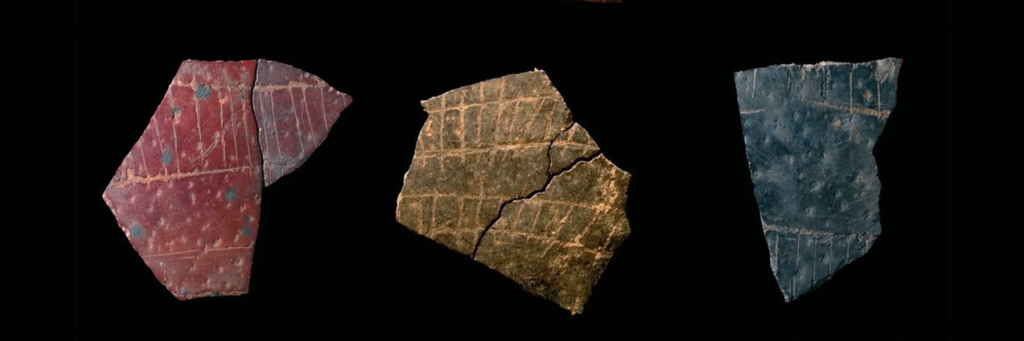
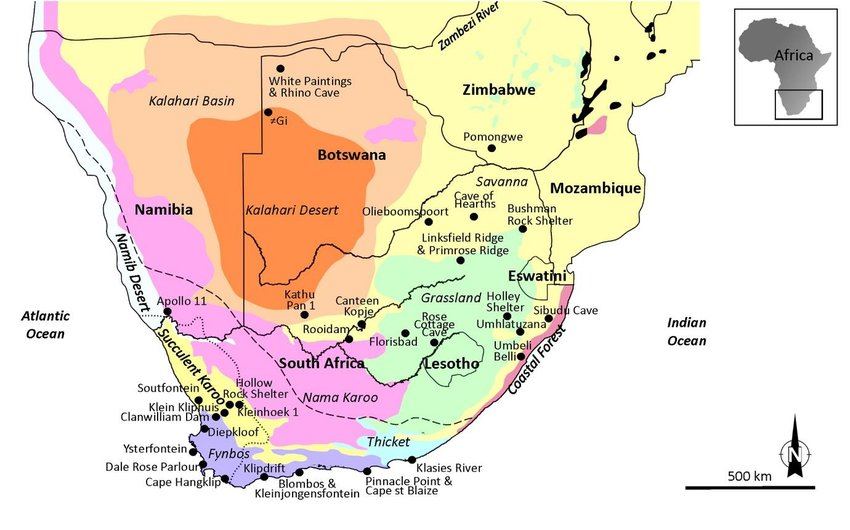
Researchers excavating Middle Stone Age rock shelters in southern Africa recovered hundreds of fragments of ostrich eggshell containers. Careful laboratory reconstruction revealed deliberate engravings forming repeating geometric designs.
The carvings include parallel lines, cross-hatching, chevron patterns, and banded motifs. Scientists determined the markings were intentional because grooves show consistent angles, depth, and spacing.
Microscopic analysis also showed the lines were carved before the eggshells broke, confirming the designs were created while the containers were intact.
“These patterns were planned and repeated,” one archaeological researcher noted in a published analysis. “They represent deliberate marking, not accidental wear.”
The containers themselves were practical tools. Hunter-gatherers drilled a small opening in the shell, emptied the contents, and used the hardened shell as a portable water bottle. Each could carry approximately one liter of water.
Because groups traveled long distances across seasonal landscapes, water storage was critical for survival.
Why the Prehistoric Artists Carved Geometric Patterns Discovery Matters
For much of the twentieth century, archaeologists believed symbolic behavior emerged in Europe roughly 40,000 years ago alongside cave paintings such as those in France and Spain.
The Prehistoric Artists Carved Geometric Patterns discovery pushes that timeline back at least 20,000 years and relocates its origin firmly to Africa.
Geometric engraving requires planning. The maker must envision a pattern before carving. That suggests memory, teaching, and shared understanding.
Scientists therefore view the markings as evidence of symbolic communication, meaning information was transmitted visually between individuals.
Evidence of Culture, Not Just Survival
A decorated container does not improve hunting ability. Its purpose lies in communication.
Researchers believe the designs may have served several functions:
- marking ownership
- identifying family or clan groups
- signaling social relationships
- strengthening cooperation between communities
Anthropologists compare the behavior to modern practices such as uniforms, national flags, or logos. These items convey belonging without spoken words.
“This indicates people recognized group membership,” one cognitive archaeology interpretation explained. “That is a cultural behavior.”
How Archaeologists Dated the Artifacts
Determining the age of the engravings required multiple scientific techniques.
Researchers used:
- stratigraphy (studying soil layers)
- optically stimulated luminescence dating
- comparison with known Middle Stone Age tools
Sediments surrounding the artifacts were analyzed to determine when they were last exposed to sunlight. That provided a reliable age estimate of about 60,000 years.
The eggshell fragments were found alongside stone tools typical of the Howiesons Poort technological tradition, a period associated with advanced toolmaking.
This combination allowed scientists to confirm both the age and cultural context of the artifacts.
Connections to Other Early Symbolic Behavior (human evolution)
The discovery fits within a growing body of evidence about human evolution showing complex thinking emerged gradually.
Earlier discoveries include engraved ochre pieces dating roughly 75,000–100,000 years old. Those objects also display deliberate patterning.
Together, the findings suggest early humans experimented with visual symbols long before written language.
Archaeologists now increasingly argue that cognitive modernity developed over tens of thousands of years, rather than appearing suddenly.
Daily Life in the Middle Stone Age (Middle Stone Age culture)
The Middle Stone Age was not a primitive period as once imagined. People hunted medium-sized animals, gathered plants, made specialized tools, and traveled seasonally.
Climate shifts forced groups to move between inland plains and coastal regions. Water availability determined migration routes.
Portable containers were essential technology.
Decorating the containers may have helped avoid conflict. When groups met near water sources, visible markings could quickly signal identity and social affiliation.
Anthropologists studying modern hunter-gatherers observe similar practices today.
How the Patterns Were Made
Researchers examined grooves under microscopes and concluded sharp stone tools were used to incise the shells.
The artist likely:
- cleaned the shell
- planned the layout
- carved slowly to avoid cracking
- repeated the design across the surface
Because eggshells are fragile, engraving them required skill and patience.
Scientists also note that repeated motifs appear across multiple archaeological layers spanning generations. That means knowledge was taught.
Teaching is considered a key sign of advanced cognition.
Comparing the Eggshell Art to Cave Paintings
The engravings differ from later cave paintings in an important way: they are portable.
Cave art remains in one location. Decorated objects travel with people.
Portable art suggests daily social interaction rather than ritual alone. Individuals carried these symbols during travel, trade, and encounters with strangers.
This strengthens the argument that the markings were part of everyday communication.
Implications for Human Intelligence (symbolic communication)
Scientists often define modern thinking by the ability to use symbols. A symbol represents something beyond itself.
Repeated geometric patterns imply shared rules. Two individuals must interpret the mark similarly for it to have meaning.
That requires:
- memory
- teaching
- agreement within a group
Therefore, the eggshells provide some of the clearest evidence that early humans communicated ideas visually.
Broader Anthropological Significance
The research contributes to a major scientific debate: when humans began behaving like modern people.
Older theories proposed a sudden “human revolution.” New evidence instead shows gradual cultural accumulation.
Technological innovations, art, and social cooperation appear earlier in Africa than previously recognized.
Many scientists now believe Africa was not only the birthplace of humans biologically, but also culturally.
Ongoing Research
Scientists are now analyzing microscopic wear patterns to determine how often the containers were used.
They are also searching for pigment residue. Some researchers suspect the engravings may have been filled with colored material to increase visibility.
Future discoveries could reveal whether different communities developed unique design traditions, similar to regional art styles.
What Scientists Still Do Not Know
Researchers cannot determine the exact meaning of the designs. Unlike written language, prehistoric symbols cannot be directly translated.
However, archaeology focuses on behavior rather than interpretation.
The presence of repetition, teaching, and standardization is enough to demonstrate shared cultural knowledge.
Final Context
The engravings show early humans interacting socially in organized ways. Even without writing, people were exchanging information through visual symbols.
Rather than isolated survival groups, they were communities with traditions.
One archaeologist summarized the importance: the objects show humans already understood identity and belonging tens of thousands of years earlier than once assumed.
FAQs About Prehistoric Artists Carved Geometric Patterns on Eggshells
Q: Were these cave paintings?
No. They were carved onto portable water containers made from ostrich eggshells.
Q: Why geometric patterns?
Simple shapes are easy to reproduce and recognize, making them effective shared symbols.
Q: Do we know their exact meaning?
No. Scientists can identify symbolic behavior but cannot translate the symbols.
Q: Why is this important?
It helps explain when human culture and organized social identity first appeared.