
A revised U.S. Citizenship Test will become harder for most immigrants applying for naturalization, but older long-term residents will face a shorter and simpler exam under updated federal rules. The changes, issued by the U.S. Citizenship and Immigration Services (USCIS), aim to expand civics knowledge requirements while preserving long-standing accommodations for senior applicants.
Table of Contents
Shorter U.S. Citizenship Test Under Updated Rules
| Key Fact | Detail |
|---|---|
| New civics exam | Applicants must answer 12 of 20 questions correctly |
| Senior exemption | Age 65+ with 20 years of residency gets simplified test |
| Language flexibility | Certain older applicants can test in native language |
USCIS officials say the agency will review outcomes and adjust procedures if necessary. Immigration experts expect policymakers to watch closely whether the revised exam affects citizenship application rates among eligible residents, particularly among elderly immigrants who depend on the simplified U.S. Citizenship Test accommodations.
What Changed in the U.S. Citizenship Test
The U.S. Citizenship and Immigration Services (USCIS) redesigned the civics portion of the naturalization process, the final step toward becoming an American citizen. Officials say the updated system is intended to ensure applicants demonstrate a stronger understanding of American government, history, and civic responsibilities.
Previously, applicants answered 10 questions drawn from a list of 100. Under the new structure, applicants may be asked up to 20 questions selected from a larger pool, and must correctly answer at least 12 to pass.
USCIS has said officers may stop the interview early once the applicant passes or fails the required threshold, shortening some interviews while making the test itself more rigorous.
The agency described the update as part of a periodic review process. In its public guidance, USCIS stated the goal is to “promote civic integration and understanding of democratic principles.”
What Topics Are Covered
The updated U.S. Citizenship Test covers three broad categories:
- American Government
- Principles of the Constitution
- Branches of government
- Rights and responsibilities of citizens
- American History
- Colonial period and independence
- Civil War and Reconstruction
- 20th-century global conflicts and social movements
- Integrated Civics
- Geography and national symbols
- National holidays
- Civic participation, including voting
Immigration educators say the revised exam places more emphasis on how government actually functions, rather than only memorizing facts.

Why Older Applicants Will Take a Shorter Exam
Despite the broader expansion, older immigrants will receive special consideration under existing federal policy. These accommodations apply to applicants who have lived in the United States for long periods as permanent residents.
The “65/20 Rule”
Applicants who are:
- At least 65 years old, and
- Permanent residents for 20 years or more
qualify for a reduced civics test.
They study a smaller list of questions and are typically asked only 10 during the interview. They must answer six correctly to pass. They may also use an interpreter and take the civics exam in their native language.
Immigration attorneys say this provision recognizes the challenges older learners face with memorization and language acquisition.
“Congress created these exemptions decades ago to account for age-related learning barriers,” said Stephen Yale-Loehr, an immigration law professor at Cornell Law School, in public commentary on naturalization policy. “They are meant to balance civic knowledge with fairness.”
Real-World Example
Community organizations that prepare immigrants for the naturalization process report that seniors often attend classes for months before applying. Teachers note older applicants frequently understand the concepts but struggle with English pronunciation or recall under interview pressure.
By allowing a simplified U.S. Citizenship Test, policymakers aim to avoid penalizing people who have already lived, worked, and paid taxes in the country for decades.
Additional Age-Based Accommodations
Not all older applicants receive a shorter exam, but many receive other relief measures.
Language Exemptions
Applicants who meet certain age-and-residency thresholds can skip the English-language portion of the naturalization test:
| Rule | Eligibility | Benefit |
|---|---|---|
| 50/20 | Age 50+, 20 years residency | No English test |
| 55/15 | Age 55+, 15 years residency | No English test |
| 65/20 | Age 65+, 20 years residency | Simplified civics test |
Under these rules, candidates still must demonstrate knowledge of civics but may do so in their first language.
Disability Waivers
Applicants with medically documented cognitive or developmental disabilities may also qualify for exemptions. A physician must certify the condition using a federal medical form.
USCIS states these accommodations are part of ensuring equal access to the naturalization process.
Debate Over the Naturalization Changes
Immigration advocates and policy analysts have offered mixed reactions to the updated test.
Some groups argue the expanded civics exam could discourage eligible immigrants from applying for citizenship. Research from the Migration Policy Institute (MPI) has previously shown that more complex testing requirements can lower naturalization rates among older and lower-income applicants.
Others support the revisions. Former immigration officials have argued that naturalization should include a meaningful understanding of democratic institutions.
USCIS maintains that accommodations for seniors preserve accessibility. “The naturalization process must both protect the value of citizenship and remain achievable,” the agency said in its guidance materials.
Political Context
Naturalization policy has historically changed with administrations. Over the past two decades, revisions to the U.S. Citizenship Test have alternated between making questions more analytical and simplifying them to encourage participation.
Analysts note the test reflects a broader debate: whether citizenship should be primarily symbolic integration or a formal demonstration of civic knowledge.
How Many People Are Affected
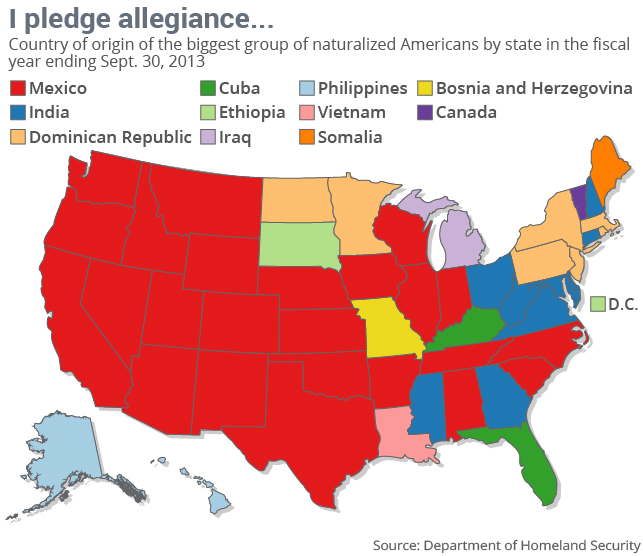
According to the Department of Homeland Security (DHS), hundreds of thousands of lawful permanent residents apply for U.S. citizenship each year. Many are long-term residents who have lived and worked in the United States for decades.
Older immigrants represent a significant share of applicants, especially among family-based immigration categories. Analysts say the senior exemptions therefore affect a notable portion of naturalization candidates, particularly retirees.
Pass Rates
Historically, USCIS reports pass rates above 85% nationwide. However, first-attempt pass rates are lower among applicants with limited formal education, according to adult education providers.
The redesigned U.S. Citizenship Test may influence those figures. Experts expect temporary declines until study programs adjust.
The Naturalization Interview: What Actually Happens
After submitting an application and biometrics data, applicants attend an in-person interview with a USCIS officer. The officer reviews identity documents, background checks, and residency history before administering the U.S. Citizenship Test.
The interview includes three parts:
- English reading
- English writing
- Civics questioning
Applicants also must take an oath promising allegiance to the U.S. Constitution.
Sample Questions
Examples commonly asked:
- What is the supreme law of the land?
- Who vetoes bills?
- What did the Emancipation Proclamation do?
Applicants are not required to write essays. They only need to read and write simple sentences in English.
Why Citizenship Matters
Becoming a citizen provides legal and social benefits. Naturalized citizens can:
- Vote in federal elections
- Sponsor more family members for immigration
- Obtain a U.S. passport
- Access certain federal jobs
Researchers at the Pew Research Center have found naturalized citizens often earn higher wages and show greater civic participation than non-citizen residents.
Oath Ceremony
Successful applicants attend a public ceremony where they take the Oath of Allegiance. Courts, schools, and convention halls often host the ceremonies, which sometimes occur on national holidays such as Independence Day.
Officials describe the ceremony as both administrative and symbolic. Many participants bring family members, and judges frequently deliver short speeches welcoming new citizens.
Preparation Resources and Community Support
Libraries, nonprofit organizations, and community colleges across the United States offer preparation classes for the U.S. Citizenship Test. Many classes are free and funded by local governments.
Teachers focus on memorization techniques, mock interviews, and practice conversations. Some programs provide bilingual instructors for older students.
Community groups say preparation courses also help immigrants understand daily civic life, including jury duty and local elections.
What Applicants Should Expect Next
USCIS says study materials and practice questions are publicly available through its citizenship resource center. Applicants will be tested during an in-person interview conducted by a USCIS officer after their application and background checks are completed.
Naturalization remains voluntary, but citizenship confers important rights, including voting in federal elections and eligibility for a U.S. passport.
Immigration analysts expect the updated system to remain in place while officials monitor pass rates and application numbers over the coming years.
FAQs About Shorter U.S. Citizenship Test Under Updated Rules
Is the U.S. Citizenship Test now harder?
Yes. Most applicants will face more questions and a broader subject pool, requiring deeper knowledge of U.S. history and government.
Do older immigrants still need to take the civics test?
Yes, but those meeting age and residency requirements receive a simplified version and may take it in their native language.
How long does the citizenship process take?
Processing times vary but typically range from 6 to 12 months, depending on location and application volume.
Why does the government give seniors an easier test?
Federal immigration law recognizes long-term residence and potential language barriers among older applicants, balancing accessibility with civic knowledge.