

If you’ve looked up at the night sky recently and noticed a straight line of bright moving dots crossing the stars, you’re not alone. Those lights are part of a growing global network of internet satellites, and they are at the center of a new scientific discussion. The increase in Starlink satellite reentries is now drawing attention from astronomers, environmental researchers, and space agencies worldwide. As more spacecraft circle our planet, Starlink satellite reentries are happening more often than at any time in human history. The network has made high-speed internet possible in places that once had no reliable connection at all mountain villages, ships at sea, and disaster zones. But every technological leap brings new responsibilities. Scientists are now asking a simple but important question: what happens when thousands of satellites repeatedly burn up in Earth’s atmosphere every year?

Starlink satellite reentries are increasing because the satellites orbit very close to Earth compared to traditional communication satellites. They operate about 500 to 600 kilometers above the planet, a region called Low Earth Orbit. At that height, the atmosphere is extremely thin but still present. Over time, even that small amount of air slows satellites down.
Instead of letting dead satellites remain in space as debris, engineers designed them to fall back and burn up safely. This approach prevents collisions in orbit but creates a steady cycle of spacecraft returning to the atmosphere. Researchers estimate that as the network grows, multiple satellites may reenter the atmosphere every week. The environmental impact is still being investigated, especially the accumulation of vaporized metals in the upper atmosphere and its possible effect on ozone and atmospheric temperature balance.
Table of Contents
Starlink Satellites Are Reentering More Frequently
| Category & Description | Key Information |
|---|---|
| Operator & Developer | SpaceX |
| Satellite Network & Purpose | Global broadband internet coverage |
| Orbit Type & Region | Low Earth Orbit (LEO) |
| Typical Altitude & Range | Approximately 500–600 km |
| Average Satellite Lifespan & Operation | Around 5 years (sometimes shorter) |
| Reentry Method & Process | Controlled atmospheric burn-up |
| Replacement Cycle & Frequency | Continuous launches & replacements |
| Main Benefit & Use | High-speed internet in remote locations |
| Primary Concern & Research Focus | Metal particles in upper atmosphere |
| Safety Risk & Ground Impact | Extremely low for humans |
Why So Many Satellites Are Being Launched
- Traditional communication satellites were large and few in number. Most of them operated from geostationary orbit, about 36,000 kilometers above Earth. From that height, one satellite could cover a massive area, but signals took longer to travel. That delay caused slower internet speeds and noticeable lag during video calls or gaming.
- The new system works differently. Instead of a handful of large satellites, thousands of small satellites form a moving network around the planet. Each satellite covers a smaller region, but together they create continuous global coverage. Because they are closer to Earth, the signal reaches users much faster.
- This is the main reason the service works so well but it also explains the rise in Starlink satellite reentries. Low orbit means stronger atmospheric drag. Satellites cannot stay there forever, so they must be replaced regularly. The network is designed around a constant cycle: launch, operate, reenter, and replace.
What Happens During Reentry
- When a satellite reenters Earth’s atmosphere, it does not simply fall like an object dropped from the sky. It is traveling at orbital speed about 27,000 kilometers per hour. As it descends, it compresses the air in front of it, producing extreme heat.
- Temperatures quickly climb high enough to melt metals. Solar panels shatter, antennas break apart, and structural frames vaporize. Most satellites completely disintegrate roughly 70 to 80 kilometers above Earth’s surface. The glowing streak sometimes seen from the ground resembles a meteor.
- This process is called ablation. Instead of large pieces falling, the satellite turns into microscopic particles and gases. Nearly all material burns up long before it could reach people, aircraft, or buildings.
- However, the real discussion begins after the satellite disappears.
The New Scientific Concern: Metal Pollution in the Upper Atmosphere
Every satellite contains metals, especially aluminum alloys. When satellites burn up, they release aluminum oxide particles into the upper layers of the atmosphere. For centuries, the atmosphere mainly received metal dust from natural meteors entering space. Now human-made spacecraft are adding a new source. The issue is not a single event. One reentry does almost nothing. The concern is repetition. Thousands of Starlink satellite reentries over many years could introduce measurable quantities of particles into atmospheric layers that scientists still do not fully understand.
Researchers are examining several possibilities:
- changes in heat absorption in upper atmospheric layers
- influence on high-altitude cloud formation
- slow interaction with ozone chemistry
The ozone layer sits below where most reentries occur, but atmospheric circulation slowly mixes air over time. Even small chemical changes could have long-term effects. At present, scientists are still gathering data, and no major damage has been confirmed. The question is about future accumulation rather than immediate harm.
Is There Any Danger to People on the Ground?
Despite the rising number of Starlink satellite reentries, there is almost no direct danger to people. The vast majority of spacecraft burn up entirely. Only extremely dense components occasionally survive, and even those usually fall into oceans or uninhabited regions. Statistically, a person is far more likely to be struck by lightning than by satellite debris. In fact, controlled reentry is considered a safety measure. If satellites remained in orbit after failing, they would create space junk. Collisions between debris could generate even more fragments, eventually threatening spacecraft, weather satellites, and even space stations. So, while reentries sound alarming, they are actually part of responsible orbital management.
Why Starlink Satellites Fail Earlier Than Expected
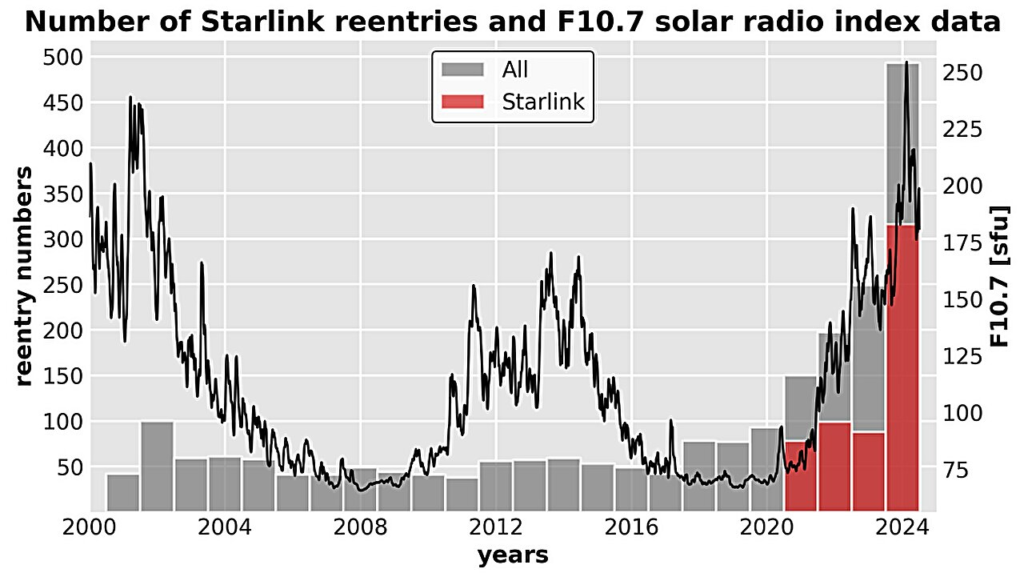
Another reason for frequent Starlink satellite reentries is solar activity. The Sun follows an approximately 11-year cycle of energy output. During active periods, solar radiation heats Earth’s upper atmosphere, causing it to expand.
When the atmosphere expands, satellites encounter more air particles than predicted. Increased drag slows them down rapidly and lowers their orbit. Some satellites have reentered only weeks after launch due to strong geomagnetic storms.
This means the rise in reentries is not only due to the number of satellites but also natural space weather. As solar activity increases toward peak cycles, more early orbital decay can occur.
A Balance Between Connectivity And Environmental Responsibility
Global satellite internet has transformed communication. Remote students can attend online classes. Emergency workers can coordinate rescues. Rural areas can run digital businesses. The benefits are undeniable. Yet space near Earth is becoming busy for the first time in history. Multiple countries and companies are planning their own satellite constellations. The number of spacecraft in orbit could multiply several times within the next decade. Scientists are not suggesting the technology should stop.
Instead, they recommend careful planning. Possible solutions include:
- designing satellites with alternative materials
- extending operational lifespans
- coordinating international launch policies
- monitoring atmospheric changes continuously
The goal is balance — maintaining connectivity without unintentionally altering atmospheric conditions.
The Future Of The Sky
- Human activity has already changed Earth’s land, oceans, and lower atmosphere. Now the upper atmosphere is beginning to feel the impact as well. The increase in Starlink satellite reentries marks the first time human technology is repeatedly interacting with the edge of space at a global scale.
- Astronomers have noticed brighter skies and streaks in telescope images. Atmospheric researchers are measuring metal traces at high altitudes. Engineers are exploring new satellite designs. Governments are discussing orbital regulations.
- This is not a crisis. It is a transition. Humanity has entered an era where near-Earth space is part of everyday infrastructure much like roads, shipping routes, and air traffic. The challenge ahead is learning how to use that environment responsibly.
- The satellites provide connectivity, navigation support, and communication across the planet. At the same time, they remind us that even the sky above is part of Earth’s ecosystem.
- Starlink satellite reentries represent both progress and responsibility. The coming years will determine whether technological innovation and environmental awareness can move forward together ensuring global connectivity while preserving the delicate layers of atmosphere that protect life on Earth.
FAQs
1. What are Starlink satellite reentries?
They occur when a Starlink satellite slows down in orbit and falls back into Earth’s atmosphere, where it burns up due to extreme heat.
2. How often do Starlink satellites reenter the atmosphere?
As the constellation grows, reentries happen regularly, sometimes several times each month.
3. Are Starlink satellite reentries harmful to humans?
No. Almost all material vaporizes high above Earth, making the risk to people extremely low.
4. Why don’t satellites stay in orbit forever?
Low Earth orbit contains traces of atmosphere that create drag, gradually pulling satellites back toward Earth.