

Giving to grandchildren is one of the most meaningful ways to pass on wealth and values. Whether you’re helping with college, buying a first car, or simply building financial security for their future, thoughtful gifting can make a lasting difference.

The good news is that federal tax law allows you to transfer substantial amounts each year without creating gift tax problems — if you follow the rules carefully. Understanding those rules in advance ensures your generosity stays stress-free and tax-efficient.
Table of Contents
Annual Gift Tax Exclusion in 2026
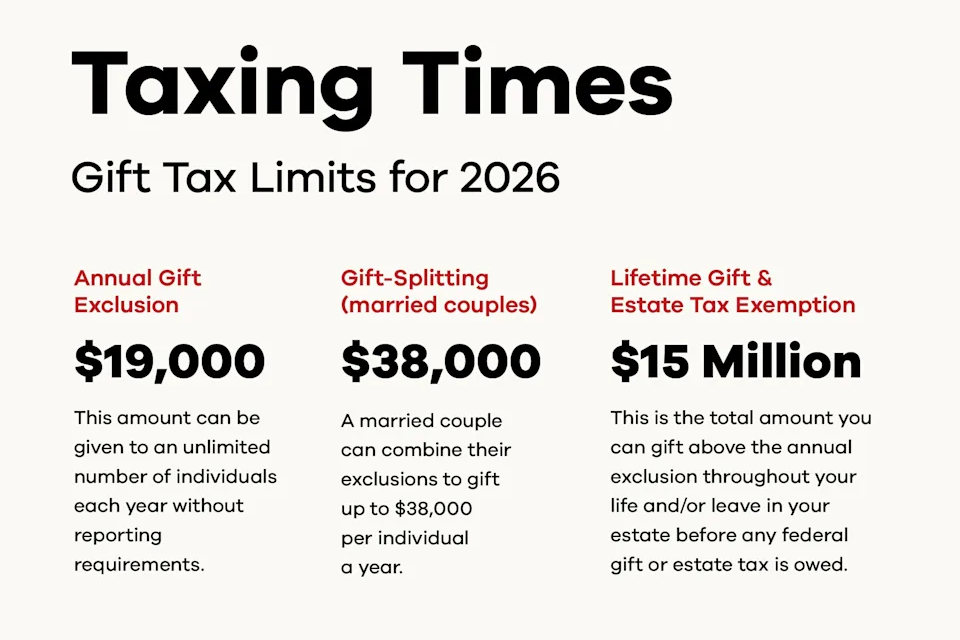
The annual gift tax exclusion allows you to give up to $19,000 per grandchild in 2026 without triggering federal gift tax or filing requirements. This limit applies per recipient, not per household. That means you can give $19,000 to each grandchild during the year, and those gifts will not reduce your lifetime estate and gift tax exemption. For married couples, strategic planning can double that amount per grandchild through gift splitting. Knowing how this exclusion works is the foundation of tax-smart gifting.
How to Gift $19,000 to Grandkids in 2026
| Rule or Strategy | 2026 Limit | Tax Impact | Filing Requirement |
|---|---|---|---|
| Annual gift exclusion | $19,000 per grandchild | No gift tax | No filing required |
| Married couple gift splitting | $38,000 per grandchild | No gift tax | Form 709 required |
| Gifts above $19,000 (individual) | Excess reduces lifetime exemption | No immediate tax unless exemption exceeded | Form 709 required |
| Lifetime gift & estate exemption | $15 million per individual | Tax only after exceeding exemption | Report via Form 709 |
| Direct tuition payments | Unlimited (paid directly to school) | Not counted toward annual exclusion | No filing required |
| Direct medical payments | Unlimited (paid directly to provider) | Not counted toward annual exclusion | No filing required |
| 529 five-year election | Up to $95,000 (individual) | Treated as spread over 5 years | Form 709 required |
1. Use the Annual Gift Tax Exclusion
The simplest way to give $19,000 to each grandchild in 2026 is by using the annual exclusion. This rule allows individuals to transfer up to that amount per recipient without owing gift tax or filing paperwork.
For example, if you have three grandchildren, you can give each $19,000 in 2026. That’s $57,000 total — completely tax-free and without reporting requirements.
The exclusion resets each calendar year. If you want to give more over time, you can repeat the same strategy in 2027 and beyond.
It’s important to remember that the annual exclusion applies per recipient. There is no cap on how many people you can give $19,000 to in one year.
2. Married Couples Can Double the Gift
If you are married, you and your spouse can combine your exclusions through what’s called gift splitting. This allows a married couple to give up to $38,000 to a single grandchild in 2026 without paying gift tax.
Here’s how it works:
- Each spouse uses their $19,000 exclusion.
- Together, the grandchild receives $38,000.
- No gift tax is owed.
However, even if no tax is due, you must file IRS Form 709 to elect gift splitting. Filing does not mean you owe money — it simply documents how the exclusion is being applied.
3. If You Give More Than $19,000 to One Grandchild
Sometimes grandparents want to make a larger gift in one year. If you give more than $19,000 individually to a grandchild in 2026, the excess amount is considered a taxable gift — but that doesn’t necessarily mean you will pay tax.
Instead, the amount above $19,000 reduces your lifetime gift and estate tax exemption, which is $15 million per person in 2026.
For example:
- You give $25,000 to one grandchild.
- $19,000 is covered by the annual exclusion.
- The remaining $6,000 reduces your lifetime exemption.
- You must file Form 709 to report it.
You only pay gift tax if your total lifetime gifts exceed $15 million — a threshold that most individuals will never reach.
4. Pay Education or Medical Expenses Directly
One of the most powerful strategies for grandparents is paying certain expenses directly.
You can pay:
- Tuition directly to an educational institution.
- Medical bills directly to a healthcare provider.
These payments do not count toward the $19,000 annual exclusion and do not reduce your lifetime exemption.
For example, you could:
- Give $19,000 in cash.
- Pay $20,000 in tuition directly to the school.
- None of it triggers gift tax.
The key is that payment must go directly to the institution or provider. If you give the money to your grandchild first, it counts as a gift.
5. Use 529 College Savings Plan Superfunding
A 529 college savings plan offers another tax-efficient way to transfer wealth.
In 2026, you can contribute up to five years’ worth of annual exclusions at once. That equals:
- $95,000 per grandchild (individual).
- $190,000 if married and gift splitting.
This is known as the five-year election. The IRS treats the large contribution as if it were spread evenly over five years.
For example:
- You contribute $95,000 in 2026.
- It counts as $19,000 per year from 2026 to 2030.
- You cannot make additional annual exclusion gifts to that grandchild during that five-year period without using lifetime exemption.
You must file Form 709 to make this election, but again, filing does not mean paying tax.
6. Trust Planning for Larger Estates
For families with substantial wealth, trusts may provide additional control and tax efficiency.
An irrevocable trust, such as a dynasty trust, can:
- Transfer assets to multiple generations.
- Provide creditor protection.
- Potentially reduce estate and generation-skipping transfer taxes.
Trust planning is more complex and typically requires an estate planning attorney. However, for high-net-worth families, it can be an effective long-term strategy.
Important Reminders
Before making large gifts, keep these points in mind:
- The giver is responsible for gift tax, not the recipient.
- Gifts within the annual exclusion require no reporting.
- Gifts above the exclusion require filing Form 709.
- Filing a gift tax return does not automatically mean you owe tax.
- The lifetime exemption protects most families from ever paying gift tax.
Also, tax laws can change. Estate and gift tax rules are subject to congressional updates, so reviewing your plan annually is wise.

Practical Gifting Scenarios
Here are common examples of how grandparents can structure gifts:
Scenario 1:
You give $19,000 to one grandchild in 2026.
Result: No tax. No filing.
Scenario 2:
You and your spouse give $38,000 total to one grandchild.
Result: No tax. File Form 709 to elect gift splitting.
Scenario 3:
You give $50,000 individually.
Result: $31,000 reduces your lifetime exemption. File Form 709.
Scenario 4:
You pay $30,000 in tuition directly to a university and give $19,000 in cash.
Result: No tax. No lifetime exemption used.
Bottom Line
Gifting $19,000 to each grandchild in 2026 is entirely permissible under federal tax rules and can be done without triggering IRS problems. The annual exclusion makes it simple, and married couples can double the benefit with proper filing. Even larger gifts typically do not result in immediate tax thanks to the generous $15 million lifetime exemption.
With thoughtful planning, grandparents can transfer significant wealth while minimizing tax complications. Whether you use annual exclusions, 529 plans, direct tuition payments, or long-term trust strategies, understanding the rules ensures your generosity benefits your family — not the IRS.
For personalized advice, especially when dealing with substantial assets or complex estates, consult a qualified tax professional or estate planning attorney. Proper guidance can help you make the most of every dollar you choose to give.