

The U.S. Farm Income Forecast to Fall in 2026 signals a modest but notable shift in the agricultural economy, according to projections from the U.S. Department of Agriculture (USDA). Despite a sharp increase in federal government payments, weaker commodity prices, steady production costs, and rising farm debt are expected to trim overall profitability next year.
Table of Contents
U.S. Farm Income Forecast to Fall in 2026
| Key Fact | Detail/Statistic |
|---|---|
| Net farm income forecast | Approximately $153.4 billion in 2026 |
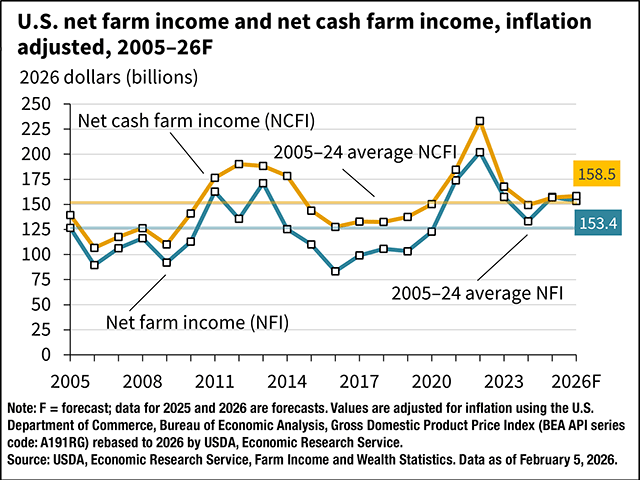
| Inflation-adjusted change | Roughly 2.6% decline in real terms |
| Government payments | About $44.3 billion, up from 2025 |
| Share of income from aid | Nearly 30% of projected net farm income |
USDA Forecast: Modest Decline After Elevated Years
The U.S. Department of Agriculture (USDA), through its Economic Research Service (ERS), projects net farm income at about $153.4 billion in 2026. That marks a slight nominal decrease from 2025. After adjusting for inflation, the decline is more pronounced.
Net farm income measures the sector’s profitability after accounting for operating expenses, depreciation, and inventory adjustments. Economists widely use it to assess the health of the agricultural economy.
Although the projected decrease is modest, it reflects cooling conditions after several years of unusually strong earnings. Farm income surged in earlier years due to supply chain disruptions, elevated global demand, and pandemic-related government assistance.
“Income levels remain historically solid, but the trend is clearly softening,” agricultural economists have noted in USDA briefings. The projected downturn does not signal a systemic crisis, but it underscores tightening margins across much of the sector.
Government Support Expands as Market Returns Ease
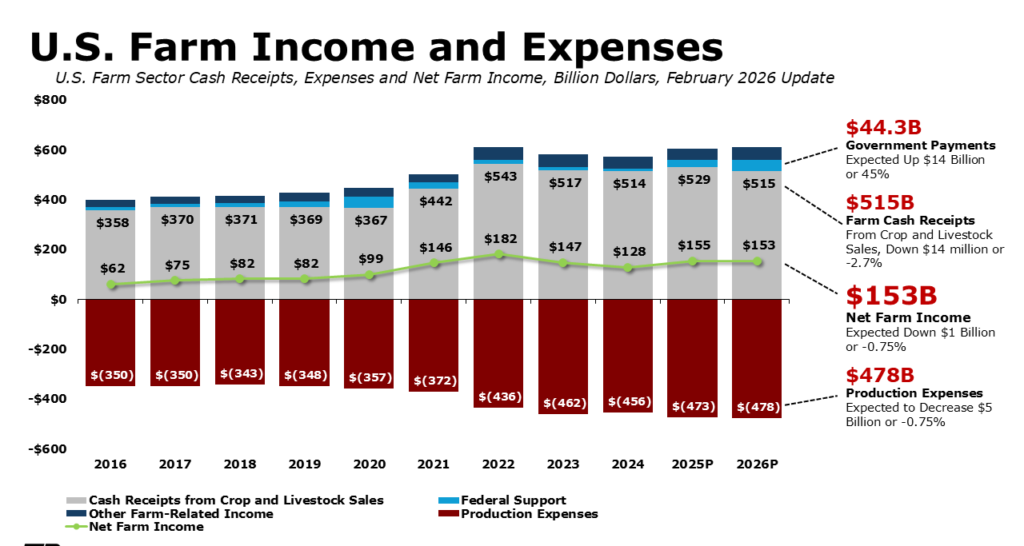
Federal support programs are expected to increase significantly in 2026. USDA projects direct government payments at roughly $44.3 billion, a substantial increase compared with the prior year.
These payments include commodity support programs, disaster assistance, and supplemental relief tied to weather and market volatility. Without them, analysts say, the decline in farm income would likely be much sharper.
Government payments could account for nearly 30% of net farm income in 2026. That proportion reflects the expanding role of federal programs in stabilizing agricultural finances during periods of market weakness.
The American Farm Bureau Federation (AFBF) has stated that federal assistance “continues to serve as a financial backstop,” particularly for producers facing unpredictable commodity cycles.
Still, experts caution that subsidies cannot fully offset market-driven revenue declines. Farm profitability ultimately depends on crop yields, livestock prices, export demand, and input costs.
Commodity Prices and Agricultural Markets Under Pressure
Lower commodity prices remain the primary driver behind the forecasted income decline.
Corn and soybean prices have retreated from highs reached during earlier global supply disruptions. Improved harvests in major producing nations and slowing economic growth in some importing countries have reduced upward price momentum.
Livestock producers face similar pressures. Beef prices have remained relatively firm, but dairy and poultry markets have experienced price adjustments amid changing consumer demand and global trade flows.
Agricultural market volatility has increased as geopolitical tensions, currency fluctuations, and shifting trade patterns influence export competitiveness. The United States remains one of the world’s largest agricultural exporters, making global demand critical to domestic farm income.
“Farmers are navigating a more normalized price environment,” agricultural economists at several land-grant universities have explained. “The extraordinary margins seen during supply shocks are not expected to persist.”
Rising Production Costs and Farm Debt
Although some input costs have stabilized, overall production expenses remain elevated.
Fuel and fertilizer prices have eased compared with peak levels seen during global energy disruptions. However, machinery costs, insurance premiums, labor expenses, and interest payments continue to weigh on farm balance sheets.
Higher interest rates in recent years have increased borrowing costs for operating loans and land purchases. USDA forecasts show farm sector debt continuing to rise in 2026, reflecting ongoing capital investment and tighter cash flow.
Smaller and mid-sized farms may feel these pressures more acutely. Many rely on short-term credit and operate with narrower margins than large commercial operations.
Regional Differences Across the Farm Economy
The projected decline in the U.S. Farm Income Forecast to Fall in 2026 will not affect all regions equally.
Midwestern crop producers, particularly those focused on corn and soybeans, may experience margin compression due to lower grain prices. Southern producers growing cotton or rice face separate market dynamics tied to global textile demand and export competition.
Western farmers contend with additional challenges, including water availability and climate-related risks. Drought conditions in some regions continue to influence irrigation costs and yield expectations.
Livestock-heavy states in the Plains and Mountain West may see more stable conditions if cattle prices remain firm. However, feed costs and export markets remain important variables.
Agricultural economists emphasize that farm-level outcomes depend on crop mix, land ownership structure, and financial leverage.
Trade, Exports, and Global Demand
Export markets play a central role in shaping farm revenue.
The United States exports significant volumes of soybeans, corn, wheat, beef, and dairy products. Changes in trade policy, currency exchange rates, and foreign demand directly influence farm receipts.
Recent global economic slowdowns have tempered import demand in some countries. At the same time, competition from Brazil, Argentina, and other agricultural exporters has intensified.
Trade policy developments remain a closely watched factor. Agricultural organizations continue to advocate for stable trade agreements and market access to support farm income stability.
Climate and Weather Risks
Weather remains one of the most unpredictable variables affecting agricultural outcomes.
While USDA projections assume average growing conditions, drought, flooding, or extreme temperatures could significantly alter yield forecasts. Climate-related volatility has increased in recent years, raising questions about long-term production stability.
Crop insurance and disaster programs form a core part of the federal safety net. These tools aim to mitigate financial losses during severe weather events.
Agricultural researchers stress that adaptation strategies, including improved seed technology and soil management practices, may help offset some climate risks over time.
Farm Bill Debate and Policy Outlook
As Congress debates updates to the federal farm bill, the income forecast adds urgency to policy discussions.
Lawmakers are reviewing reference prices, conservation funding, and rural development programs. Farm groups argue that safety-net mechanisms should reflect rising production costs and market volatility.
Some policymakers emphasize fiscal responsibility and budget limits. Others argue that maintaining rural economic stability requires robust agricultural support.
The farm bill will shape the structure of government payments in coming years and could influence future income forecasts.
Broader Rural Economic Impact
The agricultural economy supports a wide network of industries beyond farms.
Equipment manufacturers, food processors, transportation firms, and rural banks all depend on farm-sector performance. A decline in farm income can ripple through rural communities, affecting employment and local tax revenue.
However, economists note that rural economies have diversified in many areas, with energy production, manufacturing, and service industries contributing to regional resilience.
What This Means for Farmers in 2026
For many producers, 2026 is expected to bring tighter but manageable conditions.
Net cash farm income, which measures actual cash flow, is projected to remain relatively stable due to government payments. That stability may help farmers meet short-term obligations.
Still, rising debt and thinner margins may limit expansion plans and capital investments. Agricultural lenders are closely monitoring liquidity ratios and repayment capacity.
Farmers are likely to adjust planting decisions based on projected commodity returns, input costs, and policy signals.
Outlook
The U.S. Farm Income Forecast to Fall in 2026 reflects a transition from unusually strong earnings to more moderate conditions. Analysts expect continued volatility in agricultural markets, influenced by global demand, trade policy, and weather patterns.
While federal support provides a buffer, long-term profitability will depend on market fundamentals and policy decisions. As one agricultural economist summarized during a USDA outlook forum, “The sector remains resilient, but margin management will be critical in the year ahead.”
FAQs About U.S. Farm Income Forecast to Fall in 2026
What does the U.S. Farm Income Forecast to Fall in 2026 mean?
It means that overall agricultural profitability is projected to decline slightly compared with 2025, primarily due to lower commodity prices, even though government payments are rising.
How significant is the projected decline?
The decline is modest in nominal terms and somewhat larger after adjusting for inflation. Income remains above long-term historical averages.
Why are government payments increasing?
Payments are rising due to commodity support programs, disaster relief, and other federal safety-net mechanisms designed to stabilize farm finances.
Could the forecast change?
Yes. Weather conditions, global trade developments, and market price fluctuations could alter income projections.