
There are ordinary sunsets, and then there are weekends like this. A Rare Six-Planet Lineup Will Light Up The Evening Sky This Weekend, and it is one of those sky events that instantly grabs attention. If you have ever stepped outside after dark and wondered what else is out there beyond the stars, this is your chance to see the solar system in action.
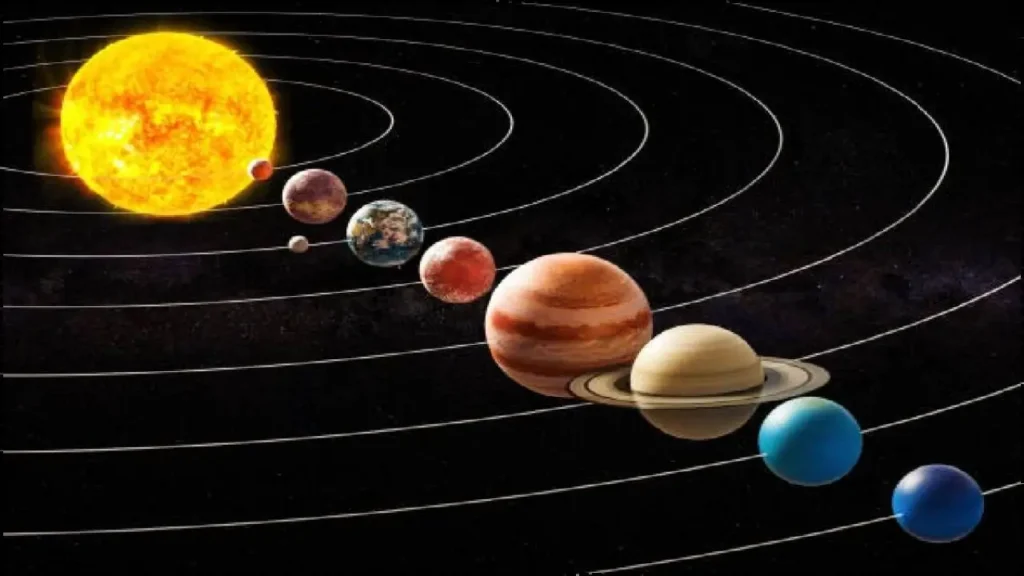
A Rare Six-Planet Lineup Will Light Up the Evening Sky This Weekend, offering a rare opportunity to spot multiple planets in one sweeping view without any special travel or expensive equipment. This is not just another minor astronomical event. The six-planet alignment will stretch across the evening sky shortly after sunset, placing Mercury, Venus, Mars, Jupiter, Saturn, and Uranus along the same arc. Several of these planets will be bright enough to see with the naked eye. Others will reward those who bring binoculars. Whether you are a seasoned skywatcher or someone who rarely looks up, this weekend presents a genuine reason to pause and pay attention.
The Six-Planet Lineup is the focus of attention for skywatchers this weekend. In simple terms, it means that six planets will appear aligned along the same path in the sky, known as the ecliptic. This alignment does not mean the planets are physically close together in space. Instead, it is a visual effect caused by the way planets orbit the Sun on roughly the same flat plane. What makes this Six-Planet Lineup particularly exciting is its visibility during convenient evening hours. Venus and Jupiter will shine brightly and be easy to identify. Mars will stand out because of its reddish glow. Saturn will appear softer but still visible under darker skies. Mercury will sit low near the horizon, requiring precise timing. Uranus, the faintest of the group, will likely require binoculars or a small telescope. For many observers, seeing this Six-Planet Lineup will feel like watching a live diagram of the solar system unfold overhead.
Table of Contents
A Rare Six-Planet Lineup
| Planet | Visibility & Equipment Needed | Best Viewing Time & Direction | Key Characteristics & Notes |
|---|---|---|---|
| Mercury | Naked eye, clear horizon & no obstruction | 30–45 minutes after sunset & low in the west | Small, faint, visible briefly before setting |
| Venus | Naked eye & no equipment required | Early evening & western sky | Brightest object after the Moon, steady white glow |
| Mars | Naked eye & optional binoculars | Evening & higher in the sky | Distinct reddish color |
| Jupiter | Naked eye & binoculars enhance view | Evening & bright in southern sky | Very bright, steady light, moons visible with binoculars |
| Saturn | Naked eye in dark areas & telescope for rings | Evening & moderate height | Pale yellow tone, rings visible with telescope |
| Uranus | Binoculars or telescope required | Later evening & darker skies | Faint bluish dot, difficult without optical aid |
When And Where to Look
- Catching the Six-Planet Lineup requires good timing. The ideal viewing window begins about 30 to 45 minutes after sunset. Start by facing the western horizon. Mercury and Venus will be the first to appear, though Mercury will not remain visible for long. Because it stays close to the Sun from our perspective, it dips below the horizon quickly.
- As twilight deepens, Jupiter and Mars become more noticeable higher up in the sky. Saturn will appear slightly dimmer but still visible if light pollution is minimal. Uranus will require darker conditions and likely some magnification.
- Location matters. A clear, unobstructed view of the western horizon is essential. Avoid tall buildings, trees, or hills that block your line of sight. Rural areas, beaches, and open fields offer the best vantage points. If you are in a city, try to move away from direct streetlights and illuminated areas.
Why Planetary Alignments Happen
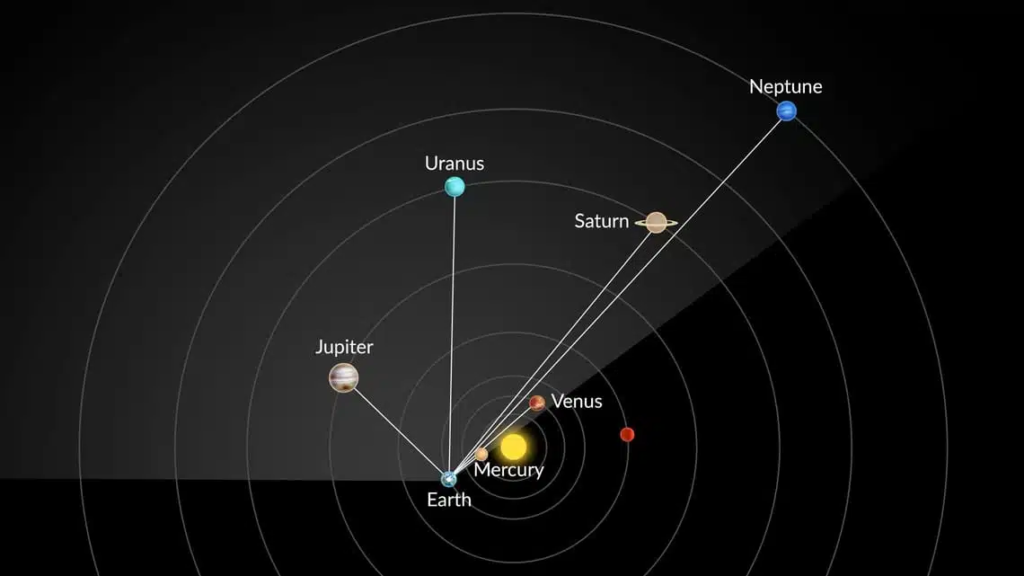
To understand why a Six-Planet Lineup occurs, it helps to picture the solar system from above. The planets orbit the Sun in a flattened disk. This means they travel along similar paths through space. From Earth, we see that shared orbital plane as a curved line across the sky called the ecliptic. Because each planet moves at a different speed, their positions constantly shift. Mercury orbits the Sun in just 88 days. Jupiter takes nearly 12 years. Saturn needs almost 29 years to complete one orbit. Occasionally, their positions line up in such a way that several appear in the sky at the same time during the evening. It is important to remember that this Six-Planet Lineup is a matter of perspective. The planets are still separated by vast distances. They only appear aligned from our viewpoint on Earth.
How Rare Is This Event?
- Planetary pairings are fairly common. You might see two bright planets close together several times a year. Three-planet groupings are less frequent but still occur regularly. A Six-Planet Lineup visible in the evening sky, however, is much less common.
- The rarity depends on orbital timing and visibility conditions. Even if planets technically align, they are not always positioned above the horizon during nighttime hours. That is what makes this weekend special. Not only are six planets aligned from our perspective, but most of them are positioned in a way that makes them accessible to casual observers.
- For many people, this will be their first time seeing so many planets in a single night without professional equipment.
Tips For the Best Viewing Experience
If you want to fully enjoy the Six-Planet Lineup, a little preparation goes a long way.
- First, check the weather forecast. Clear skies are essential. Even thin cloud cover can hide fainter planets like Uranus.
- Second, allow your eyes to adjust to the darkness. It can take up to 20 minutes for your vision to adapt fully. Avoid looking at bright phone screens during this time.
- Third, consider using a stargazing app. Many free apps can identify planets in real time, helping you confirm what you are seeing.
- Fourth, bring binoculars if you have them. While not necessary for the brighter planets, binoculars enhance detail and make Uranus easier to locate.
- Finally, be patient. The sky changes gradually. What looks empty at first may reveal a bright planet minutes later as twilight fades.
What Each Planet Will Look Like
Each planet in the Six-Planet Lineup has a distinct appearance.
- Venus will dominate the western sky with a brilliant white glow. It does not twinkle like stars, which helps distinguish it.
- Jupiter will appear extremely bright and steady. With binoculars, you may spot its four largest moons lined up beside it.
- Mars will display a warm red or orange tint, making it easy to identify among surrounding stars.
- Saturn will appear pale yellow. Through a small telescope, its rings become visible, transforming it from a simple point of light into a breathtaking sight.
- Mercury will look small and faint, close to the horizon. It may require a clear and unobstructed view to catch it before it sets.
- Uranus will be the most challenging target. Through binoculars or a telescope, it appears as a faint bluish dot rather than a sharp star.
A Reminder of Our Place in The Solar System
There is something humbling about watching a Six-Planet Lineup. Each of those small lights represents a massive world orbiting the same Sun that warms Earth. Seeing them together emphasizes the structure of our solar system in a way textbooks cannot. Moments like this often spark curiosity. Children who see Saturn’s rings for the first time frequently develop a lasting interest in science. Adults rediscover a sense of wonder that daily routines sometimes overshadow. In an era dominated by digital screens, looking up at the real sky offers a powerful contrast. The planets are not computer graphics or simulations. They are real worlds, moving through space in predictable yet awe-inspiring patterns.
Don’t Miss The Opportunity
- The Six-Planet Lineup will not remain perfectly arranged for long. Planetary motion is constant. Over the coming weeks, Mercury will shift position. Other planets will move farther apart or become lost in the Sun’s glare.
- That is why this weekend matters. A Rare Six-Planet Lineup Will Light Up The Evening Sky This Weekend, and it offers a brief but memorable viewing window. You do not need a telescope worth thousands of dollars. You do not need advanced training in astronomy.
- All you need is clear skies, a bit of patience, and a willingness to look up.
- Step outside shortly after sunset. Face west. Find the brightest point of light and begin tracing the arc of the sky upward. One by one, the planets will reveal themselves.
- You may not witness this exact Six-Planet Lineup again anytime soon. And when the sky puts on a show like this, it is worth making the effort to watch.
FAQs About A Rare Six-Planet Lineup
1. What Is A Six-Planet Lineup?
A Six-Planet Lineup occurs when six planets appear aligned along the same path in the sky from Earth’s perspective. They are not physically close together in space.
2. Do I Need A Telescope To See The Six-Planet Lineup?
No, you do not need a telescope to enjoy most of the event. Venus, Jupiter, Mars, Saturn, and sometimes Mercury are visible to the naked eye under clear conditions.
3. What Time Is Best to Watch the Six-Planet Lineup?
The best time to view the Six-Planet Lineup is about 30 to 45 minutes after sunset. Start by looking toward the western horizon. Mercury sets quickly, so earlier is better if you want to see all six planets.
4. Can I See The Six-Planet Lineup from A City?
Yes, you can see several of the brighter planets from urban areas. Venus and Jupiter are especially easy to spot even with light pollution.