

A California startup’s proposal to deploy space mirrors capable of reflecting sunlight onto Earth after dark has ignited a growing debate among astronomers, environmental scientists, and space regulators over whether private companies should be allowed to illuminate the planet’s night sky from orbit.
Table of Contents
Startup Wants to Light Up Earth’s Nights With Space Mirrors
| Key Fact | Detail |
|---|---|
| Proposed system | Thousands of reflective satellites in low Earth orbit |
| Intended purpose | Redirect sunlight for nighttime illumination |
| Primary concern | Permanent increase in orbital light pollution |
| Regulatory status | No global framework governing orbital illumination |
| Historical precedent | Soviet Znamya space mirror experiment (1993) |
The Proposal: Reflecting Sunlight From Orbit
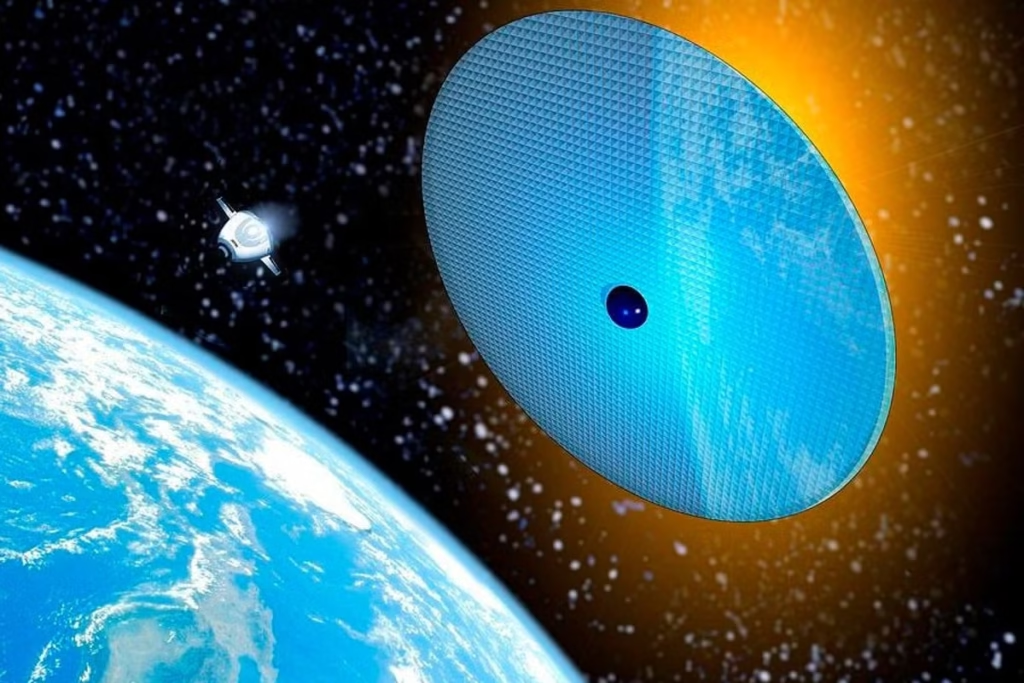
The proposal comes from Reflect Orbital, a privately funded U.S. startup that says it plans to deploy thin, steerable reflective panels into low Earth orbit. These panels would be designed to bounce sunlight toward specific regions of Earth during nighttime hours.
According to company materials reviewed by multiple news organizations, each satellite would carry a lightweight mirror spanning tens of meters when deployed. Using orbital mechanics and precision orientation, the mirror would reflect sunlight that would otherwise miss Earth, redirecting it toward the planet’s surface.
Reflect Orbital argues that the reflected light would be significantly dimmer than daylight and more comparable to twilight conditions. Company representatives have said the system could support renewable energy generation, provide temporary illumination for disaster zones, or assist infrastructure projects in remote areas.
The company has stated that it plans to begin with a single demonstration satellite later this decade, pending regulatory approval, before considering a larger constellation.
How Space Mirrors Would Actually Work
Unlike conventional satellites, which reflect sunlight unintentionally, orbital mirrors would be designed specifically to redirect light downward. The mirrors would operate only during certain orbital positions, when sunlight strikes them at an angle that allows reflection toward Earth.
Experts say this requires precise coordination. Low Earth orbit satellites move at roughly 7.8 kilometers per second, meaning any reflected beam would sweep rapidly across the surface below. As a result, sustained illumination would require multiple satellites working in sequence.
Astronomers note that even diffuse reflected light can pose problems. Modern observatories rely on extremely dark skies to detect faint objects billions of light-years away. Even brief increases in background brightness can compromise sensitive observations.
“This is fundamentally different from accidental glints,” several researchers told Scientific American. “These systems are designed to put light where it does not naturally exist.”
Astronomers’ Core Objection: A Brighter Night Sky
Astronomers say the greatest risk posed by space mirrors is not a single bright spot, but cumulative impact. Thousands of reflective satellites could introduce persistent, moving sources of artificial light across wide portions of the sky.
The International Astronomical Union has warned that increasing orbital light pollution could degrade data from ground-based observatories worldwide. This includes facilities tasked with detecting near-Earth asteroids, monitoring space debris, and studying transient cosmic events such as supernovae.
Wide-field survey telescopes are particularly vulnerable. These instruments scan large areas of the sky rapidly, making it difficult to avoid illuminated satellites during observations.
Scientists also emphasize that astronomy is a global endeavor. Light reflected over one country’s territory could interfere with observatories thousands of miles away.
Environmental and Ecological Implications
Beyond astronomy, environmental researchers warn that artificial nighttime illumination can disrupt ecosystems that depend on natural light cycles.
Studies have shown that many species rely on darkness for navigation, reproduction, and predator avoidance. Migratory birds, nocturnal insects, sea turtles, and marine plankton are particularly sensitive to changes in nighttime lighting.
While cities already produce significant light pollution, orbital illumination would differ in key ways. Unlike fixed ground-based lights, reflected sunlight from orbit could affect wide geographic areas unpredictably.
Public health researchers have also raised concerns about potential effects on human circadian rhythms, though they note that the precise impacts of orbital light sources remain poorly understood.
The Regulatory Gap in Space Governance
One of the most contentious aspects of the space mirrors proposal is the lack of a clear regulatory authority.
International space activity is governed largely by the Outer Space Treaty of 1967, which establishes that space is the “province of all humankind” and prohibits harmful interference with other nations’ activities. However, the treaty predates modern satellite megaconstellations and does not address light pollution.
In the United States, satellite launches require approval from agencies such as the Federal Communications Commission (FCC) and the Federal Aviation Administration (FAA). These agencies evaluate radio interference and launch safety, but they do not assess astronomical or ecological impacts.
“There is no comprehensive mechanism to evaluate whether orbital illumination is acceptable,” several space law experts told Reuters. “That gap is becoming more obvious as commercial space activity expands.”
A Commercial Incentive to Illuminate the Night
Industry analysts say the interest in orbital illumination reflects broader economic trends in space technology.
The cost of launching payloads into orbit has dropped dramatically over the past decade, driven largely by reusable rockets. At the same time, venture capital investment in space startups has increased, encouraging companies to pursue unconventional applications.
Supporters of orbital mirrors argue that the technology could unlock new markets, particularly in energy and infrastructure. By extending usable daylight hours, they say, solar power facilities could operate longer, and remote construction projects could reduce reliance on diesel generators.
Critics counter that these benefits remain theoretical and do not justify the potential global consequences.
Lessons From Satellite Megaconstellations
Astronomers point to recent experience with satellite internet constellations as a cautionary example.
When thousands of communications satellites were launched into low Earth orbit over the past decade, astronomers reported a sharp increase in satellite streaks appearing in telescope images. While some companies later modified satellite designs to reduce reflectivity, researchers say mitigation efforts have been only partially successful.
Space mirrors, by contrast, would be reflective by design.
“This is like skipping the lesson learned phase,” said one astronomer quoted by the Associated Press. “We are already struggling to adapt to satellites that were not meant to be bright.”
A Historical Precedent: Znamya
The idea of orbital mirrors dates back decades. In 1993, Russia tested a space-based reflective experiment known as Znamya. The project briefly produced a bright spot on Earth roughly the size of a city, visible to observers across parts of Europe.
Although technically successful, the experiment was widely criticized and later abandoned. Follow-up missions were canceled after deployment failures and growing public concern.
Scientists note that modern proposals involve far more satellites and longer operational lifetimes, magnifying potential impacts.
Global Equity and Ethical Questions
The space mirrors proposal has also raised ethical questions about who gets to decide how the night sky is used.
Astronomers and environmental groups argue that the night sky is a shared global resource, culturally and scientifically significant across societies. Indigenous communities, in particular, have emphasized the importance of dark skies for cultural practices and navigation traditions.
Critics also warn that benefits from orbital illumination would likely accrue to a small number of commercial users, while risks would be borne globally.
“There is an imbalance between private gain and collective impact,” said several ethicists cited by academic journals.
The Company’s Response
Reflect Orbital has said it is aware of the concerns and intends to engage with scientists and regulators. Company representatives have emphasized that any deployment would proceed incrementally and incorporate feedback from stakeholders.
The company has also suggested that operational limits could be imposed, such as restricting brightness levels or geographic targeting.
Astronomers remain skeptical, noting that once satellites are in orbit, enforcement becomes difficult.
What Happens Next
For now, the proposal remains in early stages. Any demonstration mission would require regulatory approval and could face legal challenges if opponents argue that it constitutes harmful interference.
Space policy experts say the debate may ultimately force governments to confront the absence of rules governing orbital light pollution.
As one researcher told BBC News, “This isn’t just about one startup. It’s about whether humanity wants to treat the night sky as a shared heritage or a commercial surface.”