
Inside the Meteorite-Hunting Industry: The meteorite-hunting industry where space rocks sell for thousands has quietly grown into one of the most fascinating intersections of science, adventure, and niche commerce. Across deserts, icy landscapes, and remote wilderness areas, professional hunters and hobbyists search for fragments of rock that once traveled through space for millions—or even billions—of years. These space rocks, known scientifically as meteorites, can fetch anywhere from a few dollars to over $1,000 per gram, depending on their rarity and origin.
In the United States and around the world, meteorite hunting has evolved from a purely scientific endeavor into a small but thriving global market. Meteorites are prized not just by scientists studying the origins of the solar system but also by private collectors, museums, universities, and investors who view these cosmic artifacts as both historical treasures and collectible assets. What makes this industry even more intriguing is that meteorites are one of the few valuable commodities that literally fall from the sky, meaning anyone—from a rancher in Arizona to a scientist in Antarctica—could potentially discover a specimen worth thousands of dollars.
Table of Contents
Inside the Meteorite-Hunting Industry
The meteorite-hunting industry where space rocks sell for thousands continues to captivate scientists, collectors, and adventurers alike. What begins as a fiery streak across the night sky can eventually become a valuable scientific specimen or prized collectible worth thousands of dollars. From the deserts of North Africa to the icy plains of Antarctica and the rugged landscapes of the American Southwest, meteorite hunters remain on the lookout for these cosmic treasures. With proper knowledge, careful documentation, and respect for scientific and legal guidelines, meteorite hunting offers a rare opportunity to connect with the history of our solar system—one rock at a time.
| Topic | Key Information |
|---|---|
| Industry Focus | Collecting, identifying, and selling meteorites from space |
| Typical Value | $0.50 to $1,000+ per gram depending on rarity |
| Most Valuable Meteorites | Lunar and Martian meteorites |
| Major Hunting Locations | Sahara Desert, Antarctica, Arizona, Nevada |
| Scientific Authority | NASA Meteorite Research Program |
| Estimated Meteorites Found | Over 48,000 officially classified worldwide |
| Official Resource | https://www.nasa.gov |
Understanding What Meteorites Really Are?
To understand why meteorites hold such value, it helps to start with the basics. A meteorite is a piece of rock or metal that originated in space and survived the intense heat of entering Earth’s atmosphere before landing on the ground.
In astronomy, three related terms often get mixed up:
- Meteoroid – A small rock or particle traveling through space
- Meteor – The bright streak of light created when a meteoroid burns through Earth’s atmosphere, often called a shooting star
- Meteorite – The fragment that survives the fall and reaches Earth’s surface
According to NASA’s Meteorite Collection, scientists have officially cataloged more than 48,000 meteorites worldwide, though many experts believe thousands more remain undiscovered in remote regions.
Most meteorites originate from asteroids located in the asteroid belt between Mars and Jupiter, but some rare specimens come from the Moon or Mars. These planetary meteorites are extremely valuable because they provide physical samples from other worlds without the need for expensive space missions.
Scientists often study meteorites to understand:
- The formation of the solar system about 4.6 billion years ago
- The chemical building blocks of planets
- The presence of organic molecules that may relate to the origins of life
Research institutions like the Smithsonian National Museum of Natural History maintain extensive meteorite collections used for ongoing scientific studies.
Inside the Meteorite-Hunting Industry: Why Meteorites Can Be Worth Thousands?
At first glance, meteorites might appear to be ordinary rocks. However, the market value of these extraterrestrial objects can be remarkably high due to a combination of rarity, scientific significance, and collector demand.
Rarity Drives the Market
Meteorites are uncommon compared to terrestrial rocks. While scientists estimate that 17,000 meteorites strike Earth every year, most fall into oceans or remote areas and are never recovered.
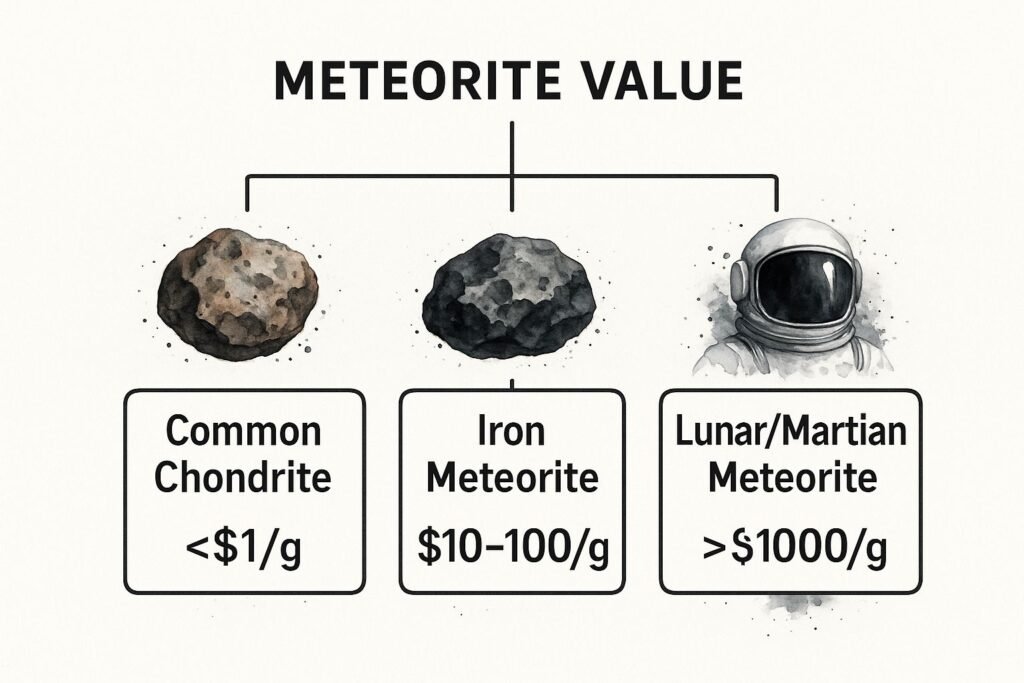
The rarity of certain meteorite types dramatically increases their value. Typical pricing ranges include:
| Meteorite Type | Approximate Value |
|---|---|
| Common chondrites | $0.50 – $5 per gram |
| Iron meteorites | $1 – $10 per gram |
| Stony-iron meteorites | $5 – $25 per gram |
| Lunar meteorites | $500 – $1,000 per gram |
| Martian meteorites | $1,000+ per gram |
Because Martian meteorites are incredibly rare—fewer than 400 known specimens worldwide—their prices can rival luxury gemstones.
Scientific Importance
Meteorites serve as natural time capsules from the early solar system. Some contain minerals that formed billions of years before Earth itself fully developed.
Scientists analyze meteorites to study:
- planetary geology
- asteroid collisions
- ancient magnetic fields
- water and organic molecules in space
Organizations like NASA’s Johnson Space Center Meteorite Laboratory analyze samples using electron microscopes, isotopic analysis, and high-precision chemical testing.
Collector and Investment Demand
In recent years, meteorites have also become a specialized collectible market. High-profile auctions through houses such as Christie’s and Sotheby’s have helped bring attention to these cosmic artifacts.
Collectors often seek:
- meteorites from famous observed falls
- rare planetary meteorites
- polished slices showing crystal structures
- large intact specimens
Some meteorites have sold for hundreds of thousands of dollars, particularly those with documented histories.
Inside the Meteorite-Hunting Industry: Where Meteorite Hunters Search for Space Rocks
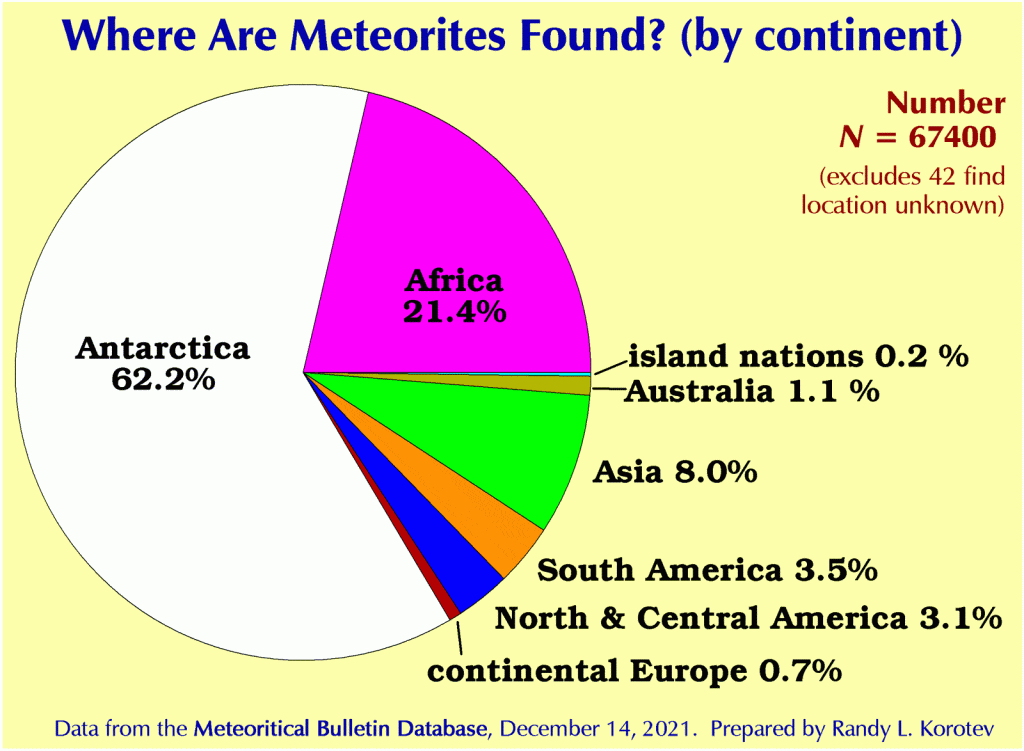
Successful meteorite hunting depends heavily on geography. Hunters target areas where meteorites are easier to spot and where environmental conditions preserve them for long periods.
Sahara Desert
The Sahara Desert is widely considered the largest meteorite hunting region on Earth. Its light-colored sand provides strong contrast against the typically dark surfaces of meteorites, making them easier to identify.
Local nomadic communities and professional hunters frequently search vast stretches of desert terrain. Many meteorites labeled “Northwest Africa” (NWA) originate from discoveries in Morocco, Algeria, and Mauritania.
Because these areas receive very little rainfall, meteorites can remain well preserved for thousands of years.
Antarctica
Antarctica might sound like an unlikely location, but it is actually one of the most productive meteorite discovery sites on the planet.
The Antarctic Search for Meteorites Program (ANSMET) has recovered more than 23,000 meteorites since 1976. Scientists locate meteorites on blue ice fields where glacial movement concentrates rocks in specific areas.
The bright white ice also makes dark meteorites easy to spot.
American Southwest
In the United States, meteorite hunters often focus on the deserts of:
- Arizona
- Nevada
- New Mexico
- California
Dry climates prevent meteorites from deteriorating quickly, and wide open landscapes allow hunters to cover large areas efficiently.
One of the most famous impact sites in the U.S. is Barringer Meteor Crater in Arizona, which formed around 50,000 years ago when a large iron meteorite struck the region.
The Tools Professional Meteorite Hunters Use
Meteorite hunting requires more than just a sharp eye. Professionals often rely on specialized equipment and scientific techniques.
Metal Detectors
Many meteorites contain significant amounts of iron and nickel, making them detectable using metal detectors. High-end detectors can locate meteorites buried several inches underground.
Magnets
Meteorites are usually magnetic due to their metal content. Hunters frequently carry strong magnets to quickly test suspicious rocks.
GPS and Mapping Technology
Professional hunters use GPS devices to record discovery locations and map search areas. This information can be important for scientific documentation and classification.
Drone and Aerial Surveys
Some modern expeditions use drones to scan large regions quickly. Although drones cannot directly identify meteorites, they help survey terrain and locate unusual rock formations.
Fireball Tracking Networks
Global networks of sky-monitoring cameras track fireballs—large meteors visible in the atmosphere. By analyzing these events, scientists can estimate potential meteorite fall zones.
One such project is the Desert Fireball Network, which uses automated cameras across Australia to track meteors and guide recovery teams.
How Meteorites Enter the Commercial Market?
Once a meteorite is discovered, it typically follows a structured path before reaching collectors or researchers.
Discovery and Recovery
A meteorite is located by a hunter, scientist, or occasionally an everyday citizen. Some famous meteorites were discovered by farmers or hikers who noticed unusual rocks.
Authentication and Testing
Professional analysis is required to confirm whether a rock is truly a meteorite. Experts examine:
- mineral composition
- metal content
- internal crystal structures
- isotopic signatures
Universities and meteorite laboratories often conduct these tests.
Official Classification
Meteorites must be classified and recorded in the Meteoritical Bulletin Database, maintained by the Meteoritical Society.
This process assigns the meteorite a name, classification, and documentation of its discovery.
Sale and Distribution
After classification, meteorites may be sold through:
- specialized dealers
- scientific institutions
- online marketplaces
- auction houses
- private collectors
Large or scientifically significant specimens are sometimes donated to museums for research and public display.
A Real Example of a Valuable Meteorite
One of the most famous planetary meteorites is NWA 7034, nicknamed “Black Beauty.”
Discovered in Morocco, this meteorite originated from Mars and contains some of the oldest Martian crust material ever found.
Key facts include:
- Estimated age: over 4.4 billion years
- Composition: Martian basaltic rock
- Scientific value: extremely high
NASA scientists have studied the meteorite extensively because it provides clues about ancient water activity on Mars.
Practical Advice for Aspiring Meteorite Hunters
Meteorite hunting can be an exciting hobby, but beginners should approach it with patience and knowledge.
Learn the Characteristics of Meteorites
Typical meteorite features include:
- dark fusion crust formed during atmospheric entry
- small surface indentations known as regmaglypts
- high density compared to normal rocks
- magnetic attraction
Understand “Meteorwrongs”
Many rocks resemble meteorites but are actually terrestrial materials such as slag or iron ore. These are commonly called meteorwrongs.
Learning to recognize these imposters is one of the most important skills for new hunters.
Document Your Discovery
Serious collectors and scientists value well-documented finds. Hunters should record:
- precise GPS coordinates
- photos of the discovery site
- weight and dimensions
- environmental conditions
Proper documentation can increase credibility and potential value.
Seek Professional Verification
Before attempting to sell a meteorite, it should be examined by experts. Universities, geological institutions, and meteorite laboratories can perform verification.
Arizona State University operates a well-known meteorite research facility.
Legal and Ethical Considerations
Meteorite hunting is regulated differently around the world.
In the United States:
- Meteorites found on private land belong to the landowner.
- Small meteorites may be collected on some public lands for personal use.
- Commercial collection may require permits.
The Bureau of Land Management (BLM) provides guidance for meteorite collection on public lands.
International laws vary widely, and some countries consider meteorites national heritage objects that cannot be exported without permission.
Responsible hunters always research local laws before collecting or selling meteorites.
Geochemist Reports Unusual Earth Measurements Previously Seen Only in Meteorites
Scientists Narrow the Search for the Luna 9 Landing Site Using AI Mapping
10 Archaeology Discoveries That Sound Fake but Are Completely Real