
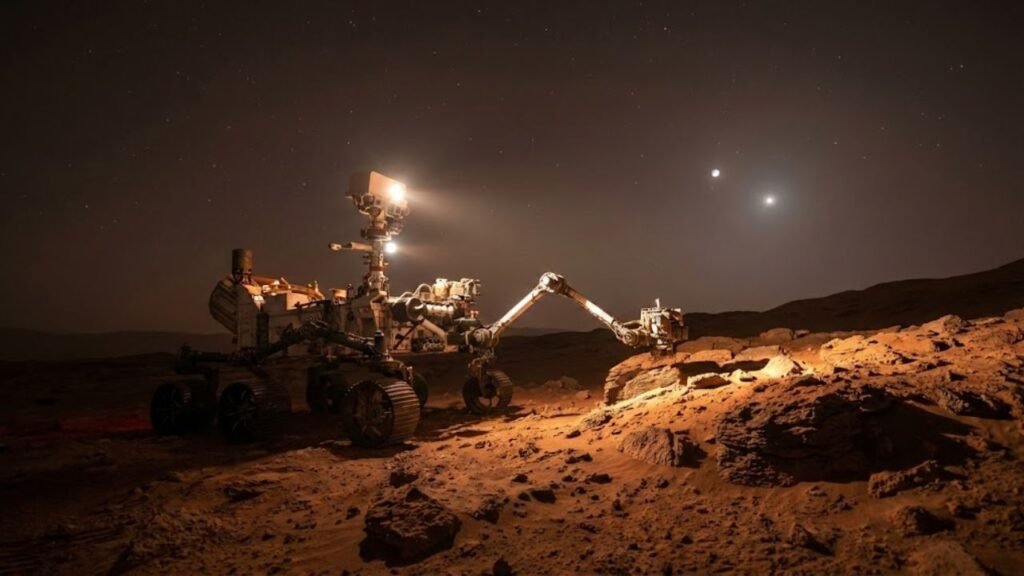
NASA has released a striking new image showing Mars in darkness, captured by its Curiosity rover using onboard lighting rather than sunlight. The rare Self-Lit Scene was taken inside Gale Crater during late 2025 and offers scientists new ways to study Martian rock textures and mineral composition that daylight images cannot reveal.
Table of Contents
NASA Curiosity Rover Snaps Stunning Night Image Of Mars
| Key Fact | Detail |
|---|---|
| Where image was taken | Gale Crater, Mars |
| Date captured | December 2025 (Sol 4740) |
| Camera used | Mars Hand Lens Imager (MAHLI) LEDs |
What Is Self-Lit Scene and Why Scientists Care
The photograph represents a rare operational mode for Mars exploration. Nearly all rover imaging occurs during daytime because sunlight provides consistent illumination and reduces operational risk.
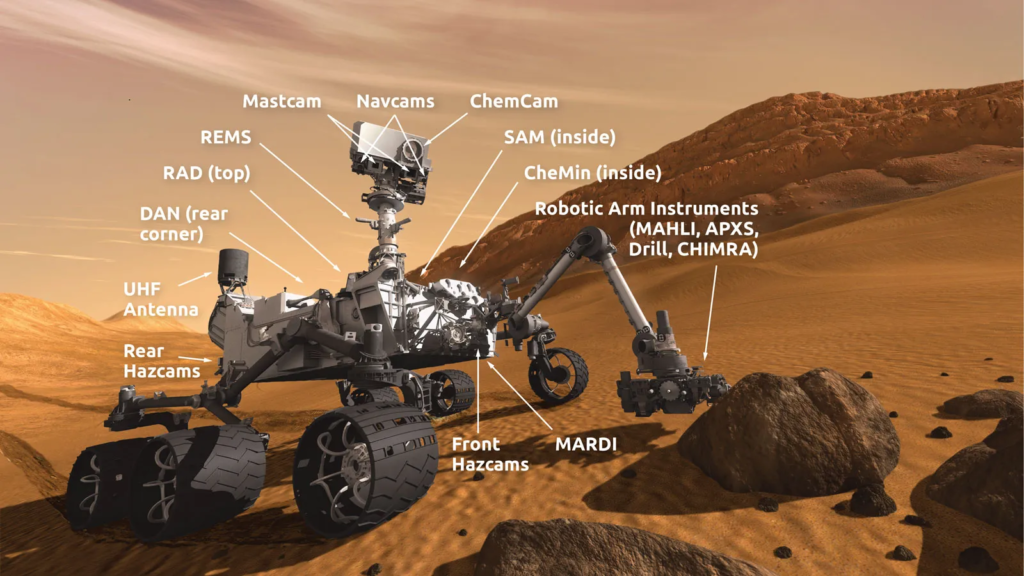
However, engineers equipped the rover with powerful light-emitting diode lamps on the Mars Hand Lens Imager (MAHLI). The device normally photographs drilled rock samples at close range.
“This allows us to examine textures and layering that sunlight can hide,” NASA’s Jet Propulsion Laboratory scientists explained in mission commentary. Artificial light casts sharper shadows and highlights microscopic features in rock walls.
Researchers say the Self-Lit Scene offers an Earth-like field geology method — essentially a robotic scientist using a flashlight at night.
On Earth, geologists frequently conduct nighttime inspections of cliffs, caves, and quarries because controlled lighting reveals surface details that midday sun washes out. NASA scientists applied the same concept to Mars, where natural lighting conditions are often harsh and flat due to thin atmospheric scattering.
How the Image Was Taken
Curiosity, a car-sized mobile laboratory operated by NASA’s Jet Propulsion Laboratory (JPL) in California, positioned its robotic arm over a drilled rock target nicknamed “Nevado Sajama.”
The rover activated white LEDs and photographed the exposed rock interior.
The method is scientifically valuable because Mars’ thin atmosphere scatters very little light. Without the rover’s lamps, the surface would be almost completely black at night.
Technical Details of the Imaging System
The MAHLI camera sits on the rover’s 7-foot robotic arm and functions as a hand-held microscope for Mars. It can focus from just a few centimeters away up to several meters. The LEDs provide both white light and ultraviolet illumination, enabling scientists to detect fluorescent minerals.
Engineers scheduled the operation carefully to conserve energy. The rover temporarily suspended other power-intensive activities while conducting the imaging sequence.
What Scientists Learned From the Mars Night Photograph
Geological Clues
The illuminated rock face shows fine sedimentary layers formed billions of years ago when water likely existed in Gale Crater.
According to NASA researchers, sediment patterns suggest the area was once part of a lakebed environment. Water-deposited minerals are a key indicator that ancient Mars may have supported microbial life.
“The lighting lets us inspect the interior of drill holes in a way that daytime images simply cannot,” mission scientists said.
Mineral Identification
Artificial lighting changes how light reflects from minerals. Certain clays and sulfates — minerals associated with past water — appear more clearly under controlled illumination.
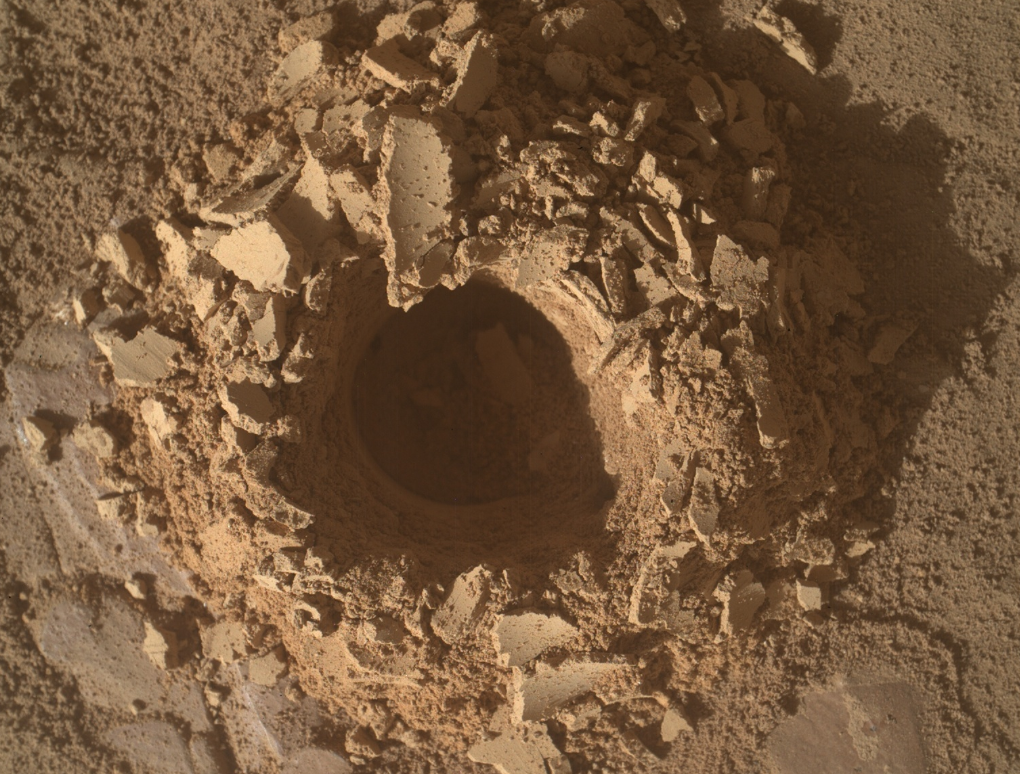
Researchers noted the rock exhibited cross-bedding, a pattern formed when sediments settle in flowing water. On Earth, such structures appear in riverbeds and shallow lakes.
Evidence of Ancient Habitability
Curiosity has already discovered organic molecules in Martian rocks. While not proof of life, they are considered building blocks necessary for biology. The new Mars night image helps confirm that the environment once contained water, chemical nutrients, and stable conditions — three major requirements for microbial habitability.
Curiosity’s Ongoing Mission in Gale Crater
The rover landed in 2012 and has traveled more than 30 kilometers across the Martian surface. Its primary goal is to determine whether Mars ever supported life.
Gale Crater contains Mount Sharp, a layered mountain scientists consider a natural archive of the planet’s climate history.
Curiosity carries:
- a chemistry laboratory
- radiation detectors
- environmental sensors
- rock drilling tools
Each layer of sediment represents a different era in Martian environmental change.
What Makes Gale Crater Important
Scientists chose Gale Crater because orbital satellites detected clay minerals there before landing. Clay forms only in long-term contact with water, making the location one of the most promising sites for past habitability.
The mountain inside the crater rises about 5 kilometers high. As the rover climbs it, scientists effectively move forward in time through Mars’ climate record.
Why Night Operations Are Rare on Mars
Mars nights are extremely harsh. Temperatures can drop below minus 70 degrees Celsius (minus 94 degrees Fahrenheit). Electronics must rely on the rover’s radioisotope power system, which converts heat from plutonium decay into electricity.
Operating at night requires careful planning because:
- visibility is limited
- navigation risks increase
- power consumption must be controlled
Despite these challenges, engineers occasionally conduct night science experiments because they reveal information daylight cannot.
The Challenge of Martian Darkness
Unlike Earth, Mars has no large moon to illuminate the surface. Its moons, Phobos and Deimos, are too small to provide meaningful light. As a result, the terrain at night is darker than most desert locations on Earth.
The new Self-Lit Scene therefore shows a landscape almost no human eye has ever witnessed.
Broader Implications for Future Exploration
Scientists say Self-Lit Scene techniques could help future missions — especially robotic drilling missions and eventual human explorers.
Night imaging could:
- inspect subsurface ice
- examine cave entrances
- study rock interiors without sunlight interference
The findings may also guide NASA’s Mars Sample Return program and future astronaut missions.
Preparing for Human Missions
NASA and international partners are planning future crewed missions to Mars in the 2030s or 2040s. Astronauts will need to conduct geology fieldwork in caves, lava tubes, and shaded regions. Controlled lighting experiments like this provide critical operational experience.
Expert Perspective
Planetary geologists note the method mirrors how researchers work in deserts and caves on Earth.
Artificial illumination changes shadow geometry, revealing grain size and rock hardness. Those features help scientists reconstruct ancient environments.
According to mission researchers, the Martian sediment layers likely formed over millions of years as water flowed and evaporated repeatedly.
One planetary scientist explained that the technique allows “micro-stratigraphy,” meaning the study of rock layers at extremely small scales. This helps scientists reconstruct seasonal cycles on ancient Mars.
How Curiosity Survives Harsh Martian Nights
Unlike newer solar-powered rovers, Curiosity uses a Multi-Mission Radioisotope Thermoelectric Generator (MMRTG). The device converts heat from radioactive decay into electricity and keeps internal instruments warm.
This system allows the rover to:
- operate during dust storms
- function during winter
- survive freezing temperatures
The heat also prevents sensitive electronics from cracking due to thermal contraction.
Looking Ahead
Curiosity continues climbing Mount Sharp, where higher layers contain minerals formed in increasingly dry conditions. Scientists hope to map how Mars transitioned from a wetter world to the cold desert seen today.
Future observations may repeat the Self-Lit Scene experiment at other sites, including possible salt deposits and ancient shoreline formations.
As one mission scientist said, the rover is “not just taking pictures — it is reading the geological history of another planet, layer by layer.”
FAQs About NASA Curiosity Rover Snaps Stunning Night Image Of Mars
Why is nighttime imaging important on Mars?
Artificial light reveals textures and mineral structures hidden in sunlight.
Could this help find life?
Indirectly. It helps identify environments that once had water, which is necessary for microbial life.
Is the rover safe at night?
Yes. Curiosity uses a nuclear power source that keeps instruments warm and operational even in extreme cold.
How long can Curiosity keep working?
NASA originally expected a two-year mission. The rover has now operated for more than a decade and continues functioning.