


Researchers Track a New Near-Earth Object: Right out the gate, Asteroid 2024 YR4 is set to be one of the most talked-about space rocks of the decade — not because it’s coming to smash Earth, but because it’s linked to the Moon in a way most people don’t fully grasp yet. Scientists are tracking this near-Earth object (NEO) closely, and we’re breaking it down plain-talk, USA style, so even a 10-year-old gets it — while still giving space professionals and educators the deep insights they need.
This article gives you hard facts, practical context, expert perspectives, and clear explanations of the science behind asteroid tracking and planetary defense. Think of it like sitting around a campfire with an old space-nerd uncle — friendly, honest, and smart. We’ll walk you through what 2024 YR4 is, how it was discovered, what it could mean for the Moon, why it matters for Earth, and what both young learners and professional audiences can learn from tracking these cosmic travelers.
Table of Contents
Researchers Track a New Near-Earth Object
Asteroid 2024 YR4 isn’t a threat to Earth, but its small chance of striking the Moon highlights why astronomers monitor near-Earth objects so carefully. It’s a rare opportunity to study impact physics, refine planetary defense strategies, and educate the public. By tracking these cosmic visitors, we improve our understanding of the solar system, protect our planet, and prepare for potential future events with confidence and expertise.
| Topic | Detail |
|---|---|
| Object Name | Asteroid 2024 YR4 |
| Discovery Date | 27 Dec 2024 |
| Size Estimate | ~53 – 67 m (about the size of a 10–15 story building) |
| Earth Impact Risk | No significant risk now |
| Moon Impact Probability | ~4% chance of striking the Moon on 22 Dec 2032 |
| Next Observations | Mid‑2028 (visible again) |
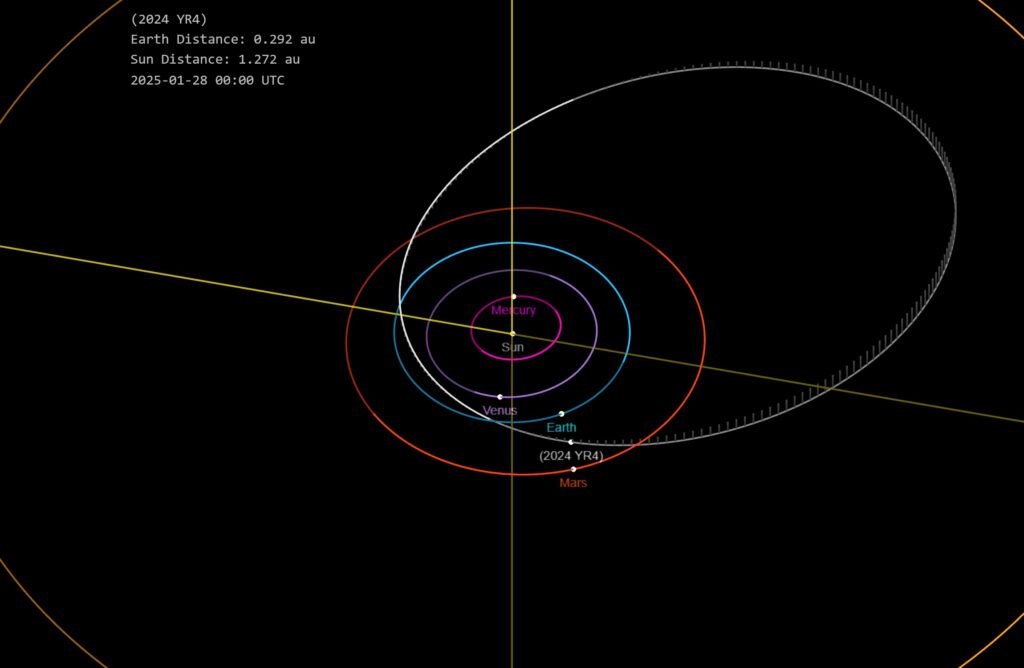
| Orbital Category | Near‑Earth Apollo asteroid (crosses Earth’s orbit) |
| Planetary Defense Programs Involved | NASA CNEOS, ATLAS, ESA Planetary Defence |
What Is Asteroid 2024 YR4? — Context for All Ages
Asteroid 2024 YR4 is a near-Earth object (NEO) — that means it’s a small rocky body in our solar system whose orbit brings it near Earth and the Moon. It was first spotted on December 27, 2024 by the Asteroid Terrestrial-impact Last Alert System (ATLAS) telescopes in Chile, which are part of a global network scanning the skies nightly to catch objects that might pose a risk to our planet.
When astronomers plugged its early trajectory into NASA’s impact risk models, the asteroid initially had a Torino Scale rating of 3 — a rare rating that sparks public attention because it suggests a potential for damage if the object were to impact Earth. But here’s the good news: as more measurements came in, scientists realized 2024 YR4’s path does not pose a significant risk to Earth in the foreseeable future.
Instead, the asteroid’s path brings it closer to the Moon than we’ve seen with many objects of its size, which gives scientists a unique opportunity to study a potential lunar impact event in advance.
Researchers Track a New Near-Earth Object: Why the Moon Matters in This Story
The Moon isn’t just a pretty rock in the sky — it’s our closest celestial neighbor and a natural laboratory for understanding impacts. Unlike Earth, the Moon lacks an atmosphere, which means any object that strikes it hits its surface directly. This makes the Moon the perfect place to observe impacts and study the resulting craters and debris.
If 2024 YR4 were to strike the Moon on December 22, 2032, the results could include:
- A visible flash from Earth: Even amateur astronomers may be able to spot the impact as a bright flash on the lunar surface.
- Crater formation: Depending on the asteroid’s speed and angle, the crater could be hundreds of meters across. Scientists can use this to refine their understanding of impact physics.
- Ejected debris: Some fragments could be thrown into space, providing researchers with natural samples of the lunar surface for observation without a mission.
By studying lunar impacts, scientists can better understand how impacts shape planetary surfaces, the likelihood of asteroid fragments reaching Earth, and even how to design mitigation strategies for larger objects that might threaten Earth in the future.
How Astronomers Track and Calculate These Probabilities?
Tracking an asteroid isn’t as simple as pointing a telescope and snapping a photo. It involves a careful process that combines observations, mathematics, and computational models.
1. Discovery & Initial Measurement
Telescopes like ATLAS and Pan-STARRS scan the night sky continuously. When a moving object is detected against the background of stars, astronomers record its position. The first few nights of observations are crucial to determine whether the object is a harmless background asteroid or something worth following.
2. Follow-Up Observations
Once an object is identified, observatories worldwide coordinate to gather more data. Multiple observations help refine the asteroid’s trajectory. The more data collected, the more accurately scientists can predict its future path.
3. Orbital Modeling
Next, scientists use software systems like NASA’s Sentry and ESA’s planetary defense tools to simulate thousands of possible future paths for the asteroid. This process generates probabilities, such as the ~4% chance of 2024 YR4 hitting the Moon.
4. Uncertainty Reduction
Each new measurement reduces uncertainties in the asteroid’s predicted orbit. This is why early predictions might show a higher risk than later, refined calculations. This constant updating is critical in planetary defense planning.
5. Continuous Monitoring
Asteroids like 2024 YR4 often disappear from view for years before returning. For 2024 YR4, scientists expect it to be observable again around 2028, giving them another opportunity to refine predictions and confirm the Moon impact probability.
This process is why astronomers can provide reliable forecasts and avoid unnecessary panic. The ability to track, predict, and update orbital data in real time is a testament to decades of expertise in space observation and computational modeling.
Physical Characteristics of a New Near-Earth Object
Asteroid 2024 YR4 is estimated to be roughly 53–67 meters in diameter — similar in size to a 10–15 story building. While this might seem small on a cosmic scale, it’s large enough to cause noticeable effects if it were to hit a planetary body. Its composition appears to be a typical stony asteroid, similar to many objects in the Apollo class of near-Earth asteroids that cross Earth’s orbit.
It travels at a speed of roughly 15–20 kilometers per second relative to Earth, meaning any collision with the Moon would release energy equivalent to hundreds of kilotons of TNT — far more than conventional explosives, but far less than a civilization-ending asteroid.
Why Researchers Track a New Near-Earth Object Matters for Earth?
Even though 2024 YR4 poses no risk to Earth, monitoring its path and studying potential lunar impacts has practical benefits:
- Planetary Defense Preparedness
Each asteroid we track improves our predictive models. Knowing how a 60-meter asteroid behaves in orbit, how small uncertainties affect predictions, and how impacts play out on airless bodies helps scientists prepare for larger threats. - Technology Validation
Observing this asteroid allows scientists to test telescopic capabilities, data processing systems, and international coordination strategies, all essential for protecting Earth. - Educational Opportunities
Real-time asteroid tracking provides educators and students with a live example of science in action. From physics to computer modeling, tracking 2024 YR4 showcases the interdisciplinary nature of space science. - Lunar Research Advantages
Potential debris and crater studies can inform future Moon missions. Understanding impact mechanics helps in selecting safe landing zones for lunar bases or rovers and guides designs for protecting equipment from micrometeorite impacts.
Practical Advice for Young Learners and Professionals
For Young Learners
- Keep an eye on science news. Observing the Moon during predicted events is a safe and exciting way to learn.
- Study basic orbital mechanics and physics — it’s not just about numbers; it’s about patterns and predictions.
For Professionals
- Track NEO data through NASA’s Planetary Defense Coordination Office.
- Collaborate internationally. Planetary defense is global; monitoring these objects requires cooperation across observatories and agencies.
- Use lunar impact predictions to refine your models for spacecraft navigation and risk assessment.
Researchers Find Microbes May Help Trees Absorb Trace Gold
Greek Inscription Offers New Evidence in the Elagabalus Temple Debate
James Webb Observations Point to a Planet With Vast Water Reserves