
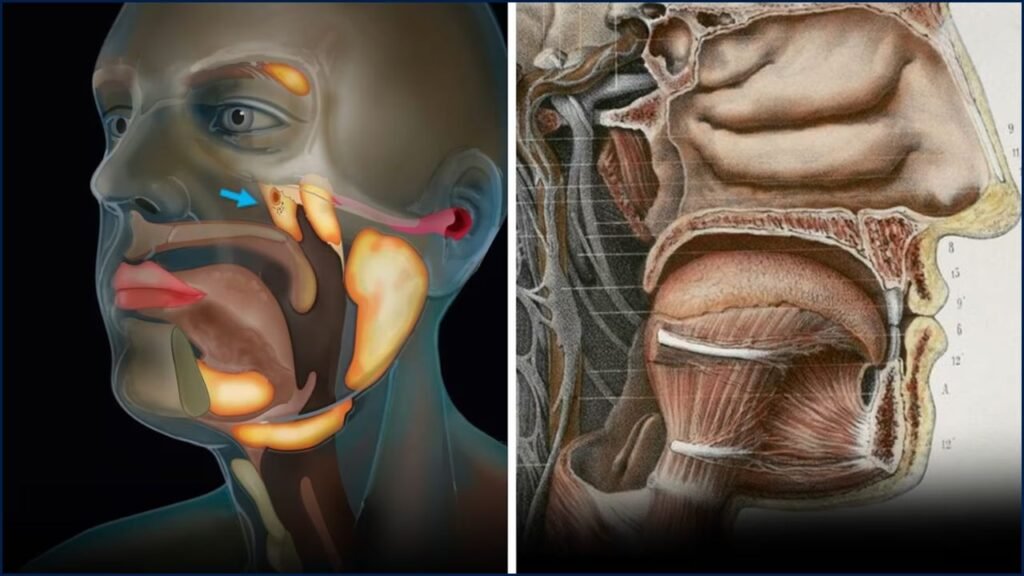
Researchers in the Netherlands reported a previously overlooked structure in the human head — the Unknown Organ Hidden Behind the Human Nose — located deep behind the nasal cavity near the upper throat. The discovery emerged from cancer imaging scans and revealed a pair of salivary glands absent from most medical textbooks, potentially improving radiotherapy safety and refining modern anatomical understanding.
Table of Contents
Unknown Organ Hidden Behind the Human Nose
| Key Fact | Detail / Statistic |
|---|---|
| Location | Upper throat behind nasal cavity (nasopharynx) |
| Discovery Method | PSMA PET-CT cancer scans |
| Medical Impact | May reduce radiation therapy side effects |
Researchers say the discovery shows medicine continues to evolve with technology. As imaging becomes more precise, doctors may uncover additional structures affecting treatment and quality of life. Ongoing international studies will determine how best to protect the Unknown Organ Hidden Behind the Human Nose during cancer therapy and clarify its full biological role.
What Scientists Found
The research team from the Netherlands Cancer Institute identified a pair of glandular structures positioned above the soft palate near the opening of the Eustachian tube. For centuries, anatomy described only three major salivary gland pairs: parotid, submandibular, and sublingual.
Lead investigator Dr. Wouter Vogel, a radiation oncologist, said the discovery occurred while reviewing scans of prostate cancer patients.
“People have three sets of large salivary glands, but not there,” Vogel explained during clinical discussions. “We found something consistently present.”
The team observed the structure in more than one hundred patients. Cadaver examinations later confirmed its physical presence, supporting that the Unknown Organ Hidden Behind the Human Nose was not a scanning artifact.
The glands appear to produce mucus-rich saliva that lubricates the upper throat, helping breathing, swallowing, and speaking.
How Imaging Technology Revealed the Structure (Advanced medical imaging)
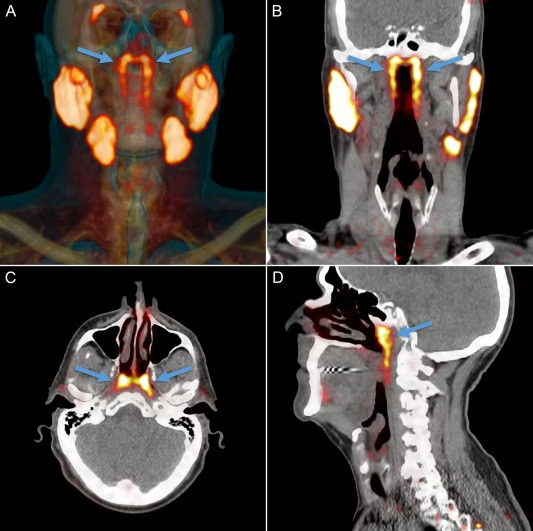
Traditional CT and MRI scans struggled to identify the tissue because it blended into surrounding mucosa. However, PSMA PET-CT — a form of advanced medical imaging — uses radioactive tracers that bind to certain cell receptors.
Salivary tissue absorbs the tracer strongly. As a result, the hidden glands illuminated clearly during scans originally intended to detect cancer spread.
The study, published in Radiotherapy and Oncology, described symmetrical glandular structures measuring roughly 3–4 centimeters in length. Researchers noted the glands appeared in every patient examined.
Medical imaging specialists say the discovery demonstrates how modern technology can refine even basic anatomical knowledge.
For centuries, anatomy relied on dissection. Today, imaging shows living tissue function, revealing structures too delicate or concealed to detect in traditional methods.
Why Unknown Organ Hidden Behind the Human Nose Matters for Cancer Treatment (Radiation therapy side effects)
The most immediate impact concerns head-and-neck cancer therapy.
Radiation treatment can damage salivary glands, causing radiation therapy side effects such as chronic dry mouth, difficulty swallowing, and impaired speech. These complications significantly reduce quality of life.
Doctors reviewing treatment records noticed a pattern. Patients receiving radiation near the region behind the nose reported more severe dryness and throat discomfort.
Researchers now suspect the newly identified glands play a crucial lubricating role in the nasopharynx. Protecting them during treatment could reduce complications.
The American Society for Radiation Oncology (ASTRO) has long emphasized preserving saliva-producing tissue. Oncologists say this discovery offers a new region to avoid when planning treatment beams.
Clinicians in several European hospitals have already begun adjusting radiation maps to spare the glandular area when possible.
Scientific Debate: Is It a New Organ? (Nasopharynx anatomy)
Scientists broadly accept the structure exists, but disagreement remains over terminology.
Some experts consider it a previously unrecognized part of the salivary system rather than a separate organ. Others argue its consistent size and specialized function qualify it as a major gland pair within nasopharynx anatomy.
Pathologist Dr. Valerie Fitzhugh explained in academic commentary:
“Anatomy evolves. Discoveries do not overturn science — they refine classification.”
The debate centers on definition. An organ typically performs a distinct function with identifiable tissue organization. The glands appear to secrete mucus essential for lubricating the upper airway.
Regardless of classification, clinicians agree the medical importance is real.
Historical Context: Discoveries in Human Anatomy Still Occur
The finding surprised the public because many assume human anatomy is completely mapped. Medical historians say that assumption is inaccurate.
Even in the 21st century, researchers have described:
- New lymphatic vessels in the brain (2015)
- Interstitial fluid tissue networks (2018)
- Previously undocumented immune pathways
Anatomists explain that hidden, microscopic, or fragile structures are difficult to identify without modern imaging or molecular markers.
The Unknown Organ Hidden Behind the Human Nose fits that pattern. Its deep location and delicate tissue made it easy to miss during traditional dissection.
What the Glands Actually Do
Researchers believe the glands produce mucus-dominant saliva rather than watery saliva.
This type of secretion coats the upper throat and nasal airway, preventing dryness during breathing. The function is particularly important while sleeping, speaking for long periods, or breathing dry air.
Ear-nose-throat specialists note the area serves as a junction where air and swallowed material pass close together. Lubrication prevents irritation and inflammation.
Without proper moisture, tissues can crack, increasing infection risk and swallowing discomfort.
Impact on Patients
Head-and-neck cancer survivors often report severe long-term dryness after radiotherapy. Some require lifelong artificial saliva or special diets.
Oncology rehabilitation specialists say protecting the glandular region may improve recovery outcomes.
Patients affected by xerostomia often struggle with:
- Eating dry foods
- Sleeping comfortably
- Speaking for extended periods
- Dental health deterioration
Because saliva protects teeth and neutralizes bacteria, preserving gland function also reduces cavities and oral infections.
Broader Implications for Medicine and Education
Medical schools are reviewing whether future anatomy curricula should include the glands. Textbook revisions typically require repeated confirmation from independent research groups.
Radiologists say the discovery illustrates a growing trend: collaboration between oncology and anatomy. Cancer imaging often reveals structures not previously recognized in classical anatomical atlases.
The case also highlights the increasing importance of functional imaging — observing how tissues behave rather than only how they appear.
Why It Took So Long to Notice
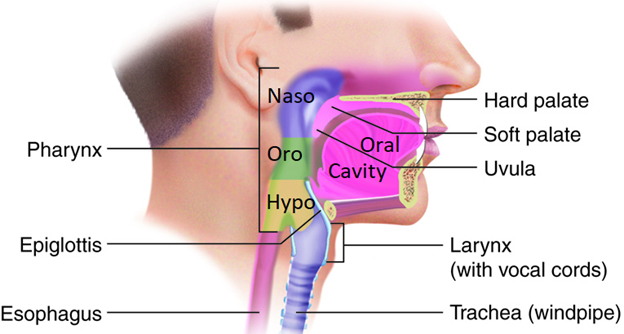
The glands lie in the nasopharynx, a narrow space behind the nasal passages and above the soft palate.
During traditional dissection, removing the skull base often damages this area. The tissue can collapse or tear, leaving little trace of organized gland structure.
Additionally, the glands resemble surrounding mucosal tissue, making them difficult to distinguish visually.
Only functional imaging — showing cellular activity — revealed their consistent pattern.
Current Status of Research
Scientists are now investigating:
- Nerve supply
- Secretion volume
- Possible involvement in infection or inflammation
- Role in chronic throat dryness
International research teams are replicating the findings to confirm prevalence across populations.
Hospitals in North America, Europe, and Asia are also testing new radiation-planning software incorporating the glandular region as a protected structure.
FAQs About Unknown Organ Hidden Behind the Human Nose
Is the Unknown Organ Hidden Behind the Human Nose dangerous?
No evidence suggests it causes disease by itself.
Will people feel it?
No. It sits deep in the upper throat and cannot be felt directly.
Why was it missed for centuries?
Its position and tissue similarity made it nearly invisible during dissection.
Does this discovery affect healthy individuals?
Mostly no. Its main importance is for cancer patients undergoing radiation therapy.