


Across cultures and age groups, people reliably connect certain sounds to specific shapes, a psychological phenomenon widely known as the Bouba Effect. Researchers say this effect, sometimes called the Bouba–Kiki effect, appears in infants and even animals, suggesting the roots of language may lie partly in biology rather than social convention.
Table of Contents
The Bouba Effect Explained
| Key Fact | Detail / Statistic |
|---|---|
| Cross-cultural agreement | About 95% of participants match “bouba” with rounded shapes |
| Infant response | Babies only months old react to mismatched pairings |
| Animal evidence | Domestic chicks show similar sound-shape associations |
Researchers continue testing the Bouba Effect using neuroimaging, developmental psychology, and cross-species experiments. Scientists say understanding the phenomenon could clarify how humans first created spoken language and how perception shapes communication, a question still central to cognitive science.
What Is the Bouba Effect?
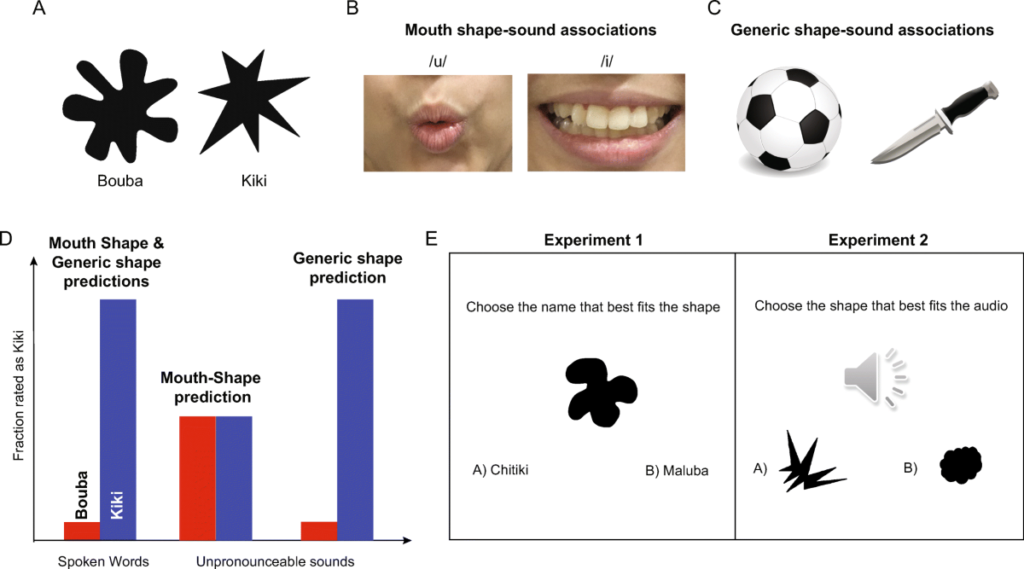
The Bouba Effect refers to a consistent mental association between speech sounds and visual forms. In experiments, participants view two abstract figures — one rounded and one jagged — and assign nonsense words such as “bouba” and “kiki.”
The results are remarkably uniform. Most participants choose rounded shapes for “bouba” and sharp shapes for “kiki.”
Cognitive neuroscientist Dr. Vilayanur S. Ramachandran of the University of California, San Diego, has argued the pattern reflects fundamental brain organization.
“These correspondences suggest that the brain is not arbitrary in how it links sound and meaning,” he wrote in research on cross-modal perception.
Researchers classify the phenomenon under sound symbolism, meaning speech sounds can carry meaning independent of vocabulary.
Historical Origins of the Discovery
The Bouba Effect was not discovered recently. German psychologist Wolfgang Köhler first documented a similar phenomenon in 1929 while studying perception and language development. He used different nonsense words — “takete” and “maluma” — but observed the same pattern.
Nearly a century later, modern psychologists replicated his work with global participants and confirmed the reliability of the effect. Researchers tested speakers of English, Spanish, Tamil, Japanese, and Himba (a language spoken in Namibia). Despite linguistic differences, responses remained similar.
The consistency has made the Bouba Effect one of the most cited demonstrations in cognitive psychology and linguistics.
How Scientists Study Sound-Shape Matching
Mouth Movement and Phonetics
Speech articulation plays an important role. The word “bouba” requires rounded lips and smooth airflow, while “kiki” requires a sharp release of air and tongue tension.
Cognitive scientist Dr. Morten Christiansen of Cornell University says speech production itself shapes perception.
“When we produce sounds, we generate physical sensations that may mirror the objects we describe,” he explained in discussions on language evolution.
Acoustic Properties
Linguists also analyze acoustic patterns:
- Rounded sounds: lower frequency, continuous waveform
- Sharp sounds: higher frequency, abrupt waveform
The brain appears to interpret sound textures similarly to visual textures, linking auditory qualities with visual features.
Evidence From Babies and Animals
One of the strongest findings is that the Bouba Effect appears before language learning.
Developmental psychologists observed that infants around four months old look longer at incorrect pairings, indicating surprise. Because infants cannot yet speak, researchers interpret this as evidence of innate perception rather than learned vocabulary.
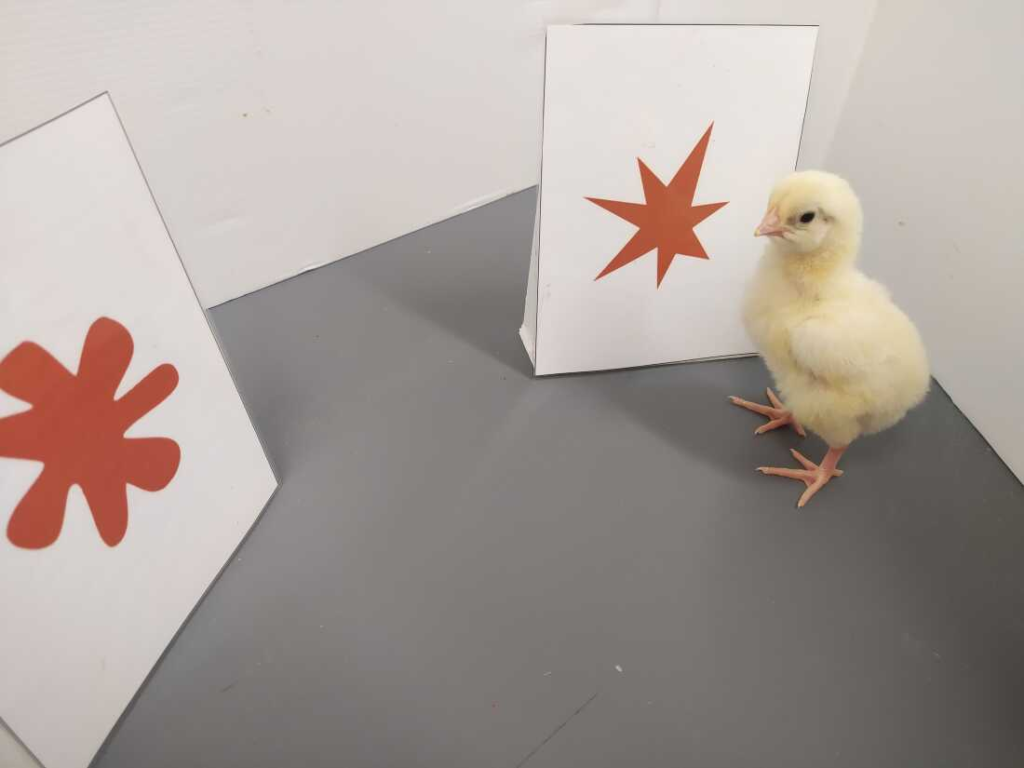
Comparative cognition experiments extended the findings further. Newly hatched domestic chicks, raised without prior exposure to human language, also matched soft sounds to rounded shapes.
Ethologist Dr. Luca Regolin of the University of Padua concluded:
“The association likely reflects a general perceptual mechanism shared across species.”
Brain Imaging and Neuroscience Findings
Functional MRI scans have allowed researchers to observe the brain during these experiments. When participants see a mismatched pairing — such as a jagged figure labeled “bouba” — certain brain regions activate more strongly.
Scientists interpret this as a prediction error: the brain expected a different sensory combination.
Neuroscientists believe the effect involves interaction between:
- auditory cortex (hearing)
- visual cortex (sight)
- angular gyrus (multisensory integration)
The Bouba Effect therefore illustrates cross-modal perception, the brain’s ability to combine sensory information.
Implications for the Origins of Language
For decades, linguistics held that words were arbitrary symbols. The Bouba Effect challenges that idea.
Many scientists now propose early human communication relied on intuitive sound-meaning links. Harsh sounds may have indicated danger or sharp objects, while soft sounds signaled safe or gentle objects.
This could have helped early humans communicate before structured grammar existed.
Linguistic patterns across languages support this view. Words describing smallness or cuteness often contain high-pitched vowels, while words describing largeness use lower-pitched vowels.
Researchers believe such biases help children learn vocabulary faster because the brain narrows possible meanings.
Cultural and Linguistic Evidence Worldwide
Studies have examined speakers in Asia, Africa, Europe, and the Americas. While pronunciation differs, the mapping between sound and shape remains similar.
However, scientists caution the effect is not universal in a strict sense. Some cultures show weaker associations, suggesting biological tendencies may interact with learning.
Linguist Dr. Asifa Majid of the University of York noted:
“Biology provides a bias, but culture shapes how strongly it appears.”
Real-World Applications
Branding and Marketing
Product names often follow sound symbolism patterns. Soft-sounding names are frequently used for food or cosmetic products, while sharper sounds appear in tools or technology brands.
Marketing researchers say such naming can subtly influence consumer perception.
Character Naming and Storytelling
Film and animation writers often give villains harsh consonants and heroes softer names. Psychologists believe audiences subconsciously interpret these sounds before understanding the character.
Education and Literacy
Educators are studying whether the Bouba Effect can help early reading instruction. Linking phonics to visual meaning may improve comprehension in young learners.
Artificial Intelligence and Human-Computer Interaction
Researchers in human-computer interaction are also studying the effect. Designers aim to create voice assistants and robots whose names and voices feel intuitive to users.
Ongoing Scientific Debate
Although widely accepted, the Bouba Effect remains under investigation.
Some researchers argue neural wiring explains the phenomenon entirely. Others believe learning during infancy strengthens the association.
Psychologist Dr. Asifa Majid emphasizes caution:
“The effect is reliable, but we still do not know whether it evolved specifically for language or is a general sensory principle.”
FAQs About The Bouba Effect
Is the Bouba Effect universal?
It appears in many cultures but varies in strength.
Does it mean words are not arbitrary?
Most linguists now think language is partly arbitrary but guided by perceptual biases.
Why does it matter?
It may explain how children learn language and how human speech evolved.