
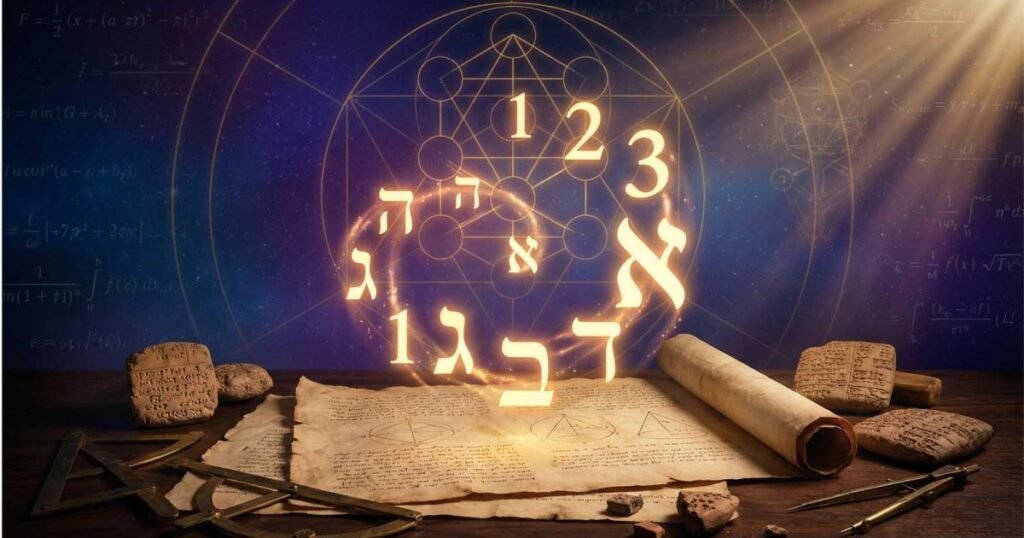
Ancient Gematria, a centuries-old interpretive system assigning numerical values to letters, has long been used to uncover hidden meanings in sacred writings. Emerging in the eastern Mediterranean and preserved through Jewish scholarship, the method continues to draw attention from historians, linguists, and mathematicians studying how early civilizations combined language, theology, and numbers.
Table of Contents
Ancient Gematria
| Key Fact | Detail |
|---|---|
| Origin | Late Second Temple period, roughly 1st century BCE |
| Principle | Letters function as numbers and words can be compared mathematically |
| Cultural Impact | Used in Jewish mysticism, early Christianity, and Arabic traditions |
What Ancient Gematria Is and How It Works
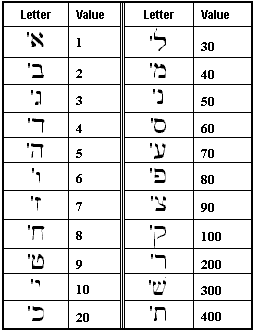
Ancient Gematria assigns a numerical value to each letter of an alphabet. When a word is written, its letters are added together to produce a total value. Scholars compare words with matching totals to identify symbolic connections or interpretive meaning.
In Hebrew letter numbers, the first nine letters represent values one through nine, the next group represents tens, and the final letters represent hundreds. This dual function existed because early societies did not possess separate numeral symbols.
For example, the Hebrew word meaning “life” equals 18. As a result, the number 18 gained cultural significance in Jewish charity and gift-giving traditions.
Dr. Jonathan Ben-Ami, historian of religion at the Hebrew University of Jerusalem, explains:
“Ancient readers treated sacred writings as deliberate compositions. If every letter mattered, then numeric patterns were viewed as intentional rather than accidental.”
Ancient Gematria was therefore not arithmetic for its own sake. It was part of sacred text interpretation, a method for reading spiritual meaning into the structure of language itself.
Historical Roots Across Civilizations
Although widely associated with Judaism, researchers say Ancient Gematria developed from broader Mediterranean intellectual traditions. Greek scholars practiced a similar technique called isopsephy, while Arabic scholarship later used the abjad numeral system.
Ancient inscriptions reveal that alphabets served administrative, financial, and spiritual functions. Letters recorded trade accounts but also carried symbolic meaning in religious texts.
Historians have discovered examples where rulers encoded their names numerically in architecture and monuments. These were not puzzles but demonstrations of cosmic order and divine legitimacy.
Dr. Francesca Rochberg, historian of ancient science at the University of California, Berkeley, notes:
“For ancient cultures, mathematics described the structure of the universe. Numbers were not abstract—they were evidence of divine harmony.”
This worldview helps explain why biblical numerology appears frequently in ancient writings. Numbers such as 7, 12, and 40 occur repeatedly, reflecting symbolic meaning rather than literal measurement.
Role in Jewish Mysticism and Theology
Connection to Kabbalah Numerology
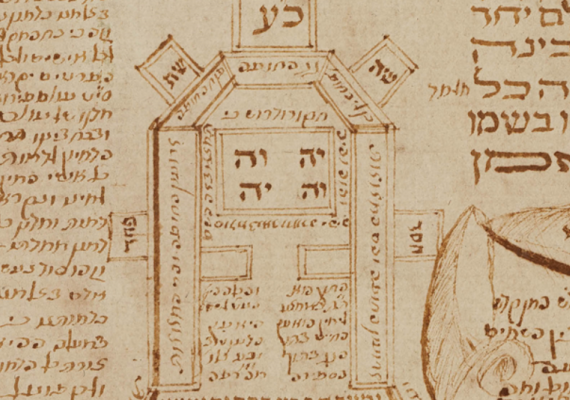
Ancient Gematria became especially important in Kabbalah numerology, a medieval Jewish mystical tradition that viewed scripture as layered with multiple meanings.
Medieval scholars argued that sacred texts contained literal, allegorical, and hidden numerical interpretations. Under this system, identical numerical totals implied theological relationships between words.
Rabbinic commentary sometimes linked different Hebrew words sharing a number, suggesting deeper spiritual connections.
Rabbi David Shapiro, lecturer in Jewish thought, says:
“Ancient Gematria supplemented traditional reading. It was a reflective exercise meant to deepen understanding, not replace scripture’s plain meaning.”
Scholars emphasize that it functioned as interpretive theology rather than predictive prophecy.
How Scholars Used Ancient Gematria in Practice
Ancient commentators applied the system in several ways:
1. Cross-Referencing Verses
Writers compared passages with equal numerical totals to suggest thematic unity.
2. Identifying Symbolic Concepts
Some numbers came to represent abstract ideas.
For example:
- 7 symbolized completeness
- 12 symbolized community or tribes
- 40 symbolized transformation or testing
3. Memorization Tool
In oral cultures, number associations helped preserve and recall long texts before widespread literacy.
Dr. Miriam Adler, a textual historian, explains:
“Ancient Gematria likely helped readers organize and remember large bodies of religious literature. It was both theology and mnemonic device.”
Influence Beyond Judaism
Ancient Gematria influenced several religious traditions. Early Christian writers analyzed symbolic numbers in apocalyptic literature. Interpretations of the “number of the beast” in the Book of Revelation often relied on Hebrew or Greek letter-number calculations.
In Islamic scholarship, Arabic letter numbers were used in inscriptions, poetry, and architectural dedications.
Historians view these similarities as evidence of a shared intellectual environment across the ancient Near East and Mediterranean rather than independent invention.
Ancient Gematria and Biblical Numerology
The system also intersects with biblical numerology, the symbolic reading of numbers in scripture. Many recurring numbers in religious texts may reflect intentional literary structure rather than coincidence.
Examples include:
- 7 days of creation
- 12 tribes of Israel
- 40 days of fasting
Modern biblical scholars caution against over-interpretation but acknowledge that ancient authors intentionally used symbolic numbers as literary devices.
Professor Michael Stone, a specialist in early Jewish literature, writes:
“Numerical symbolism tells us how ancient readers understood sacred texts. It reflects interpretive culture more than hidden messages.”
Modern Academic Interest
Today, researchers study Ancient Gematria through linguistics, religious studies, and digital humanities. Scholars use computer software to analyze large collections of ancient manuscripts and track recurring numerical patterns.
Mathematicians view it as an early form of structured textual analysis. Some experts compare it to modern data analysis, where patterns in large datasets reveal meaning.
Computer historian Dr. Alan Pierce explains:
“Ancient Gematria is a primitive data system. Instead of algorithms, ancient scholars used arithmetic to detect relationships within texts.”
Universities now digitize manuscripts, allowing researchers worldwide to compare variations in interpretation.
Debate Among Scholars
Researchers disagree on whether ancient writers deliberately encoded hidden messages.
One group believes numeric patterns were intentional literary artistry. Another argues interpreters discovered patterns after the texts were written.
Most academic consensus holds a middle position: authors used symbolic numbers, but later readers expanded interpretations.
“Ancient Gematria reveals interpretive creativity,” said Professor Stone. “It tells us how communities engaged with scripture rather than how scripture predicted events.”
Ancient Gematria in the Digital Age
Interest in Ancient Gematria has expanded with the internet. Online communities apply number systems to modern languages and contemporary events.
Scholars caution that these modern uses differ significantly from historical practice.
Historical gematria depended on specific alphabets and linguistic contexts. Applying it to modern English or random phrases lacks scholarly basis, researchers say.
However, the renewed attention has prompted museums and libraries to publish educational material explaining the original historical practice.
Why It Still Captures Public Interest
Ancient Gematria remains compelling because it sits between religion, mathematics, and cryptography. It shows how humans have long searched for order within language.
Researchers say the fascination reflects a universal human tendency: finding patterns in complex information.
Dr. Ben-Ami notes:
“People naturally look for meaning in text. Ancient Gematria demonstrates that this impulse existed thousands of years before computers.”
Looking Ahead
Digitization projects are making manuscripts widely available, allowing broader scholarly collaboration. Researchers now focus on cultural understanding rather than mystical claims.
As Dr. Rochberg concludes:
“Ancient Gematria matters because it reveals how ancient societies understood knowledge itself—language, mathematics, and belief were inseparable.”
FAQs About Ancient Gematria
What is Ancient Gematria?
A system assigning numbers to letters to interpret sacred writings symbolically.
Is it a code or encryption?
No. Historians describe it as symbolic interpretation rather than secret communication.
Is it still used today?
It is studied academically and used in some religious study traditions.
Why are numbers important in religious texts?
Ancient authors often used symbolic numbers as literary structure and theological teaching.