
Where fat is stored in the body may be linked to brain health: that’s the headline shaking up the worlds of medicine, neuroscience, and fitness. New research reveals that it’s not just about how much fat you carry, but where it’s parked that could spell big differences in your brain’s aging process, memory, and long-term cognitive health. While many Americans are aware of weight-related issues like heart disease or diabetes, few realize the silent effect that body fat — especially hidden, internal fat — can have on the brain. Even if you’re thin on the outside, the inside story might be different. Researchers now say two specific fat distribution patterns are connected to faster brain aging and reduced brain volume — and one of them may be flying under your radar.
Table of Contents
Where Fat Is Stored in the Body May Be Linked to Brain Health
The idea that where fat is stored in your body may be linked to brain health marks a turning point in how we think about obesity, aging, and cognitive decline. It’s not just about weight — it’s about internal body composition. Thanks to advances in imaging and a growing body of research, we now understand that pancreatic fat and hidden visceral fat patterns may shrink brain volume, speed up aging, and impair thinking. But the good news? These patterns can be reversed or slowed — through targeted lifestyle changes, muscle-building, clean eating, and stress reduction. So don’t wait for a diagnosis. Start living in a way that protects your body — and your brain — from the inside out.

| Topic | Key Data / Insight |
|---|---|
| Study Size | Nearly 26,000 adults studied via MRI |
| Fat Patterns of Concern | Pancreatic-predominant fat, Skinny-fat (TOFI) |
| Brain Impact | Reduced gray matter, smaller brain volume, signs of cognitive decline |
| At-Risk Individuals | Those with high visceral/internal fat, even with normal BMI |
| Limitations of BMI | BMI fails to detect internal or organ-specific fat deposits |
| Reference | Study published via RSNA: Radiology Study |
The Shift in Science: Where Fat Is Stored in the Body May Be Linked to Brain Health
Let’s back up a little. We’ve been taught to use BMI (Body Mass Index) as the go-to number to gauge health. It’s fast, simple, and easy — but it might also be lying to you.
Two people with the same BMI could have vastly different fat distribution. One may carry most of their fat under the skin — which is more benign — while the other stores it deep in the abdomen, clinging to organs like the pancreas, liver, and kidneys. This internal fat, known as visceral fat, is far more dangerous and can drive inflammation, insulin resistance, and now — potentially — cognitive decline.
The most concerning patterns researchers identified were:
1. Pancreatic-Predominant Fat
This fat pattern involves a disproportionately high amount of fat around and within the pancreas. In the study, these individuals showed up to 2–3 times higher pancreatic fat than others.
The shocking part? Many of these individuals didn’t appear obese or even overweight from the outside. But inside, their fat distribution told a different story — and their brain scans showed less gray matter, which is essential for decision-making, memory, and thinking.
2. The “Skinny-Fat” Profile
Known scientifically as TOFI — Thin Outside, Fat Inside — these people may look lean, but internally, they store excessive visceral fat.
This pattern is particularly deceptive. A seemingly “healthy” individual can show up to a checkup with a normal BMI and waistline, but if their body fat percentage and distribution were measured via imaging, they might be carrying dangerous levels of fat inside. These people showed early signs of brain shrinkage, cognitive slowness, and reduced connectivity.
Where Fat Is Stored in the Body May Be Linked to Brain Health: What Happens in the Brain?
The brain is not immune to the effects of fat. When fat accumulates around organs, it sends out distress signals:
- Inflammation: Visceral fat releases inflammatory cytokines, which can cross the blood-brain barrier and trigger brain cell damage.
- Insulin Resistance: Fat around the pancreas disrupts insulin production and regulation, leading to high blood sugar — a key driver of cognitive decline.
- Oxidative Stress: Hidden fat boosts free radicals, damaging neurons and brain tissue over time.
Studies from Harvard Health and the National Institute on Aging confirm that individuals with higher amounts of abdominal and visceral fat perform worse on cognitive tests, show greater brain atrophy, and are more prone to developing dementia-related conditions.
Beyond the Scale: What the Study Did Right
This research, published in the peer-reviewed journal Radiology and presented by the Radiological Society of North America (RSNA), went way beyond typical fat measurements. Here’s how:
- It used MRI body composition analysis, providing high-resolution insights into where fat is stored.
- Researchers analyzed nearly 26,000 participants, making it one of the largest fat-brain studies ever conducted.
- It compared different fat distribution patterns and correlated them directly with brain scan results.
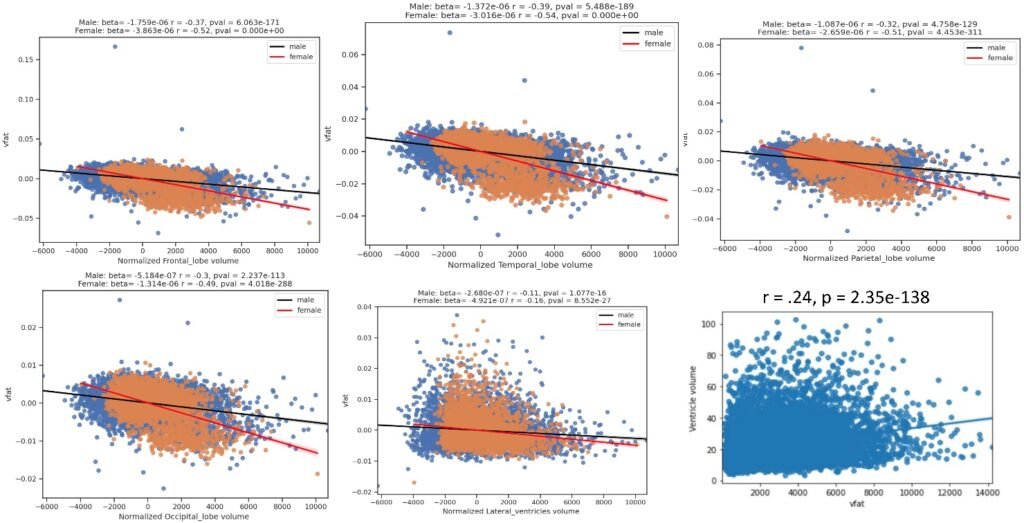
Their conclusion? Fat around internal organs — especially the pancreas — was more strongly associated with signs of aging in the brain than overall body weight.
Why BMI Might Be Misleading?
We’ve used BMI since the early 19th century — and while it’s still useful in population health, it’s not a one-size-fits-all tool.
A 6-foot, 190-pound athlete with low body fat might have the same BMI as a sedentary individual with high visceral fat. Yet their risks for brain aging are very different.
That’s why we need to move beyond BMI and focus on body composition and fat location.
Real-World Case Example
Consider this:
- John, a 52-year-old former college athlete, eats reasonably well and walks daily. His BMI is 24.9 — normal. But he recently had a full-body MRI as part of a wellness screening and discovered his visceral fat was high, especially around the pancreas.
- His MRI brain scan revealed reduced gray matter volume. He’d also been forgetting tasks at work, losing his train of thought in meetings.
Thanks to early detection, John worked with his doctor on a nutrition plan, resistance training, and cardio program that helped reduce his internal fat and improve his metabolic markers. Six months later, a follow-up scan showed improvement.
How to Take Action Today?
You don’t need an MRI to start addressing hidden fat and its impact on your brain. Here are steps to get ahead:
1. Track More Than Weight
- Use a body composition scale that measures body fat percentage.
- Track waist circumference — anything over 40 inches in men or 35 in women suggests increased risk.
2. Prioritize Muscle
Muscle mass is one of your best defenses against fat storage and cognitive decline.
- Include resistance training 2–3 times a week — squats, lunges, push-ups, dumbbells.
- Lean muscle helps burn calories even at rest and reduces visceral fat.
3. Eat with the Brain in Mind
Focus on anti-inflammatory, nutrient-rich foods:
- Omega-3 fats (salmon, walnuts, flaxseeds)
- Leafy greens (spinach, kale)
- Whole grains, beans, legumes
- Avoid excessive sugar, processed carbs, and trans fats
The Mediterranean Diet has been repeatedly shown to improve brain and heart health.
4. Sleep and Stress Matter
Chronic stress and poor sleep increase cortisol, which boosts visceral fat accumulation.
- Aim for 7–9 hours of quality sleep
- Try mindfulness, breathing exercises, or walks in nature to reduce stress
This Mysterious Human Skull Could Rewrite the Out of Africa Theory
Scientists Identify a Previously Unknown Organ Hidden Behind the Human Nose
The Human Skull Discovery That Challenges the Out of Africa Theory